The park looked too quiet for anything dangerous to be true.
That was the first thing Elliot noticed, and then the second thing: the quiet felt staged, like someone had turned the volume down too far. No kids shrieked near the swings. No dogs barked. Even the geese by the pond stood around as if they’d been told to keep it classy. Leaves lay across the path in soft brown and gold, thick enough to muffle footsteps. The air had that clean, cool bite that made you breathe deeper without meaning to.
Elliot sat on the oldest bench he could find—the one under the big maple that had probably watched three generations of breakups and first kisses. The wood slats were worn smooth in the middle, and the metal armrests were cold through his suit jacket. He’d picked the bench for the shade and for the view: clear sightlines down the path, a decent angle on the pond, and just enough distance from the parking lot to discourage casual interruptions.
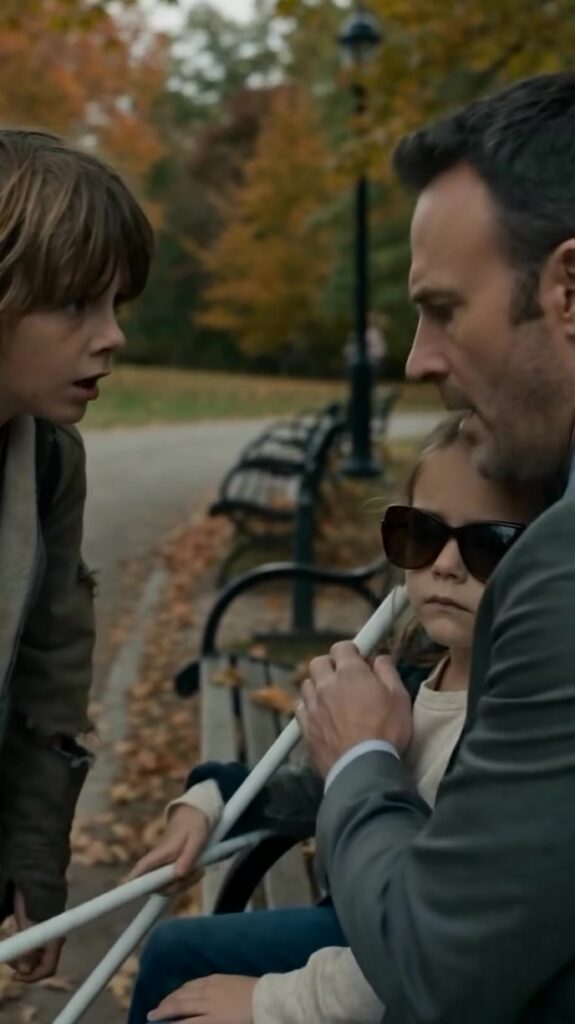
He pulled his daughter closer, because that’s what fathers do when they’re trying to pretend everything is normal. Maisie fit neatly against his side, all small bones and careful stillness. Dark sunglasses covered most of her face. Her white cane rested against the bench, angled like a prop in a school play. She looked calm, silent, fragile—like the kind of kid strangers lowered their voices around.
Elliot adjusted the collar of his gray suit and checked his watch, more out of habit than need. Another minute. Then another. He’d told Lydia he wanted to take Maisie out for air, for a change. Lydia had smiled too quickly, kissed his cheek, and reminded him to pack the special snacks.
Special. That word had started feeling like a trap.
Maisie’s hands were folded in her lap. She hummed a tune under her breath—soft, wandering notes that didn’t land anywhere familiar. Elliot listened and tried not to think about spreadsheets, about hospital invoices, about the way Lydia’s voice got sharp whenever he asked questions. He tried not to think about the last appointment, when the doctor had asked a basic thing—“Has she shown any response to light recently?”—and Lydia had answered for him before Elliot even opened his mouth.
He was mid-thought when a shadow snapped over the leaves and a boy appeared like he’d been cut out of the background and pasted into the scene.
Dirty. Oversized torn clothes. A backpack hanging open with a frayed strap, the inside stuffed with something that looked like blankets and plastic bottles. His face was streaked with grime and sweat, and his eyes—his eyes were not the eyes of a kid who’d just skipped school. They were the eyes of someone who slept in places that could bite you in the night.
Before Elliot could stand, the boy grabbed his sleeve. Not gently. Not politely. Like he was holding onto the only solid thing in a storm.
Elliot’s body reacted before his brain did. He turned sharply, shoulder squaring, ready to shake the kid off. “Hey—what are you doing?”
The boy leaned closer, breath coming fast, words packed tight. “Your daughter isn’t blind.”
The sentence landed wrong. Not because it was rude, but because it was impossible, and yet it made something inside Elliot go cold like a coin dropped down his spine.
“What did you just say?” Elliot heard his own voice go flat, the way it did in meetings when someone tried to bluff him with numbers.
The boy didn’t let go. “She can see. I saw her.”
Elliot stared at him, and the emotions arrived in order: confusion, then irritation—who was this kid, why was he touching him—then something worse, something that made his mouth go dry.
Maisie sat quiet, face angled toward the pond as if she hadn’t heard anything. The sunglasses hid her eyes, and the cane stood like a promise.
“That’s not funny,” Elliot said, but it came out less like a threat and more like a plea for the world to stay in its assigned lanes.
“I’m not joking,” the boy said. His voice shook, but his stare held, awful and certain. “I saw her look.”
As if the park itself wanted to prove the point, a leaf let go from the maple above them. It drifted down slow, spinning in the air, catching a stripe of sunlight. It passed in front of Maisie’s face.
And without thinking—without performing, without checking for approval—Maisie’s head turned, following the lazy float of the leaf.
Just a tiny movement. A tiny reaction. Subtle enough that if Elliot hadn’t just been punched in the brain by the boy’s statement, he might’ve missed it.
Then her cane, resting against the bench, slipped. The rubber tip scraped softly. Before it could fall, Maisie’s hand shot out and caught it with quick certainty.
Elliot felt all the blood drain out of his face in one go. His arm tightened around her, not from affection now but from instinct—like his body needed to anchor itself to something real.
Maisie didn’t flinch. She didn’t act caught. She just sat there, humming stopped, head still turned slightly toward where the leaf had landed on the path.
Elliot looked at the boy. Then at his daughter. Then, suddenly paranoid, over his shoulder.
A woman jogged in the distance—black leggings, ponytail bouncing, earbuds in. Just a blur of movement on the far path. A background detail. A harmless stranger.
Except Elliot’s brain, newly ripped open, refused to file her away as harmless anymore. Everything in the park felt like it had edges.
“Why are you saying this?” Elliot asked the boy. His voice came out tight. “Do you… do you know us?”
The boy swallowed and finally loosened his grip, but only because he’d shifted to hold the straps of his backpack like a shield. “I sleep near your house,” he said. “In the hedge by the side gate. Sometimes behind the shed.”
Elliot’s stomach turned. He pictured the neat backyard Lydia insisted on keeping perfect. The side gate with the new lock he’d installed because Lydia said it made her feel safer. The shed with the gardening tools he never used. Somewhere nearby, a kid had been curling up at night, listening to their lives.
“What did you see?” Elliot asked, and it was the most honest question he’d ever asked.
The boy’s eyes flicked toward the distant jogger path, not because the woman there mattered, but because he needed somewhere to point his fear. He lifted one grimy finger and indicated the motion beyond the trees, where the path curved out of sight.
“It’s your wife,” he said, and the words came out like they hurt his throat. “She puts something in her food. I saw her do it. Like powder. In a little cup. She stirs it like she’s making chocolate milk.”
Elliot’s hand loosened for one second, a reflex of shock, and in that small gap Maisie shifted. Not much. Just enough that her face angled toward where the boy pointed.
As if she knew exactly who he meant.
Elliot tried to speak, but his mouth didn’t cooperate. His mind filled with scraps: Lydia insisting on packing Maisie’s meals herself. Lydia hovering in the kitchen, smiling too hard, shooing Elliot away like he was a dog underfoot. Lydia’s sudden anger when Elliot suggested a second opinion. Lydia’s frequent line—“You don’t understand what it takes to keep her calm.”
He looked down at Maisie. “Mais,” he said softly. “Sweetheart.”
She didn’t answer. The sunglasses kept her expression safe. Her little fingers held the cane with a grip that now looked less like reliance and more like practice.
“Why tell me?” Elliot whispered to the boy. “Why now?”
The boy’s shoulders rose and fell with a rough breath. “Because I heard her talking,” he said. “On the phone. She said she couldn’t let you ‘mess it up.’ She said the word ‘settlement.’ And she said… she said you’d believe her over anyone.”
Elliot’s throat tightened until it hurt. The bench, the leaves, the quiet—everything suddenly felt like a set built for a scene he never agreed to act in.
“There’s… there’s a number,” the boy added quickly, as if afraid Elliot would stand up and leave and the chance would be gone. He dug into his pocket and produced a crumpled receipt with digits written on the back. “I stole it off the counter when I went in the garage for water. I know it’s wrong, but—”
“Give it to me,” Elliot said, and his voice startled even him with how steady it sounded.
The boy handed it over with fingers that trembled. Elliot took it like it was a live wire. He didn’t know whose number it was—doctor, lawyer, someone Lydia trusted—but it was something. A thread. Proof that the world wasn’t just his word against hers.
From somewhere down the path, a notification chirped—someone’s phone, bright and casual. The sound made Elliot’s skin prickle.
He tightened his arm around Maisie again, but gentler this time, like he was holding a truth that might break if he squeezed too hard. “Maisie,” he said, leaning close enough that his words could be private. “Can you see me?”
Her head tipped a fraction toward his voice. Then, barely, a nod.
Elliot’s lungs forgot how to work for a second. Tears threatened, hot and furious, but he swallowed them because he needed his brain sharp. He needed to move correctly. He needed to not make the kind of noise that would bring Lydia running and smiling.
He looked at the boy. “What’s your name?”
“Cal,” the boy said.
“Cal,” Elliot repeated, anchoring it. “You did the right thing.”
Cal gave a small, bitter laugh like he’d never heard that sentence and believed it. “Just… don’t let her see me,” he said. “She’ll know it was me.”
Elliot nodded once. He slipped the receipt into his wallet, the motion practiced, automatic, as if he were filing away a business card. Then he stood, lifting Maisie carefully. She wrapped her arms around his neck, her cane bumping against his leg. She didn’t pretend to fumble. She didn’t perform helplessness. She just held on.
The park stayed quiet. The leaves stayed golden. The old bench stayed still beneath the trees.
But now Elliot knew the quiet wasn’t peace. It was the pause right before something finally confessed itself.
“We’re going,” he murmured to Maisie, and then, to Cal, “Stay back. I’ll call someone. I promise.”
As he walked toward the parking lot, Elliot kept his eyes on every moving shape—joggers, dog walkers, the distant blur of a woman who could be anyone. The park looked too quiet for anything dangerous to be true.
And that’s how he knew it was.