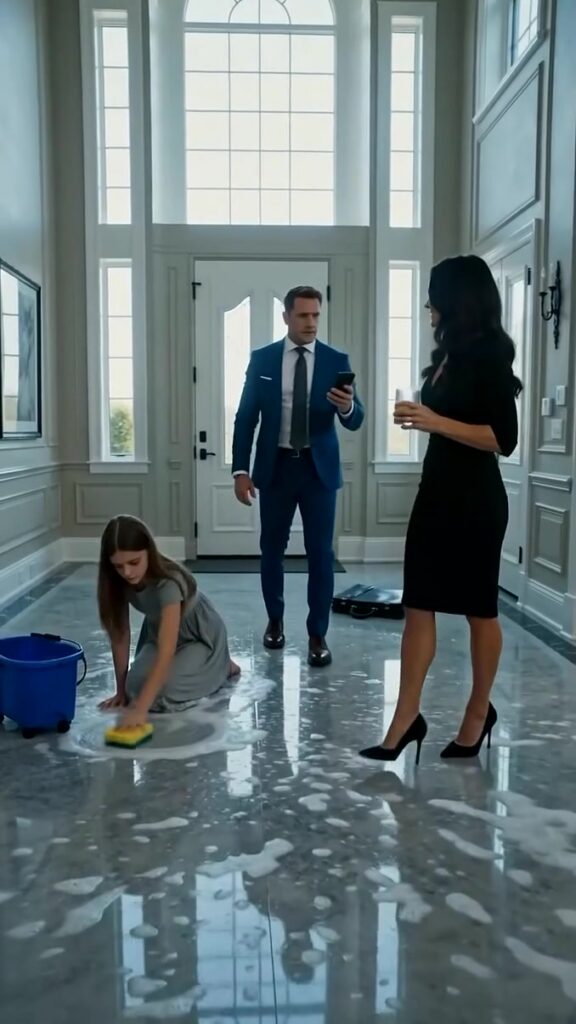
The house was too grand for a child to be kneeling on its floor.
It hit Ezra Lang like a slap before he even fully stepped inside. The front door swung wide on silent hinges, and the foyer opened up the way a museum lobby does—too much ceiling, too much echo, too much money trying to convince you it was taste.
White daylight poured through the tall windows and fell in clean rectangles across the marble. The floor was so polished it reflected the chandelier like it was proud of itself. Paintings with little brass plaques watched from the walls—abstract swirls that cost more than Ezra’s first apartment, portraits of people who didn’t look like they laughed.
And in the center of all that grandeur was a bright blue bucket. Soap suds had drifted out of it like spilled clouds, leaving pale, imperfect streaks on the marble—proof that someone had been scrubbing for a while.
Someone small.
His daughter, Lila, was on her knees. Gray dress. Wet hands. A sponge clenched in fingers that looked tired in a way fingers shouldn’t. Her hair, usually in two neat braids when Ezra did it, had fallen loose and stringy near her cheeks. She scrubbed at the marble like the marble had personally offended her.
Ezra froze so hard his body forgot how to breathe. His hand loosened on his briefcase without him realizing it. The leather handle slid, and the case fell, hitting the marble with a crack that shot through the foyer and into every quiet corner of the house.
Lila looked up slowly.
Not startled. Not surprised. Just… cautious. Like she was waiting for the next instruction, or the next insult, and trying to guess which one it would be.
Ezra’s eyes flicked from the suds, to her knees—reddened, slightly raw where the fabric had bunched and rubbed—to her face. Her expression wasn’t crying, not exactly. It was more like she’d practiced holding everything in so long she didn’t know where to put it anymore.
Something in him shifted, fast and ugly and irreversible.
“Lila,” he said, and his voice sounded unfamiliar in the echoing space.
She swallowed and lowered her gaze almost immediately, like the act of looking at him too long might get her in trouble. That small movement—down, quick, automatic—was what cracked him open. Kids didn’t do that unless they’d learned it. Unless someone had taught them that eyes up meant attitude, and attitude meant consequences.
A soft laugh floated in from the side hall.
Maris came in like she belonged there. Black dress, effortless. A glass of something golden in her hand, ice catching the light. Her hair was pinned back with the kind of clip that made you think of old money and sharp decisions. She took in Ezra, the fallen briefcase, then let her gaze drift to Lila as if she were noticing a rug that had been left out in the rain.
“Oh,” Maris said, lips curving into the wrong kind of smile. “You’re home early.”
Ezra didn’t answer. He couldn’t stop looking at his daughter’s wet hands.
Maris sipped her drink and added, almost lazily, “She’s just doing what she’s good at.”
Lila’s shoulders went smaller. Ezra saw it. He saw the way her body tried to disappear without moving. Like invisibility was a skill she’d been told to develop.
He turned his head toward Maris. He didn’t shout. He didn’t throw anything. That would’ve been easier—anger was loud and familiar. What he felt now was colder. It was the kind of calm you got right before you made a decision you could never undo.
Ezra slid his phone from his pocket without looking away from her. His thumb tapped. He brought it to his ear.
“Cancel everything,” he said.
Maris blinked, her smile wobbling. “What?”
“All of it,” Ezra said into the phone. “My evening. My meetings. The dinner. The fundraiser. Clear my calendar. Right now.”
A pause on the other end. His assistant, Dana, started to respond, but Ezra didn’t wait for questions.
“Text the driver to turn around,” he added. “And call security. Tell them I’m requesting an immediate property access review. Today.”
Maris’s glass lowered an inch. “Ezra, that’s dramatic. You’re making a scene.”
Ezra stepped forward, placing himself between Maris and Lila like his body knew what to do before his mind did. “You,” he said to Maris, voice steady, “are done.”
Her eyebrows rose. “Excuse me?”
He ended the call and slid the phone back into his pocket with a careful, deliberate motion. Then he bent at the waist, slow enough not to scare Lila, and reached toward her hands.
Lila flinched first, like she expected him to grab her wrist. That flinch landed in Ezra’s chest like a thrown stone.
“Hey,” he said softly. “It’s okay. I’ve got you.”
He gently eased the sponge from her fingers. It was heavy with water, and her grip had been tight, like letting go was against the rules. He dropped it back into the bucket. It made a wet, dull sound.
When he straightened, he looked Maris directly in the eye. “This house is no longer yours.”
Maris’s mouth opened, then closed. The confident ease in her posture cracked. For the first time, she looked… not scared exactly, but calculating, like she was searching for the lever that would put everything back in place.
“You can’t be serious,” she said, stepping forward, voice sharpening. “We have an agreement. You can’t just—”
“I can,” Ezra said, and it wasn’t a threat. It was a statement of fact.
Behind him, the bucket rocked once against the marble, nudged by Lila’s shifting knee. The motion made the suds creep outward, a slow, pathetic tide.
Ezra turned back to Lila and lowered himself to her level. “Stand up,” he said, keeping his tone gentle. “No one’s scrubbing anything. Not you.”
Lila hesitated. Her eyes flicked toward Maris and then away again, as if she needed permission from the person who’d been giving it. “I’m almost finished,” she whispered. “She said if it’s not perfect—”
“I don’t care about perfect,” Ezra said, trying to keep his voice from breaking. “I care about you.”
He reached for her elbow to help her up, and that’s when he saw it.
A silver anklet around her ankle, half-hidden by the hem of the gray dress. Tiny. Child-sized. It was delicate, with a small charm that looked like a lock. At first glance, it could’ve passed as a piece of jewelry. Something pretty. Something harmless.
Except it was snug in a way jewelry wasn’t supposed to be, and the clasp wasn’t a normal clasp. It was thicker. More secure.
Ezra’s breath went shallow. His fingers hovered near it, afraid to touch, afraid of what touching would confirm. He leaned closer, eyes narrowing until he could read the engraving.
Two letters, cleanly etched: M.S.
Maris Sloane.
Ezra’s vision went bright at the edges, like the white light from the windows had turned into something hotter. He looked up at Maris with a stillness that made the air feel heavier.
“What,” he said quietly, “is that?”
Maris’s chin lifted. “It’s a reminder,” she said, as if she were talking about a sticker on a lunchbox. “She loses things. She wanders. It’s just—”
“No,” Ezra cut in, and even his calm had an edge now. “It’s not ‘just’ anything.”
Lila’s hand crept toward her ankle, protective. “I didn’t mean to,” she murmured. “I didn’t—”
“Sweetheart,” Ezra said, turning to her immediately, voice softening again, “you didn’t do anything wrong. None of this is on you. Okay?”
Lila stared at him like she’d heard those words in movies but never believed they were available in real life.
Maris scoffed. “Ezra, don’t turn this into some big rescue fantasy. Children need structure. She needs to learn her place in this home.”
Ezra rose slowly, keeping one hand on Lila’s shoulder so she knew he was still there. “Her place,” he said, “is not on her knees. Not in any home. Not ever.”
Maris’s face tightened. “You think you can scare me? This is my house too.”
Ezra’s eyes went to the paintings, the chandelier, the marble—every shiny surface that had seemed impressive an hour ago. Now it all looked like a stage set built over something rotten.
“No,” he said, and the word came out like the click of a lock opening. “It isn’t.”
He pulled his phone out again and dialed a number he hadn’t used in years, the one you saved when you thought you’d never need it. When the call connected, his voice didn’t waver.
“I need you at the house,” he said. “Now. And I need an officer too. There’s a child involved.”
Maris’s eyes widened a fraction. “You wouldn’t.”
Ezra didn’t look at her. He crouched again and began working the clasp on the anklet with careful fingers, the way you’d handle something sharp near skin. Lila held still, trembling, watching his hands like they were performing a magic trick.
“You’re not in trouble,” he whispered to her. “You’re not going to be punished. You’re coming with me.”
The clasp resisted. It wasn’t meant to come off easily. Ezra’s jaw tightened. He tried again, slower, gentler, until it gave with a small metallic snap.
He slid the anklet into his palm and closed his fist around it. It felt heavier than it should have.
“There,” he said, and helped Lila stand. When she wobbled, he lifted her without asking, tucking her against his chest like he should’ve done the first time he walked into this house with Maris at his side and excuses in his mouth.
Lila’s arms wrapped around his neck with a sudden urgency, like she was afraid the floor might claim her again.
Maris took a step forward, glass trembling slightly now. “Ezra, think about what you’re doing. The press. Your company. Your image—”
Ezra adjusted his hold on Lila, keeping her face turned into his shoulder so she didn’t have to see Maris’s expression. “My image,” he said, voice flat, “is not worth my daughter.”
He walked toward the front door. The marble echoed beneath his shoes, each step a decision. Behind him, Maris’s voice rose, trying to regain control, tossing out threats like hooks—lawyers, contracts, money. Ezra didn’t turn back.
At the doorway he paused, just long enough to look down at the bright blue bucket, the suds spreading, the sponge sitting there like a surrendered flag. He looked at the grand staircase, the tall windows, the expensive art, and felt only disgust at how easily he’d believed beauty meant safety.
Lila lifted her head slightly. “Are we… leaving?” she asked, as if the idea was fragile.
Ezra pressed his lips to her hair. “Yeah,” he said. “We’re leaving. And you’re never cleaning a floor to earn kindness again.”
Outside, the light was warmer. Realer. Ezra carried her down the front steps, the anklet still clenched in his fist, cold silver biting into his skin like a promise he intended to keep.
Behind them, the grand house stood quiet, full of echo and marble and the last little ripples of a blue bucket rocking itself back to stillness.
Too grand, Ezra thought, for anyone to kneel in. But especially a child.