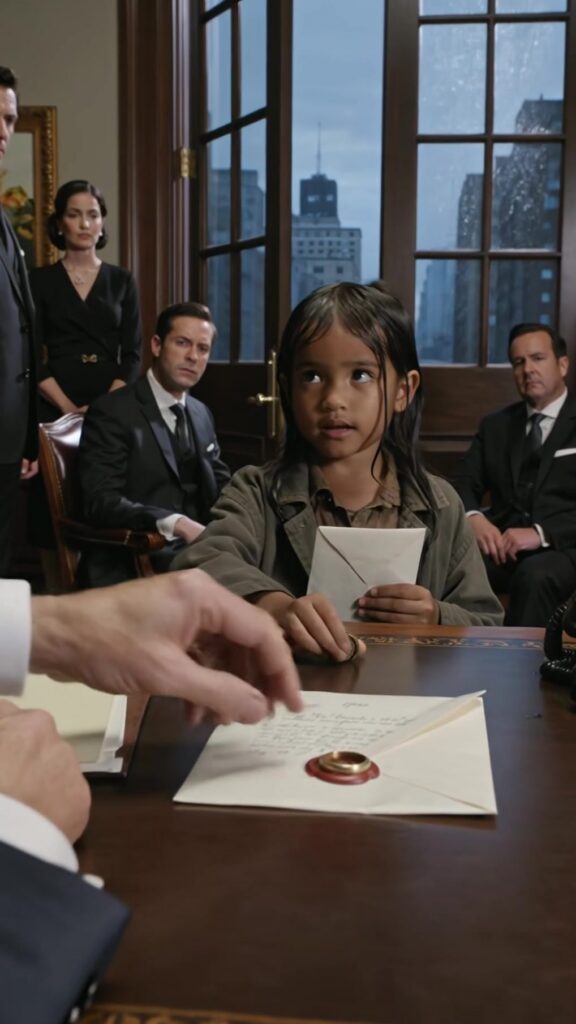
Rain always made the twenty-third floor feel higher. It pressed itself against the glass like it wanted in, turning the city into a watercolor smear. Inside, the conference room at Halloway & Pierce had the opposite vibe: too sharp, too dry, too expensive. The kind of room where even the air seemed billed by the hour.
Arthur Halloway sat at the head of the table with a thick folder in front of him and a headache behind his eyes. He’d read wills in all kinds of situations—tearful, hostile, drunken, occasionally theatrical—but this one had its own gravity. When a billionaire dies, everyone walks in heavier. Their grief wears jewelry.
On one side sat the relatives: the nephew with a pinched smile, the sister-in-law who sniffed like she was judging the entire concept of death, a couple of cousins who had flown in so fast their black clothes still had store tags tucked in seams. On the other side: the executor’s assistant, a notary, and a private banker who looked like he’d been carved out of a spreadsheet.
Arthur cleared his throat. “Thank you for arriving promptly. For the record, this is the last will and testament of Malcolm Vane.”
The name Malcolm Vane made the room tighten. It was a name built into buildings. Hospitals. Scholarships. A fancy wing at the art museum that most of these people had visited once and then forgotten.
Arthur slid a page out of the folder, the paper so thick it practically had shoulders. He adjusted his glasses and started the usual legal preamble, the stuff everyone endured like chewing cardboard.
He had just reached for the sealed inner envelope—Malcolm’s “personal instruction,” the one that couldn’t be opened until the reading—when the conference room door creaked.
Everyone’s head turned, synchronized like a bored audience catching a latecomer.
A little girl stood in the doorway. Maybe eight. Maybe nine. Her hair was plastered to her forehead in wet strings, and her jacket looked like it had been a jacket in a former life. Rainwater dripped from her sleeves onto the polished floor, making a small, spreading pond that didn’t seem to apologize for itself.
In her left hand she held an envelope, swollen at one corner like it had nearly lost the fight with the storm. In her right hand she held a ring—old, heavy-looking, the kind that didn’t belong on a child’s palm.
Arthur stared for half a beat too long, the way people do when their brain is trying to decide if something is real.
The nephew stood up so quickly his chair squealed. “This is a private family matter,” he snapped, as if the child were a solicitor and not a soaked kid with trembling fingers.
The girl didn’t look at him. She looked past him, scanning the room until her eyes landed on Arthur and the folder in front of him. Her expression was weirdly steady for someone standing in a room full of expensive strangers.
Arthur found his voice. “Can I help you?”
She stepped inside. Her shoes made small squelching sounds, a rude soundtrack in a room that usually only allowed the whisper of money.
“My mom said,” she began, then swallowed. “My mom said this belongs with the letter. She said I had to bring it here if… if anything happened.”
She walked up to the table like she’d rehearsed it, then placed the ring gently beside the sealed envelope Arthur had been about to open.
The ring landed with a soft clink.
Arthur’s stomach dropped.
The ring wasn’t just old. It was specific. A signet ring, dark gold with an engraved crest—two crossed keys beneath a star. Arthur had seen that crest exactly once before: on the wax seal of Malcolm Vane’s most private correspondence.
His fingers went cold. He heard himself say, too quietly, “Where did you get this?”
The girl glanced down at the ring like it might answer for her. “My mom had it. She kept it in a tin with buttons and little coins. She said it was important. She said Malcolm would know.”
The sister-in-law let out a laugh that didn’t have any humor in it. “This is ridiculous. Who even is she?”
Arthur didn’t answer. He picked up the ring with the care you use for artifacts. The inside band was worn, but there—faintly visible—were initials etched by hand: M.V.
Malcolm had once joked to Arthur, during a late-night signing session, that the ring was “the only thing I own that tells the truth without me having to talk.” Arthur had assumed it was billionaire poetry. Now it felt like a key turning in a lock.
He looked at the swollen envelope in the girl’s hand. “May I?”
She nodded and slid it toward him. It was sealed with wax—smudged, but still bearing the imprint of the same crossed keys and star. The ring matched the seal like a fingerprint.
Arthur’s assistant leaned in, eyes wide. The notary straightened as if the air had suddenly become official.
Arthur broke the wax carefully, using the edge of the signet ring the way Malcolm himself used to. The seal gave with a soft crack. He unfolded the first page, and the room seemed to shrink around the words.
He read the opening line, and for a second the conference room blurred like rain on glass.
Arthur—if you’re reading this, I’m gone, and I’ve finally stopped being a coward.
Arthur’s throat tightened. Malcolm’s handwriting was unmistakable: sharp, impatient, somehow elegant even when it insulted you.
He read the next lines, and his breath caught so hard it almost hurt.
There is a first heir. I did not lose her. I abandoned her. Her name is Lena Harper. She will arrive with my ring and this letter if my timing is right. If she is there, it means her mother kept her promise when I didn’t keep mine.
Arthur looked up at the child, and the room tilted. “Lena?” he asked, voice cracking in a way he didn’t recognize.
The girl nodded once. “Yeah.” Then, quieter: “My mom’s name was Jules. She… she got sick last month.”
The nephew barked, “This is a scam. You can’t just walk in here with some ring and—”
Arthur raised a hand, and the nephew stopped like he’d hit an invisible wall. Arthur didn’t even look at him. He kept reading, eyes racing over the page.
I am directing you, as executor, to suspend the public reading until you verify Lena Harper’s identity. I have arranged for a DNA test through Dr. Saito at Grant Memorial. The sample is already in your file cabinet, top drawer, labeled ‘VANE—PRIVATE.’
Arthur’s assistant made a tiny sound, like she’d just remembered that drawer existed.
Arthur continued, and each sentence landed heavier.
If she is my daughter—and she is—then all controlling interest in Vane Holdings transfers into a trust in her name. The family will receive what I’ve already outlined, but they will not touch the core. Not anymore.
Arthur’s pulse thudded in his ears. The relatives were no longer politely tense; they were vibrating with anger. The sister-in-law’s face went pale. A cousin started whispering into his phone like he was calling a lawyer to fight another lawyer in real time.
Lena stood there dripping on the expensive carpet, hands empty now, shoulders tucked in like she expected to be shoved out. She didn’t look triumphant. She looked tired. Like the rain had been a long walk, and this room was the next long walk after that.
Arthur set the letter down slowly. For a moment he couldn’t find the right professional voice, so he used the human one.
“Lena,” he said, “where is your mother now?”
“At St. Brigid’s shelter,” she answered. “They… they said I could come here if I was fast. She told me not to be scared. She told me you’d understand because you were Malcolm’s friend.”
Arthur swallowed hard. Malcolm, you absolute disaster, he thought. You left a child in the world like a secret and expected a piece of jewelry to fix it.
He reached into his suit pocket and pulled out a clean handkerchief. It felt like a weirdly small gesture compared to what the letter was doing to the room, but it was something. He offered it to her.
She hesitated, then took it and wiped her cheeks—though she might’ve been wiping rain, not tears. Hard to tell with a storm following her indoors.
Arthur looked around the table, meeting eyes that were suddenly hostile, calculating, panicked. “The will reading is suspended,” he said firmly. “We will proceed according to the decedent’s instructions. Verification will be completed today.”
The nephew slapped his hand on the table. “You can’t—”
“I can,” Arthur replied, ice settling into his tone like a final layer. “And I will. Sit down.”
The nephew didn’t sit. But he did stop talking, because the notary had already started making notes, and the banker had started looking at Lena like she was a new kind of number.
Arthur turned to his assistant. “Call Dr. Saito. Now.”
Then he looked back at Lena, at the way her wet jacket clung to her thin shoulders, at the ring sitting on the table like it owned the place.
“You did the right thing coming here,” he told her. “You’re not going back out in that rain alone.”
For the first time since she’d entered, Lena’s face shifted—just a little. Not a smile, exactly. More like her guard loosened by a millimeter.
Outside, lightning flickered behind the windows. Inside, in a room full of people who thought inheritance was about money, a soaked little girl had just changed the story entirely.
And Arthur Halloway, who had come to read a will, realized he was about to help raise the ghost of a man into something like responsibility—through the child he’d left behind.
He picked up the signet ring and slid it gently toward Lena. “Hold onto that,” he said. “It’s yours now.”
Lena curled her fingers around it like it was warm.
“My God,” Arthur murmured, more to himself than anyone else. “The first heir is still alive.”
The relatives stared at Lena as if she’d stepped out of the rain carrying a different kind of storm.
And in that quiet, Arthur finally understood what Malcolm had meant all along: the ring didn’t just seal letters. It opened doors.