Everyone thought he was just another street kid, which was kind of the whole point. If people looked through you, they didn’t ask questions. They didn’t remember your face. They didn’t wonder why you were sitting outside a closed bakery at eight in the morning like you were waiting for it to open just for you.
Rook sat on the curb with his knees up and his sleeves pulled down over his hands, even though it wasn’t cold. He watched the street like it was a TV show that never got canceled. Delivery vans, commuters with coffee, tourists turning in slow circles like compass needles. The city didn’t notice him, and he didn’t mind. Not until the black car appeared.
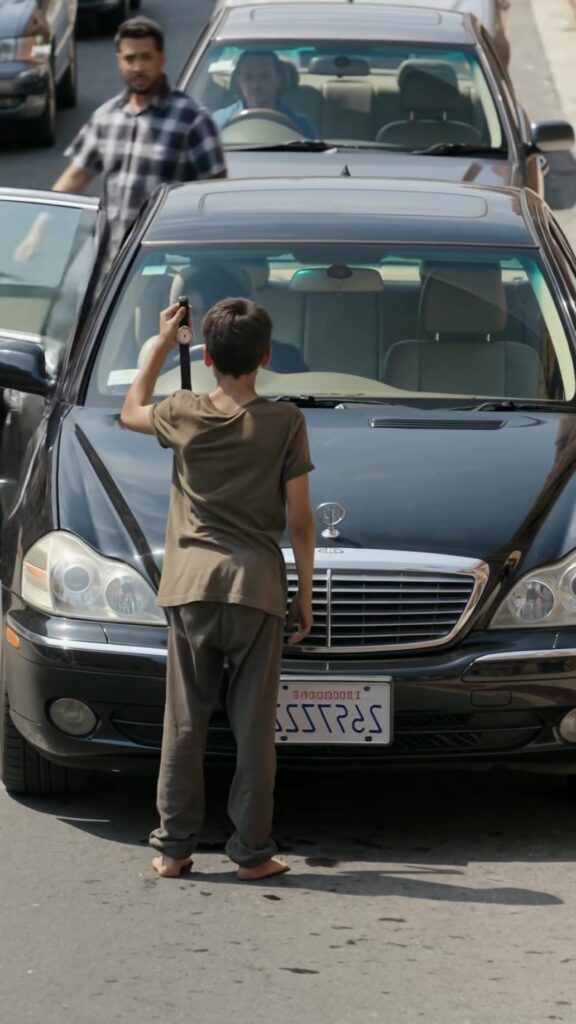
It slid through the intersection without urgency, glossy as a piano and twice as expensive-looking. The kind of car that made pedestrians hesitate even when they had the right of way. The driver had the vibe of someone who’d never had to hesitate in her life.
Rook stood up.
The plan had been to wait for the right moment, and as soon as he saw the license plate—three letters he’d memorized from a grainy screenshot—his stomach went tight. It was like a fist had closed around the inside of him. He checked the thin pocket sewn into the lining of his hoodie. Still there. Still real.
He stepped off the curb and into traffic like the street belonged to him.
A cyclist swore and swerved. A taxi honked so hard it sounded offended on a personal level. The black car braked, but not fast enough to avoid the drama of it all. Rook slapped both palms down on the hood with a loud, flat smack. He leaned into it like he was ready to fight the whole vehicle.
For a second, the intersection froze. The city loves a spectacle. Heads turned. People slowed down. Two phones appeared immediately, held up by strangers who could smell a viral moment like rain.
The car’s engine hummed with contained irritation. The driver’s door opened with this smooth, practiced motion, like it had been choreographed for her entrance.
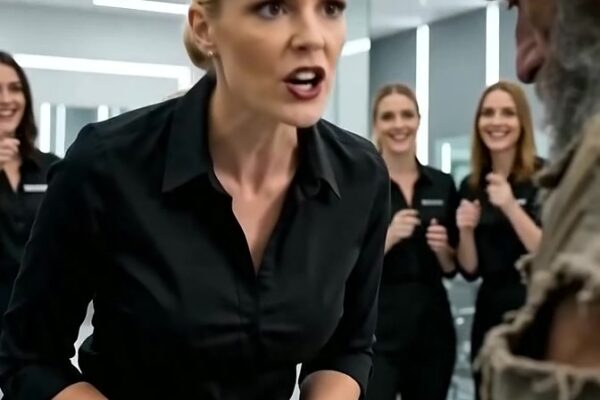
She stepped out in heels that made no sense on asphalt. Her coat looked tailored to her body and her mood. She wore sunglasses even though the day was cloudy, and her hair was the kind of perfect that implied someone else had done it.
“Are you out of your mind?” she said, calm and sharp at the same time. Confident. In control. She didn’t look at the phones; she looked at Rook like he was an inconvenience she could have towed.
Rook didn’t move away from the hood. Up close, he could see his own blurry reflection in the car’s paint. Messy hair. Scraped knuckles. A face that had learned to keep its feelings behind a locked door.
“You almost hit me,” he said.
She made a sound that wasn’t quite a laugh. “You jumped in front of my car.”
“Same thing,” he said, because he wasn’t here to win a debate. He was here to crack a wall.
She took a step closer, her perfume drifting across the space like she expected it to do half the work. “Get off the hood. Now.”
“Not yet.”
That got a tiny change out of her—her jaw tightening, the angle of her shoulders shifting. She leaned in like she was about to deliver a speech that would make him regret existing near her vehicle.
And then Rook pulled the thing from inside his sleeve.
It wasn’t a gun. It wasn’t a knife. It wasn’t even big.
It was a key fob.
Old. Scuffed. The kind of black plastic that had been held too tightly for too long. A small silver emblem on the back was worn almost smooth from anxious fingers. A piece of tape wrapped the corner, like someone had tried to keep it together.
He held it between his thumb and forefinger like it was a tiny, ugly piece of jewelry. He didn’t point it at her. He just showed it to her.
The woman’s expression changed so fast it was almost funny. The confidence didn’t fade gradually—it dropped, like a curtain cut loose. Her mouth opened slightly. Her hand, which had been poised to gesture dismissively, froze midair.
Even behind the sunglasses, something in her eyes shifted. Panic didn’t always look like wide-eyed terror. Sometimes it looked like a person trying to remember how to breathe while staying polite.
“Where did you get that?” she said, and her voice had moved into a different register. Lower. Thinner. Careful, like her words were glass.
Rook watched her face. He’d spent weeks imagining this moment, wondering if he’d gotten the wrong person, if the car would be different, if she’d step out laughing and call him crazy. But no. She recognized it.
“So you do know,” he said.
“Put it away,” she snapped, but it didn’t sound like a command anymore. It sounded like fear dressed up as authority. “You don’t know what you’re doing.”
“I know exactly what I’m doing.”
He clicked the button once, softly. Nothing dramatic happened—no siren, no honk. But the car lights blinked in acknowledgment, like a nod.
People around them murmured. Phones zoomed in. A woman with a stroller slowed down, eyes wide, like she couldn’t decide whether to keep watching or protect her kid from the world.
The driver took her sunglasses off. That was when everyone could see it: the tiny tremor at the edge of her lower eyelid, the way her pupils seemed to lock on the fob like it was a ghost.
“What do you want?” she asked.
Rook swallowed. He wasn’t doing this for money. Not really. He’d lived without money long enough to know it came and went like weather.
“I want you to look at me,” he said.
She did, reluctantly, like she was afraid his face might contain a memory she’d buried.
“You used to park behind the hospital,” he said. “The one with the ivy on the side. You’d sit in the car for a while before you went in. Like you were rehearsing.”
The color drained from her face in a way makeup couldn’t hide. “Stop.”
“You’d leave the car running,” he continued, voice steady even though his ribs felt too tight. “And you’d hold this. You’d press the lock button over and over like it could keep something inside.”
Her lips parted. “Who are you?”
Rook turned the fob over in his fingers. “You don’t get to ask it like that. Like you’re meeting me for the first time. You walked away from me.”
She flinched, like the word had weight. “That’s not—”
“My name was Robin,” he said, and the name tasted weird in his mouth, like chewing on something he’d stopped eating years ago. “But nobody called me that for a long time. You don’t recognize it because you trained yourself not to.”
The driver’s throat bobbed as she swallowed. “No.”
“Yeah,” he said. “I’m the thing you weren’t supposed to lose. I’m the part of your story you paid people to erase.”
A horn blared somewhere behind them, impatient at the blocked lane. The city was trying to restart itself, but the moment wouldn’t move. It held.
She stared at him like his face was rearranging her past in real time. “You’re lying,” she whispered, but there was no conviction in it.
Rook held the fob out toward her, not close enough to grab easily. “This was in a box with my birth certificate. You remember the box. Gray. Cheap cardboard. Like it came from an office supply store.”
Her eyes flicked down to the fob and back up. Her hand hovered near it, then jerked away, as if touching it would burn. “Where… where did you get that box?”
Rook’s laugh came out dry. “From the guy who was paid to keep it hidden. Turns out people talk when they need money. Turns out secrets don’t stay loyal.”
She looked around suddenly, noticing the phones, the eyes, the growing attention like she’d just realized she was standing on a stage. Her voice dropped. “Get in the car.”
“I’m not getting in your car,” he said.
“Please,” she said, and it was the first truly human thing she’d said since she stepped out. The word didn’t match her coat or her heels. It matched her bare eyes.
Rook felt something twist in his chest—anger and satisfaction and a sharp little grief that didn’t know where to land. He’d imagined her as a villain because it was easier than imagining her as complicated.
He leaned closer so only she could hear him over the street noise. “You’re going to tell me the truth,” he said. “Not the version for your lawyers. Not the version for interviews. The truth.”
Her hands balled into fists at her sides. “Not here.”
“Here is exactly where,” he said, nodding at the phones. “Because you care about witnesses. You care about being seen as… controlled.” He let the word hang. “So here’s the deal. You don’t get to act like I’m a problem you can manage. You’re going to listen.”
She held his gaze. Her eyes were wet now, but not with soft tears. With fury. With fear. With the sheer shock of a door being kicked open inside her life.
“What do you want from me?” she asked again, quieter.
Rook looked down at the key fob, then back up. “I want my name back,” he said. “I want the part of me you tried to delete. And I want you to understand something.”
He clicked the button a second time. The car blinked again, obedient.
“This,” he said, “is proof you can’t lock me out anymore.”
For a moment she stood there, stripped of her script, blinking in the middle of the intersection while the whole city watched her forget how to act.
Then, carefully, like she was handling an explosive, she reached for the fob.
Rook didn’t let go.
“Not yet,” he said, and this time his voice was almost gentle. “You’re going to hear me first.”
And for the first time in his memory, she didn’t interrupt him. She didn’t dismiss him. She didn’t look past him like he was nothing.
She listened.
The traffic waited. The phones recorded. And Rook finally got to tell the part of the story that was never supposed to come back.