The bank looked like it had been designed by someone who hated noise. Marble floors polished to the point of vanity. Glass walls that held daylight the way museums hold famous paintings. A scent in the air that wasn’t quite perfume and wasn’t quite money, but somehow convinced you to stand up straighter.
People waited in the lounge chairs like it was an airport for the wealthy: calm, plugged in, distracted. A woman in a cream trench coat scrolled through her phone with the expression of someone who’d never had a pop-up ad in her life. Two guys in matching navy suits sipped lattes from tiny cups, talking quietly about ski season like they were booking a private mountain. Someone laughed softly at something on a tablet. The laugh was polite, like even joy had a dress code.
The only sound that mattered came from the counters. The soft click of keyboards. The gentle “Certainly” and “Right away” and “Of course” from tellers with perfect posture and perfect hair. It was a place where time didn’t rush; it glided.
Marina, teller window three, had been having what she’d call a decent day. No one was yelling. No one was crying. No one was holding up a line to argue about overdraft fees like overdraft fees were personal insults. She’d processed a wire transfer for someone who looked like he never touched his own wallet. She’d watched a woman sign a document with a pen that probably cost more than Marina’s monthly grocery budget.
Her coffee sat to the side, still warm, because she rarely had time to finish it. She’d been about to take a sip when it happened.
BAM.
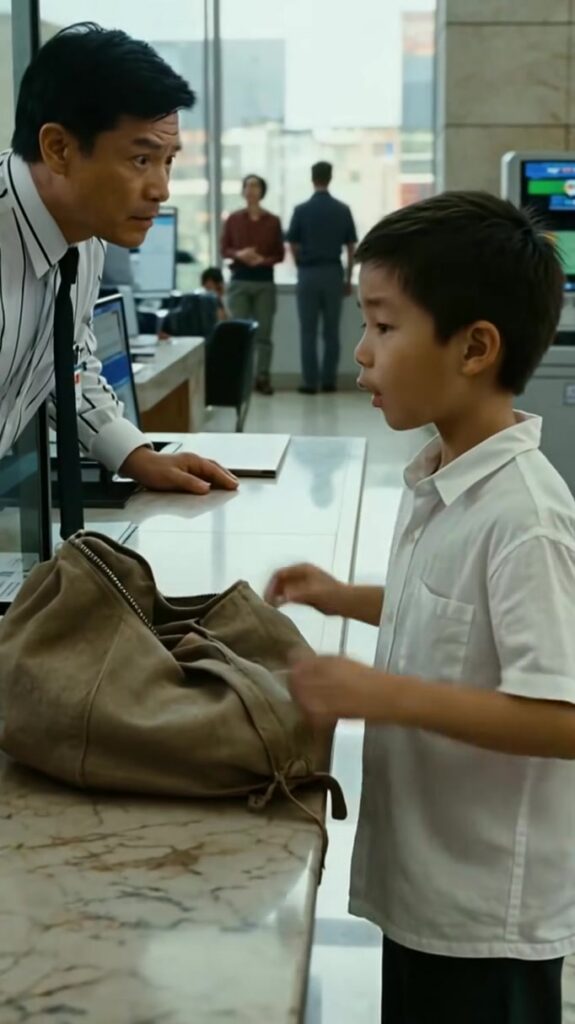
Something heavy and dirty slapped down onto the marble counter like a challenge.
The sound didn’t just echo. It erased the room. The quiet wealth, the polite murmur, the smooth rhythm—gone. It was like the building itself inhaled and forgot how to exhale.
Every head turned.
Marina’s eyes dropped to the object. A bag. Old, the color of spilled coffee and dust. It looked like it had lived under a sink, been dragged across sidewalks, maybe survived a storm or two. The straps were frayed. The zipper was held together with a bent paperclip. There was something dark on one corner that Marina decided was probably grease and not, you know, anything worse.
Then she looked up.
A boy stood on the other side of the counter, small enough that his chin barely cleared the edge. He wasn’t smiling, but he wasn’t scared either. His face was calm in that unsettling way people get when they’ve decided the world is going to do what they need it to do.
He wore a hoodie that had once been blue. His shoes were too big, scuffed and tied with mismatched laces. His hair was messy, like he’d cut it himself or let the wind do it. His eyes were dark and steady, the kind that didn’t dart around looking for exits.
Marina felt her own heart do a dumb little jump, then immediately got annoyed at it. It was a child. A child with a gross bag. That was it. Probably.
Before she could ask anything gently—because she was usually good at gentle—her voice came out louder than she intended, sharp from the sudden silence pressing in.
“Hey! What is wrong with you?”
The words landed like a slap. Somewhere behind the boy, a man in a suit made a quiet, offended noise, like Marina had just said a swear word in church.
The boy didn’t blink. Not even a flinch. He just stood there, hands resting lightly on the rim of the bag, like he’d practiced this.
“I want to open an account,” he said.
There was a pause. Not the normal pause where someone searches for a form. This was a pause where everyone in the bank tried to figure out what the rules were supposed to be for this situation.
Marina’s brain ran through its own checklists. Minors needed a guardian. IDs. Documentation. The usual. But the bag sat there, filthy and stubborn, like it didn’t care about policy.
“Sweetheart,” Marina said, forcing her tone down into something that wouldn’t get her written up, “how old are you?”
“Nine,” he answered. “Almost ten.”
He didn’t say it proudly. He said it like he was reading a label. Like age was a fact and facts were tools.
Marina glanced around, searching for an adult. A parent hovering with an apologetic face. A guardian trying to catch up. Someone who’d wave from behind and mouth, Sorry! He’s excited! Something.
No one moved. The waiting area was full of people pretending they were above curiosity while clearly starving for a reason to break the boredom of wealth.
“Is your mom or dad with you?” Marina asked.
“No,” the boy said. “But I have the money.”
He reached into the bag.
Instinct kicked the room into a tighter silence. Marina watched his hands like they were a magic trick that could go wrong. The security guard at the far corner—an older man with a neat mustache who usually looked bored—shifted his weight. His hand moved closer to the radio on his belt.
The boy pulled out a bundle. Not cash at first. Something wrapped in a plastic grocery bag, tied in a knot. He placed it on the counter carefully, like it was delicate.
Then another.
Then a third.
Marina’s mouth went dry.
“What… is that?” she asked, because her brain refused to make assumptions.
The boy untied the first bag. Inside were bills. Lots of them. Mostly small denominations—tens, twenties, fives—flattened and stacked with the kind of obsessive neatness adults usually don’t have. The bills looked like they’d been through life. Some were wrinkled. Some had little stains. But money is money, and the pile was real enough to make Marina’s fingers itch with the urge to count.
From behind him, someone whispered, “Is this a prank?” and another person whispered, “He’s alone?” as if the boy was a stray dog that had wandered into a gala.
Marina’s training tried to take control of the moment. She put on her professional face, the one that made her look older and calmer than she felt.
“Okay,” she said slowly. “That’s… a lot of cash. Where did you get it?”
The boy didn’t hesitate. “From the laundromat.”
Marina stared. “You work at a laundromat?”
“I clean it,” he clarified. “After school. On weekends. I pick up the coins people drop. I empty the lint traps. I wipe the machines. The owner pays me. Sometimes people tip if I help with the carts.”
He said it with the calm of someone listing ingredients. Like it wasn’t unusual at all to be nine years old and talking about income streams.
Marina looked at the bundles again. If it was laundromat money, it was… a lot of laundromat money. More than a kid should have. Enough to make the air in the room feel different.
“How much is it?” she asked.
The boy finally blinked, once, slowly. “I don’t know exactly,” he said. “But it’s mine. I counted it once. Then I counted again. Then I got tired.”
That earned him a small, nervous chuckle from someone in the lobby, which died instantly when the boy turned his head and looked at them. Not angry. Just… aware. Like he was taking inventory of the room.
Marina noticed his hands. There were faint little cuts on his knuckles, the kind you get from work, not play. Under his nails was a shadow of grime that soap hadn’t fully won against. His sleeves were a bit too short, showing wrists that looked thin in a way that made Marina’s stomach pinch.
She lowered her voice. “Honey, we can’t just open an account for you without an adult. It’s policy. But we can figure out something. Do you have an ID? A birth certificate? Anything?”
The boy reached into the bag again, and Marina’s shoulders tensed even though she hated herself for it.
He pulled out a folded paper. Not official-looking. Not crisp. It was a lined sheet torn from a notebook, creased a dozen times. He pushed it toward Marina with the same careful seriousness he’d used for the cash.
Written in pencil, in tidy block letters, were two columns.
On the left: names. Some crossed out. Some circled. Some with little notes beside them like “moves fast” and “talks too much.”
On the right: numbers. Big ones. Followed by dates.
Marina’s throat tightened.
“What is this?” she asked, her voice suddenly too quiet.
The boy watched her like he’d been waiting for this exact question.
“It’s my plan,” he said.
Marina looked at him, then at the dirty bag, then at the bundles of cash, and felt the entire marble-floored room tilt into something she couldn’t name. Because the bank wasn’t just silent anymore.
It was listening.
“I need an account,” the boy continued, still calm, still steady, “because I’m running out of places to hide it.”
Marina’s fingers hovered over the paper, unsure whether touching it meant agreeing to something she didn’t understand. She forced herself to breathe normally, the way she’d been trained to do when a customer brought in something that made no sense.
“What’s your name?” she asked.
The boy leaned forward slightly, the soft daylight catching in his eyes. For the first time, there was a hint of something that wasn’t calm. Not fear. Not anger.
Purpose.
“Elias,” he said. “And I need it today.”
In the background, the security guard quietly spoke into his radio. Someone else stood up, pretending they were stretching but clearly trying to get a better view. Marina could feel the bank’s polished world struggling to decide where this boy belonged.
And in the center of it all, Elias waited—like he already knew the answer was going to be yes, and the rest of them were just catching up.
Marina slid her coffee aside, straightened the paper, and reached for a form she’d never imagined using for a nine-year-old with a filthy bag and a plan written in pencil.
“Okay,” she said, surprising herself with how steady her voice sounded. “Let’s start with the basics.”
Elias nodded once, satisfied, as if the first door had finally opened.
And the quiet wealth of the room, for the first time all morning, felt less like comfort and more like a cover.