The summer heat pressed down on the street like a heavy secret, the kind everyone pretended not to notice even while it sat on their shoulders and made them mean. Asphalt shimmered. Dogs lounged in the thinnest strips of shade. The air smelled like sun-baked dust and frying oil, and if you stood too long by the curb you could feel the tar giving up its grip on the earth.
Shiomara’s cart was wedged into its usual spot—two steps away from the cracked bus stop bench, across from the corner store that sold single cigarettes and dented cans of soda. The cart had a squeaky wheel that she promised herself she’d fix every week and never did. On top sat her small pan of oil, her rice pot, and a cooler full of whatever she could afford that morning.
It had been a thin day. The kind of day where your ingredients run out at exactly the moment you start thinking you might sell them all. Rice clung to the bottom of the pot in stubborn, toasted patches. Oil snapped in the pan with tiny, irritated pops. Shiomara scraped together the last portion, packed it into a foam container, and handed it to a man who paid her with coins that were warm from his pocket.
“Bless you,” he muttered.
“Eat slow,” she told him. “It lasts longer.”
He laughed like that was a joke, but she meant it. Everyone in their neighborhood had learned how to stretch a little into something that felt like enough.
Her hands ached. Her shoulders ached. Even her smile felt tired, like it had been working overtime for years. Still, whenever a kid wandered by—sticky-faced, dragging an older sibling’s hand, chasing a plastic bottle like it was a soccer ball—she smiled at them like it cost nothing. It was cheaper than letting her face harden. Cheaper than turning into the kind of adult that scared children away.
She was rinsing her ladle with the last of her water when the sound hit the street.
A deep, smooth engine note rolled toward them, low and luxurious, as if the car had been trained not to disturb the air too much. Shiomara straightened without meaning to. Around her, conversations thinned. The corner store door stopped slamming. The bus stop bench went quiet.
Then a second engine joined it. Then a third.
Three cars rounded the bend like they’d taken a wrong turn out of a magazine. White. Black. White again. Their paint caught the sunlight and threw it back hard. They moved slowly, almost politely, like they didn’t want to bruise the street by arriving too fast.
People stared. A teenager with a broom forgot to sweep. Two women mid-argument paused with their hands still in the air. Even the heat seemed to hold its breath, waiting to see what kind of trouble rich cars brought to a place like this.
The Rolls-Royces stopped directly in front of Shiomara’s cart.
Her stomach dropped so quickly it felt like a separate body part. She wiped her hands on her apron, then immediately regretted it because it left two dark smears on the faded fabric. The ladle slipped in her grip and tapped the pan with a soft clink.
The doors opened.
Three figures stepped out. The first was a woman with silver hair cut in a neat bob, wearing a suit that looked like it had never met a wrinkle. The second was a man in a blue suit, taller than the door frame, his tie perfectly knotted but his eyes not nearly as composed. The third was a broad-shouldered man in charcoal, his posture controlled and careful, like he’d practiced how to stand in front of cameras.
They looked expensive, yes, but it wasn’t the clothes that made Shiomara’s mouth go dry. It was the way their faces carried something cracked underneath the polish. Like grief that had been taught to behave.
The silver-haired woman stared at Shiomara so intensely it felt like being held in a spotlight. The woman’s lips parted, then pressed together, then opened again as if she was afraid the word would break if she said it too loud.
“…It’s you,” she whispered.
Shiomara blinked. Her first thought was that they had the wrong person. Her second was that someone had finally come to collect on a debt she didn’t know she owed.
“I’m sorry,” she said, careful. “Do I know you?”
The man in the blue suit took one step forward, then stopped as if he was suddenly unsure of the ground. His voice came out thin at first, then steadier, like he was forcing it through a narrow space.
“We were the children under the bridge.”
Shiomara felt the street tilt.
Under the bridge. The words weren’t a place as much as a sensation—cold damp concrete, the sting of rain on her scalp, the smell of river water and rust. A memory that lived in her bones, not her mind. She swallowed and suddenly tasted those old days: cheap coffee, hunger, fear that had nowhere to sit except her throat.
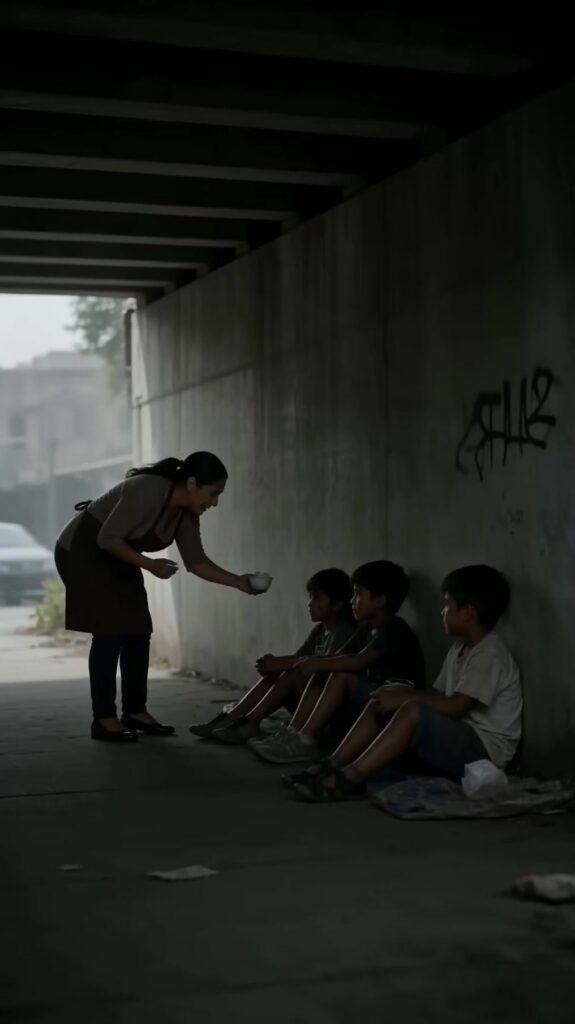
She saw them, as if her eyes were playing a cruel trick. Three small figures huddled together, soaked through, shivering even though it wasn’t winter. The oldest trying to look brave. The smallest barely making noise, as if being quiet might make them invisible enough to survive.
And her—young, thinner, pushing a cart that looked even worse than this one, clutching a pot of rice she’d meant to take home. Her hands shaking from fatigue and the kind of stubborn hope that made no sense.
She remembered the moment she’d stopped. How she’d told herself she’d just give them a little. How “a little” became everything she had because the way they looked at her didn’t leave room for half-measures.
“I…” Shiomara’s voice came out small. “I just fed you. That’s all. I had rice. You were hungry.”
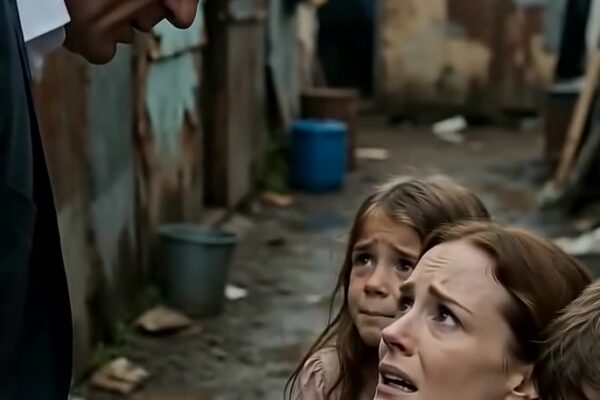
The silver-haired woman’s expression crumpled like paper. Tears flooded her eyes fast, surprising and messy against her perfect makeup. She stepped closer and didn’t seem to care about the heat, the street, the crowd watching like this was a movie.
“No,” she said, her voice breaking. “You did more than feed us. You—” She shook her head as if the words were too big. “You saw us. You didn’t walk past. You didn’t pretend we weren’t there.”
The broad-shouldered man in charcoal cleared his throat, but the sound came out rough. “We were supposed to be invisible,” he said. “Everyone made sure of it.”
Shiomara’s chest tightened. She could feel eyes on her from every direction. Neighbors. Strangers. The kids she always smiled at. A bus driver who had stopped and was leaning out of his window. The whole street was frozen in a curious, humid silence.
“How… how did you find me?” she asked.
The man in the blue suit let out a shaky laugh. “We looked for years. We found the bridge first. It was rebuilt. Then we found the old church that used to give out blankets. A woman there remembered a ‘girl with the food cart’—said you always had a flower clipped to your hair.” He gestured softly toward Shiomara’s ear, where a cheap plastic clip held back her curls. “Same spot.”
Shiomara touched the clip without thinking. It was the kind of thing you did when you couldn’t afford jewelry, when you wanted to look like you still had a choice about how you showed up in the world.
The silver-haired woman reached into her bag and pulled out an envelope so thick it looked unreal. She set it gently on the edge of the cart like she was placing something sacred on an altar.
Shiomara stared at it, then at them. “What is that?”
“A start,” the woman said. “Not payment. We know you can’t pay something like that back and neither can we. It’s a start.”
The broad-shouldered man nodded once. “For your cart. For a storefront if you want it. For rest. For whatever you’ve been postponing because life kept taking your breath away.”
Shiomara’s fingers hovered over the envelope but didn’t touch it. She had spent years learning not to accept things that came with strings. But these three weren’t looking at her like she was a charity case. They were looking at her like she was the first kindness they’d ever understood.
“We didn’t just survive,” the man in the blue suit said. “We got adopted. Separately. It was… complicated.” He swallowed. “But we promised ourselves that if we ever got steady, we’d come back for you. We didn’t know if you’d still be alive. We didn’t know if you’d want to see us. We just—” His eyes went red. “We had to try.”
Shiomara finally placed her hand on the envelope. The paper was smooth, cool even in the heat. She felt something inside her shift, like a locked door deciding to open a crack.
“I’m not a hero,” she said, because she needed them to understand. “I was hungry too. I was scared too. I just—” She exhaled. “I couldn’t watch you go without eating.”
The silver-haired woman wiped her cheek with the heel of her hand, smudging mascara like she didn’t care anymore. “That’s what made it real,” she said. “You didn’t have extra. You gave anyway.”
A child’s laugh cut through the stillness. One of the neighborhood kids—barefoot, bold—walked up to Shiomara’s cart and peered at the fancy cars like they were spaceships.
“Miss Shio,” the kid asked, loud enough for everyone, “are they buying lunch?”
The street released a breath it hadn’t realized it was holding. Someone snorted. A few people chuckled, cautious at first, then warmer. The tension cracked. The world remembered how to move.
Shiomara looked at the three strangers who weren’t strangers at all. She looked at her empty rice pot. She looked at the child waiting with bright, unafraid eyes.
Her smile returned, this time not tired, just stunned and human. “I’m sold out,” she said to the kid. Then she turned back to the three of them. “But if you’re hungry,” she added, “we can find food. We’ll eat together.”
The man in the blue suit nodded like he’d been waiting his whole life to hear that invitation. “Yeah,” he said, voice thick. “Together.”
And as the heat continued pressing down, as heavy as it had been all day, it didn’t feel like a secret anymore. It felt like a witness—like the street itself had been keeping this story warm until it was ready to be told out loud.