The alley smelled like mud, rust, and rain that never fully dried. Not the clean rain that rinsed pavement and left a bright shine, but the stubborn kind that got trapped between leaning boards and bent sheet metal, hanging around like an unpaid debt.
Adrian Crowe had stepped into it by choice, which already made him feel like he’d made a mistake. His driver was two streets over with the car running, a polite distance away from anything that could cling to a suit this expensive. Adrian hadn’t told him the real reason for coming. He’d said “a quick errand,” the way you did when you didn’t want to explain why you were about to wade into the part of the city that didn’t appear on glossy brochures.
Someone at his townhouse had mentioned the maid—Mara—hadn’t shown up two afternoons in a row. “She’s from the slum behind the train yard,” the butler had added, like it was a diagnosis. There were other whispers too: that she’d been late more often, that she’d been distracted, that the pantry inventory didn’t quite add up. Adrian had come prepared to be stern, to be disappointed, to do what wealthy men did when they felt their schedules inconvenienced.
He wasn’t prepared to be recognized.
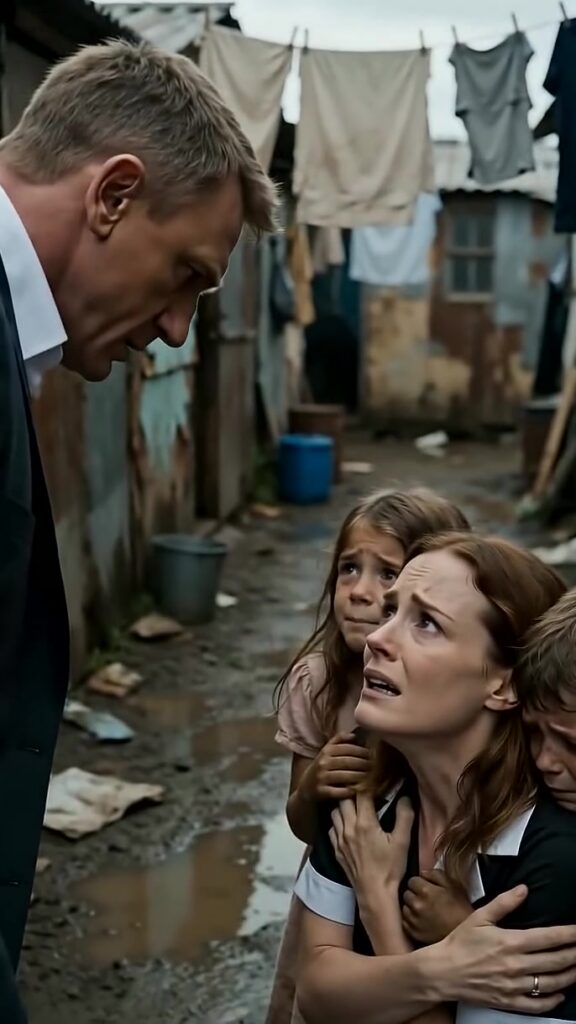
He took three steps into the alley, and a small boy shot out of a doorway as if fired from a cannon. His face was smeared with grime and the kind of tears that left clear tracks on dirty cheeks. He slammed into the waist of a young woman in a black-and-white uniform—Adrian’s uniform—and wrapped his arms around her like she was the only thing stopping the ground from swallowing him.
“Mom!” the boy sobbed. “Mom!”
Mara dropped to one knee instantly, like she’d rehearsed it. She pulled the boy and a little girl behind her, one arm guarding each of them. Her body angled between Adrian and the children. She wasn’t shielding them from a man; she was shielding them from what he could do with one phone call.
Her face went so pale it almost glowed against the dim alley light. She knew him. Worse—she knew what he might assume.
“Please,” she blurted, words tripping over each other. “Please don’t fire me. I just— I needed the job. I’m not trying to cause trouble.”
Adrian stopped so abruptly his shoes slid in the mud. He stared at her like she’d spoken in a language he hadn’t learned. “Fire you?” he repeated, and heard how cold his own voice sounded even though he didn’t mean it that way.
He’d come expecting excuses or defiance. He hadn’t come ready for fear that felt older than the moment.
His eyes moved slowly, unwillingly, taking inventory like his brain was trying to prove this was real. Scrap-wood shacks leaned together as if they’d agreed to hold each other up. Laundry lines sagged between boards, shirts and socks fluttering like tired flags. A cracked bucket floated in a puddle, turning lazily in water that was more brown than clear. The alley looked like the city had forgotten it on purpose.
The boy’s sobs softened into hiccups. He peeked around Mara’s shoulder and looked up at Adrian with the seriousness kids used when they were trying to decide if a situation was dangerous. “Mom,” he whispered, voice thin, “is he bad?”
The question hit Adrian in the chest, plain and honest and unearned.
Mara squeezed her eyes shut for a second, as if she’d been waiting for that exact sentence. Then she opened them and lifted her gaze to Adrian’s shoes like she didn’t deserve eye contact. “He doesn’t understand,” she said quickly. “I told him you’re… you’re the man I work for.”
Adrian felt something in him shift—not into anger, but into a strange, embarrassed kind of shock. “Why didn’t you tell me you had children?” he asked. He meant it neutrally. It came out like an accusation anyway.
Mara’s mouth opened. No sound came. There were too many reasons, all of them heavy. Shame. Fear. The simple math that said landlords didn’t accept excuses and employers didn’t accept complications.
The little girl, who’d been silent so far, lifted one small hand from where she clung to Mara’s shoulder. Her dress was a faded pink that might have been bright once, before too many washes in cold water. She held something in her fist—a worn photograph, its edges frayed, the corners rounded from being handled too often.
She stretched it toward Adrian with the confidence of someone offering proof.
His gaze dropped to the picture, and the alley seemed to tilt.
It was him. Not the polished, controlled version that appeared in business magazines, but a younger Adrian with softer eyes and a careless smile. His arm was slung around someone just out of frame, a blur of hair and shoulder. The photograph looked like it had been taken on a sunny day—a day Adrian couldn’t immediately place, which made his stomach twist.
The girl looked up at him, eyes wide and steady. “Mom cries to your picture,” she said, not accusing, just stating a fact like the sky was blue.
Mara lunged forward to snatch the photo away, but she was a heartbeat too late. Adrian had already seen what was tucked behind it: a folded poster, old paper creased into submission. At the top, partially visible, were the stark words that made every missing person story feel like a prayer you weren’t sure would be answered.
Adrian’s throat tightened. “Where did you get that?” he asked softly, but there was an edge now—something sharp with memory.
Mara froze, photo halfway between her and her daughter. Her fingers trembled. “It’s not what you think,” she said, and the irony of that line seemed to hit her mid-sentence because she flinched as if struck.
Adrian crouched down, ignoring the wet seeping into the knees of his tailored trousers. He brought himself level with the children, not because he wanted to be kind but because standing felt wrong. “What do I think, Mara?” he asked.
The boy’s grip tightened around Mara’s apron. The girl leaned closer, curious in the fearless way children were when they sensed secrets.
Mara swallowed hard. “I think you think I stole it,” she whispered. “Or I’m trying to… trap you. I think you think I’m lying to get money.” Her voice cracked. “I didn’t plan any of this. I didn’t even know it was you at first. I—I didn’t want to be recognized.”
Adrian held his hands open, palms up. He didn’t know if it was reassurance or a plea. “Recognized from where?” he asked.
Mara’s eyes flicked to the photograph again. “From before,” she said. Then, as if the words finally broke the dam, she rushed on. “You came to the community clinic five years ago. Your foundation was doing one of those publicity drives—free checkups, pictures, a ribbon-cutting. I was volunteering. I’d just… I’d just lost my sister.”
Adrian stared. Memory unspooled reluctantly: a day with cameras, a handshake line, a girl handing him water when his throat had gone dry. A quick laugh shared over something trivial. Adrian had been in his “humanitarian” phase back then, trying to prove to board members and maybe to himself that he wasn’t just a man who bought buildings and called it progress.
“We talked,” Mara continued. “You were kind. You told me to apply for the housekeeping position when it opened. You wrote the email down yourself. I still have it.”
Adrian’s brain tried to stitch the timeline together and kept snagging. “And the missing person poster?” he asked, nodding toward the paper behind the photo.
Mara’s breath shuddered. “It’s my sister,” she said. “Lena. She disappeared the week after that clinic event. The police took the report and then… they stopped calling. I kept the poster because it’s the only thing that proves she existed to anyone who matters.”
The alley seemed to go quiet except for distant train noise and the drip of water from a bent gutter. Adrian looked at the children again, really looked. The boy had Adrian’s dark eyes. The girl had his mouth, the same slight curve at one corner when she concentrated. It was the kind of resemblance you didn’t notice until it was pointed at you like a spotlight.
Adrian’s pulse thudded in his ears. “Mara,” he said carefully, “how old are they?”
Mara’s chin lifted a fraction. There was fear still, but something else slid underneath it—an exhausted determination. “Eli is four,” she said. “Nora is three.”
Adrian did the math without wanting to. His stomach dropped as if he’d stepped off a ledge. “Why didn’t you tell me?” he asked, and this time it came out raw, stripped of all the comfortable distance money usually provided.
Mara laughed once, sharp and humorless. “Tell you what?” she demanded in a whisper. “That the man who funds hospitals wouldn’t pay for a test? That the man who owns half this neighborhood wouldn’t rent to me if he knew I had kids? That the man in the photo would look at me like I was a mistake he didn’t remember making?”
Adrian flinched. He wanted to say he wasn’t like that. He wanted to say he’d never— But the alley, the shacks, the bucket in the puddle, the way Mara’s shoulders had automatically become a shield—those things argued louder than his intentions.
Nora tugged on Mara’s sleeve and pointed at Adrian’s tie like it was the most interesting object in the world. “Are you a boss?” she asked.
Adrian swallowed. “I’m… I’m someone your mom works for,” he said, because anything else felt like trying to grab a moving train. Then he looked at Mara. “And apparently I’m someone who owes you more than a paycheck.”
Mara’s eyes filled, but she blinked hard as if tears were an indulgence she couldn’t afford. “Don’t,” she said. “Don’t say things you’ll regret when you leave this alley.”
Adrian stood slowly, mud pulling at his shoes like it wanted to keep him there. He reached into his coat pocket and pulled out his phone, the screen too bright in the gloom. “I didn’t come here to fire you,” he said. “I came because you didn’t show up, and I thought… I thought you were careless.” He exhaled, tasting rust and rain. “I was wrong.”
Mara tensed, watching the phone like it was a weapon. “If you call anyone—”
“I’m calling my driver,” Adrian said, and the fact that he had to clarify made him feel sick. He raised the phone but kept his eyes on her. “I’m not leaving you here. Not tonight.”
Mara’s jaw tightened. “We’re fine.”
Adrian looked past her to the doorway the children had run from. Fine was a word rich people used when they didn’t want to admit they were scared. “You’re surviving,” he said. “There’s a difference.”
He paused, then added, quieter, “And I need to see that poster. Your sister. I want her name. I want the date. I want every detail you have.”
Mara’s eyes narrowed with suspicion so practiced it could’ve been taught in school. “Why?”
Adrian didn’t have a clean answer. Because guilt. Because responsibility. Because the photo in Nora’s hand had cracked something open in him that had been sealed for years. Because somewhere in his polished life, there was a missing week, a missing woman, and now—apparently—missing parts of himself.
“Because if someone can vanish from this city and no one with power cares,” Adrian said, “then I’ve been living in a lie I helped build.”
Eli sniffed and asked, small and tentative, “So… you’re not bad?”
Adrian looked down at the boy, at the mud on his own shoes, at Mara’s arms still curved protectively around both children. “I don’t know what I am,” he admitted. “But I can choose what I do next.”
The alley smelled like mud, rust, and rain that never fully dried. Adrian had thought the worst thing he’d find here was a servant who didn’t respect his rules. Instead, he’d found a photograph that didn’t belong to the life he remembered, two kids who looked at him like a story they’d heard too many times, and a missing person poster folded behind a smile he didn’t deserve.
His driver answered on the second ring. Adrian didn’t look away from Mara when he spoke. “Pull up as close as you can,” he said. “And… bring an umbrella. Two extra.”
Then, before Mara could protest again, he lowered the phone and said the one sentence that made her go very still—like she was bracing for impact, like she didn’t dare hope.
“We’re going to find Lena,” Adrian said. “And you’re not losing your job.”
Mara’s grip on the children tightened. The rain dripped somewhere above them, patient and persistent, like it had all night to wait for people to become honest.