People didn’t drive thirty miles out past the grain silos to clap politely. They came for the hot dust, the loud music, the smell of fried dough and diesel, and the part where something big and mean tried to fling a grown man into the cheap seats. The hand-painted banner over the gate said SAGEBRUSH SUMMER RODEO, but everyone called it the Danger Show.
I was there because my aunt Ellie had dragged me along to “get out of my apartment and look at the horizon for once.” Ellie liked the rodeo for the same reason she liked scary movies: she enjoyed being safe while somebody else wasn’t. We found seats halfway up the bleachers, close enough to see the churn marks in the arena floor and far enough that Ellie insisted we were “outside the splash zone.”
Down in the ring, the announcer strutted in a bright blue suit that could’ve been stolen off a game-show host. His name was Wade Crowley—everybody knew it, because he never stopped saying it. He told jokes into his microphone, did a little spin, and leaned over the rail to holler at the bull handlers like they were his rowdy cousins. Behind him, in the holding pen, something black and massive slammed into the gate. The metal shuddered. Dirt puffed up under hooves like smoke.
“Next up,” Wade boomed, “we got a special guest, the kind of guest that makes insurance agents wake up screaming—Ranger!”
The crowd roared at the name. Ranger wasn’t just a bull; he was the bull. I’d heard stories even before I moved to town: eight seconds was a rumor on his back. He’d tossed riders like they were jackets. He’d knocked one man’s helmet clean off and left the imprint of a horn in the dirt so sharp it looked drawn with a pencil.
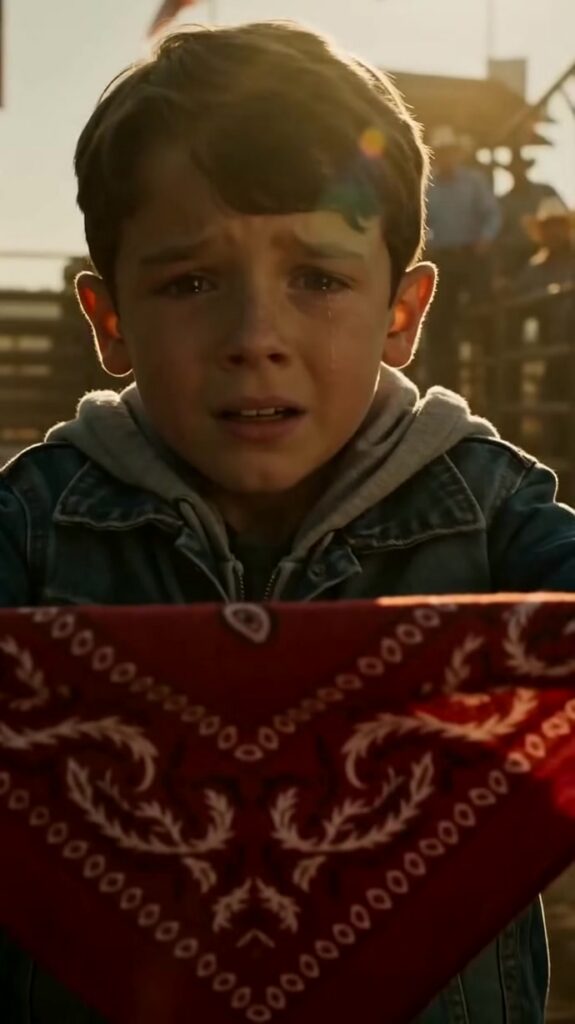
Wade was still working the audience when the first scream hit—high and ragged, like a chair leg scraping across concrete. A kid climbed over the railing, dropped into the arena, and landed hard enough that even from my seat I could see the puff of dust from his knees. He couldn’t have been more than nine. Denim jacket. Gray hoodie. Too small to be down there, too alone to be a stunt.
“Hey—HEY!” Wade’s voice cracked through the speakers. “Buddy, no, no, no. Get back over the fence.”
The kid didn’t run. That was the strangest part. Most people, even adults, move when eight hundred pounds of bad mood is nearby. This kid stood in the middle of the ring like he’d stepped out there on purpose and only now realized his legs were made of jelly. His shoulders trembled so hard it looked like his jacket was trying to shake itself off him.
He reached into his denim and pulled out a red bandana. Not bright red—more like the color had been sun-bleached and washed a hundred times. I could just make out stitched letters in one corner. Two initials. M. R.
Somewhere behind me, a man said, very quietly, “No way.” Another person whispered the name like a prayer and a curse at the same time. Mason Reed. The local legend. The guy who used to grin at Ranger like he was flirting with disaster. The guy who’d died last fall in what everyone called a terrible accident at the grounds.
Ranger swung his head toward the kid. The arena didn’t just get quiet—it got held-breath quiet. Even the speakers seemed to hum less. Wade lowered his mic, which told me he was truly scared. “Kid,” he said, and for the first time all night he sounded like a normal person, “please. Listen to me. Walk to the fence.”
The boy lifted the bandana higher like it was a flag. His voice didn’t reach my seat, but the nearest folks heard him and the words rippled upward in fragments: something about his dad, something about the bull knowing. Ranger snorted, heavy and wet, and started forward. Not a full charge, not yet—more like a slow-moving storm deciding where to drop lightning.
Ellie grabbed my wrist so tight it stung. “Someone go get him,” she hissed, even though nobody could move fast enough across that open dirt. The kid’s mouth wobbled. Tears shiny on his cheeks. Still he didn’t back up. Ranger got close enough that I expected the boy to disappear under him like a dropped hat.
Then Ranger stopped. Just stopped. One horn hovered near the boy’s chest, close enough to thread a needle. The kid stared into the bull’s dark eye and whispered a name that floated up to us in the hush: “Ranger?” It wasn’t said like a dare. It was said like you say it to a dog at the shelter, hoping it remembers being loved.
The bull made a low, vibrating sound, not anger—something older. Recognition, maybe. Ranger lowered his head and pushed his nose against the bandana, breathing it in. The crowd let out a sound that wasn’t cheering and wasn’t screaming, more like the whole place exhaled after almost drowning.
The kid sobbed openly now, the kind of crying that uses your whole ribs. He took a careful step forward and Ranger didn’t flinch. Instead, the bull dipped his head farther, showing a worn leather strap near his neck. Something small glinted there: a silver ring tied on with twine, and a little folded packet wrapped in cloudy plastic.
The boy’s hands shook so hard I didn’t understand how he managed to untie it. The ring fell into his palm. Even from far away I could see the engraving catch the stadium lights. Two names. Mason & Ava. Ellie’s mouth opened soundlessly. “That’s his wife,” she whispered, like the truth might explode if she said it too loud.
The boy unfolded the plastic, then the paper inside it. His face changed as he read—tears still there, but now mixed with something sharp and startled, like he’d touched a live wire. He looked up toward the announcer’s platform, and for a second it felt like all the lights turned to point at Wade.
“What’s it say?” an older ranch hand yelled from the rail, voice cracked with urgency.
The boy swallowed. His voice carried because the sound system, forgotten on, picked him up faintly through the open air. “It says… ‘Not an accident. Barn Three.’”
Wade’s smile didn’t just fade—it collapsed. He took a half-step back like he’d been shoved. For the first time, I noticed how white his knuckles were around the microphone. Another man at the platform—one of the event staff in a dusty hat—turned his head too quickly, eyes darting toward the row of barns behind the arena like he was checking whether a door was still locked.
Ellie’s grip on my wrist loosened, replaced by a cold stillness. “Mason died in the barn area,” she murmured. “They said it was a fall. They said he slipped.”
Down in the ring, Ranger stood like a statue beside the boy, head lowered protectively. The kid clutched the note and ring like they were the last solid things in the world. And as the first wave of murmurs turned into angry shouting, I realized the crowd hadn’t come to see danger after all.
They’d come to watch it on purpose. They just didn’t know whose danger it was supposed to be.