The first chop didn’t sound like wood. It sounded like a door in your brain getting kicked in.
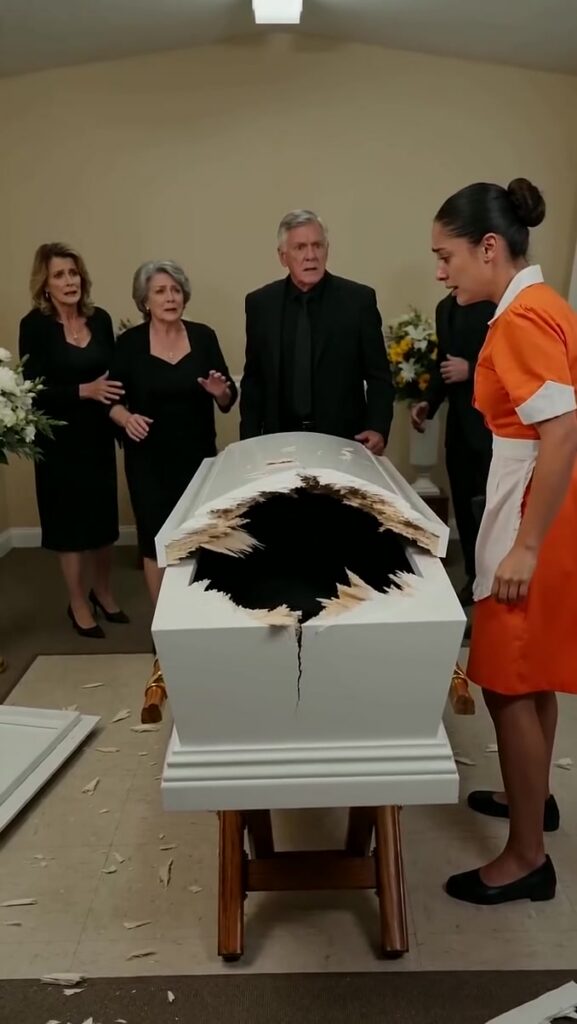
Everyone in the funeral parlor had been doing what people do in beige rooms filled with white lilies: blinking too much, pretending tissues helped, listening to someone’s sniffles echo like a metronome. The closed casket sat in the middle under a soft light that made the varnish look almost wet. A priest was halfway through a sentence about eternal rest when the maid—bright orange uniform, hair pinned back with the kind of no-nonsense clip you buy in bulk—walked up like she belonged there.
No one stopped her. When you see someone in a uniform, your brain hands them a hall pass. She reached behind the tall fern by the wall, grabbed an axe—an actual axe, like the kind you imagine in a shed—and swung it like she’d practiced in secret. The blade hit the coffin lid dead center. The crack was sharp enough to make a few mourners flinch like they’d been slapped.
Wood splintered and popped. Somebody screamed. A cousin—no one would remember which one later—stumbled backward and took down a flower stand in a slow-motion disaster of white petals and ribbon.
The maid held the axe handle like it was the only thing keeping her upright. Her eyes were wet and frantic. “She’s not gone,” she said, voice cracking. “She’s in there.”
Her name was Lina. Most of the people in the room knew her only as the woman who quietly appeared at parties with trays of drinks and quietly disappeared before anyone said thank you. But the Ashfords knew her better. Lina had been there for a decade, maybe more. She’d held hair back in bathrooms during migraine nights, carried soup no one ate, and learned the difference between a rich person’s silence and a rich person’s fear.
Richard Ashford, the widower, stepped forward like his anger could rewind time. He had the glossy, camera-ready grief people get when they’ve practiced in mirrors. “What the hell are you doing?” he snapped, too loud for a room meant for soft voices.
Lina’s hands shook so hard the axe wobbled. She didn’t point it at anyone. She didn’t threaten. She looked like someone who’d sprinted miles just to arrive too late. “I heard her,” she said. “I heard her make a sound. I was in the hallway and I heard—” She swallowed. “I cleaned her up this morning. Her fingers weren’t cold.”
That line hit the room like a thrown glass. A couple of people exchanged quick looks—because everyone had had a weird thought, once, in the middle of loss. What if? But no one ever said it out loud. Not unless they wanted to be called unstable and escorted out.
Emma’s sister Margaret lifted her face from a tissue that had basically dissolved. Her mascara had given up and started moving south. “Lina,” she whispered, like she was afraid to wake something. “Don’t—don’t do this. I can’t do this.”
Richard’s mouth opened for another burst of rage, but something about Lina’s certainty dented him. His eyes flicked to the jagged opening in the lid. He went quiet in the way a person goes quiet when their plans get a surprise chapter.
And then the coffin answered.
It wasn’t a dramatic bang. It was the tiniest little thud, like a knuckle tapping wood from far away. So small that, if the room had been full of music or chatter, it would’ve disappeared. But the room was holding its breath. The sound slid right into everyone’s spine.
Margaret made a noise that was half sob, half laugh, and dropped to her knees beside the casket. Lina rushed in, leaving the axe lying on the carpet like a crime scene prop. Together they gripped the broken lid and pulled. The varnished board fought them, then gave way with a squeal that made several people wince.
Emma Ashford was inside.
Not the Emma from framed photos. Not the gala Emma in velvet and diamonds. This Emma looked like winter. Her skin was pale in a way that didn’t look like peaceful sleep—it looked like her body had been tricked. Her lips were cracked. Her eyes fluttered as if they couldn’t decide whether to open or stay shut. She dragged in a shallow breath that sounded like paper tearing.
Margaret reached in immediately, because of course she did. Because love doesn’t wait for permission. Lina hovered, crying openly now, whispering Emma’s name like she was afraid it might break if said too loud.
But Emma’s eyes did open. Not wide. Not with a dramatic movie gasp. Just enough to focus.
Her gaze slid right past Margaret, right past Lina, and latched onto Richard. Her pupils tightened like she’d found the only thing in the room that mattered.
Richard’s face—so composed seconds ago—went strangely blank. His hand twitched at his side. He looked, for the first time, like a man standing on ice that had started to crack.
Emma tried to speak, failed, and tried again. Her throat worked like it had been glued shut. Lina grabbed a cup of water from the table meant for the priest, spilled half of it on her own hands trying to get it to Emma’s lips. Emma swallowed a fraction, then lifted one trembling finger and pointed at Richard like she’d saved the last of her strength just for that.
Her voice came out rough and thin. “Don’t… let him… burn it.”
Silence dropped hard.
Margaret blinked. “Burn what?” she asked, too fast. “Em, what are you talking about? Richard, what is she—”
Richard’s grief-mask finally slipped. His eyes darted toward the wall, toward the side door that led to the back rooms. Toward the part of the building where a discreet cremation service waited, a convenience package someone had paid extra for. He forced out a laugh that sounded like it hurt. “She’s disoriented,” he said. “She’s—she’s not—”
“Stop,” Lina cut in, and the word came out steadier than anything she’d said yet. She looked at Richard like she’d been watching him for years and had finally decided to speak in full sentences. “You told us it was what she wanted. Quick. Quiet. No fuss. You pushed for the sealed casket. You pushed for—” She gestured at the room like the whole thing was a set he’d rented.
Margaret’s breath hitched. She stared at Richard the way you stare at a stranger wearing your friend’s face. “Richard,” she said slowly, “why would she say that?”
Emma’s hand fumbled against the satin lining, searching. Lina slid her own hand in and found what Emma was trying to reach: a thin chain around Emma’s neck, tucked under the collar of the dress. The pendant wasn’t jewelry. It was a tiny key, the kind used for a lockbox.
Emma’s lips moved again. The words were barely there, but they landed. “Safe… deposit,” she rasped. “Under… my name. Not his.”
Richard stepped back like the air had turned hot. “This is insane,” he said, but his voice didn’t have any strength left. “You’re all—she’s—”
At the back of the room, one of the funeral attendants—an older man with kind eyes and sleeves rolled up—quietly closed the side door. Not locked it. Just closed it. Like he’d decided the next part didn’t need an audience wandering in and out.
Margaret stood, wiping her face with the heel of her hand, suddenly sharp. “Call an ambulance,” she told someone without looking away from Richard. Then she leaned down so Emma could see her. “I’m here,” she said, voice firm. “I’m listening. You’re safe.”
Emma’s eyelids fluttered, relief or exhaustion—maybe both. Her grip tightened faintly around Lina’s fingers, a desperate little squeeze that said thank you without wasting breath.
Richard tried one last time to regain control, stepping forward with his hands out like he was the reasonable one. “Let me help her,” he said, too smooth, too practiced.
Lina didn’t grab the axe again. She didn’t need to. She simply shifted her body between Richard and the coffin, shoulders squared, orange uniform bright as a warning sign. “You’ve helped enough,” she said.
Later, people would argue about what they remembered first: the splintering wood, the scream, Emma’s cracked whisper, Richard’s face when he realized the room had turned on him. But everyone—every single person who sat in that beige parlor for years afterward—would flinch the moment they heard an axe bite into anything.
Because that sound wasn’t just violence. It was a doorway. It was the instant a neat little story got busted open, and the truth—gasping, bruised, stubbornly alive—pulled itself into the light.