No one noticed him because the street had trained everyone not to. It was one of those downtown intersections where horns made up their own language and pedestrians crossed like they were playing a video game on hard mode. There were always people asking for change, people selling something, people arguing into their phones. The city had so much noise that silence became the easiest thing to ignore.
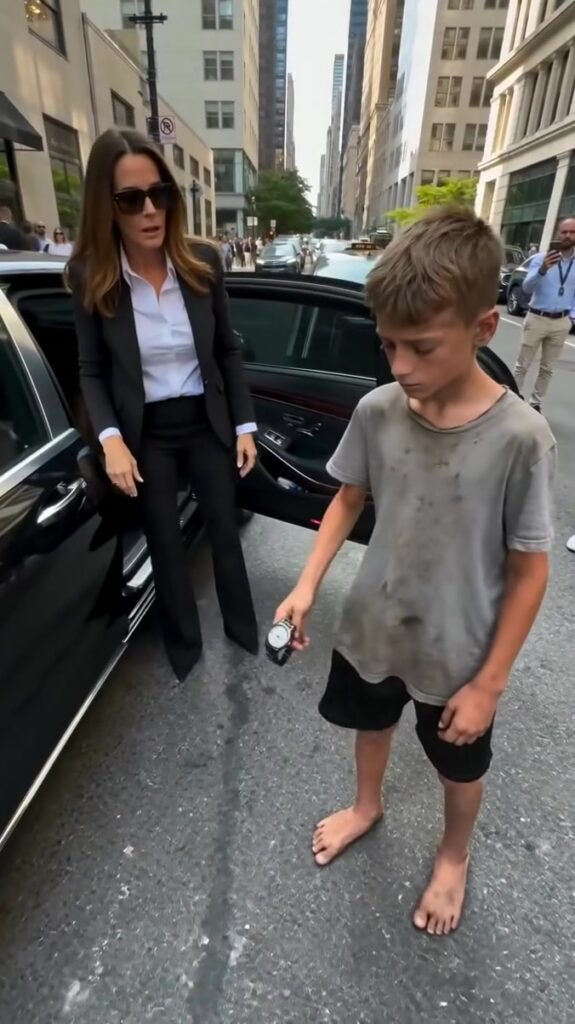
So the boy standing barefoot near the curb didn’t register as unusual. He was too still. Not performing, not begging, not even looking around. Just… placed there. Like someone had set him down and forgotten to pick him back up.
Cars kept squeezing through the chaos. A delivery van lurched forward. A taxi crept into the crosswalk like it owned the paint. And then, sliding into view with the smooth patience of money, came a black luxury sedan—glossy enough to mirror the sky. It eased up to the light, windows tinted, engine humming like it was trying not to be bothered.
The boy moved.
Not fast. Not dramatic. He took one step, then another, and reached out to the hood.
His palm made soft contact with the car’s polished skin. More a tap than a slap. A touch that shouldn’t have meant anything.
But the street stuttered anyway.
It wasn’t that traffic stopped because it had to—the light still blazed red like always. It stopped because something about the moment hit everyone at once. A kid and a luxury car. Bare feet and expensive paint. A quiet collision of worlds. Heads turned. A phone lowered. Even a guy mid-argument paused with his mouth open.
The driver’s door clicked, and the woman stepped out with the controlled irritation of someone who didn’t do surprises. She looked like she belonged inside a magazine: tailored coat, hair smoothed into place, sunglasses that probably cost more than most people’s rent. She shut the door with a firm little motion, as if snapping a sentence shut.
“Hey,” she called, sharp enough to cut through the honking. “What are you doing?”
The boy didn’t flinch. He didn’t back away. He just stared at her, eyes too steady for his face. Not defiant exactly—more like he was seeing through her, past her coat and her watch and her perfect posture, into something she’d built walls around.
“You can’t—” she started, then stopped herself. She didn’t want to sound like she was yelling at a child in public. She adjusted her tone, clipped and managerial. “Move away from the car.”
He still didn’t answer.
Slowly, like his joints were rusty, he raised his hand again. But this time he wasn’t reaching for the hood. He was holding something.
A wristwatch.
Old, the kind with a leather strap that had been worn soft and cracked at the edges. The glass was spiderwebbed, and one of the hands looked slightly bent, like it had tried to keep time through something violent and failed. It should have been worthless—something you’d find in a junk drawer and throw out without thinking.
The woman’s face changed anyway.
It wasn’t a movie gasp. No dramatic stagger. It was subtler, worse: a tiny falter in her breathing, a stiffening around the mouth, the way her fingers tightened on her purse strap like she’d been yanked by an invisible rope.
Because she recognized it.
She hadn’t seen that watch in years. Not since she’d stood in a hospital hallway staring at a vending machine that wouldn’t take her coins, while a doctor tried to explain words that wouldn’t fit into her brain: accident, fire, no survivors, we’re so sorry.
The last person who wore that watch had been her brother.
And her brother was supposed to be dead.
“Where did you get that?” she asked, and the sharpness was gone. What replaced it sounded almost… afraid.
The boy’s lips parted like he was testing the idea of speaking. When he finally did, his voice was quiet and rough, like it hadn’t been used much.
“He told me to find you,” he said.
The street kept moving around them. A cyclist wove past. Someone honked impatiently. But the woman didn’t hear any of it. Her world narrowed to the watch in his hand.
“Who is ‘he’?” she demanded, even though her throat tightened on the word. She already knew who he meant, and she hated herself for hoping.
The boy glanced toward the corner where an alley cut between two buildings. “The man with the scar,” he said. “On his neck.”
Her stomach dropped. Her brother had a scar there. A childhood thing from climbing a fence when they were both dumb and fearless.
She took a step closer, the heels of her shoes clicking on the asphalt like punctuation. “What’s your name?”
He hesitated. “Milo.”
“Milo,” she repeated, and the way she said it surprised her—gentle, as if saying it softly might keep him from vanishing. “How old are you?”
“I don’t know,” he admitted, and there was a flash of something unguarded in his eyes. Not confusion, exactly. More like the truth had always been inconvenient.
She looked him over properly for the first time. The dirt on his feet. The thin hoodie that wasn’t warm enough for the season. The way his shoulders stayed squared even while his fingers trembled around the watch.
“Come with me,” she said automatically, then corrected herself, because she was used to people doing what she said and this wasn’t one of those times. She lowered her voice. “Please. We’ll talk somewhere safe.”
Milo didn’t move.
“I can’t,” he said. “He said you wouldn’t believe it if I came alone.”
“Believe what?” Her pulse thumped in her ears. “Where is he?”
The boy lifted the watch higher, turning it so the cracked face caught the dull daylight. Something was etched into the back—tiny letters, uneven like they’d been scratched in a hurry. The woman reached out without thinking. Her fingers hovered, then gently took it from him, like it might break further if she gripped too hard.
She flipped it over and read the engraving.
Not a name. Not a date.
A sentence.
“I didn’t die. I ran.”
The air left her lungs. For a second she couldn’t stand, couldn’t breathe, couldn’t do anything but stare at those words like they were a trapdoor opening under her feet.
“That’s his handwriting,” she whispered. She hadn’t heard her own voice go small in a decade.
Milo watched her closely. “He said you’d get angry,” he said. “He said you’d think he left you.”
She swallowed hard. “Why would he—” She couldn’t finish the question because it wasn’t one question. It was a whole pile: Why didn’t you come home? Why did you let me mourn you? Why did you let me build a life on the lie of your death?
Milo shifted his weight, glancing at the traffic like he’d learned to measure danger by the speed of strangers. “He didn’t leave,” he said. “He said he got taken.”
She blinked, the word slamming into her brain. “Taken?”
He nodded. “He said he tried to call you. But they didn’t let him keep his phone. He said… he said someone made the fire on purpose.”
Her hands went cold around the watch. The “accident” had always been too neat. The investigation had closed too quickly. She’d paid lawyers, asked questions, gotten polite dead ends. Eventually she’d learned the city’s favorite answer: there’s nothing we can do.
But she had never stopped wondering.
“Where is he now?” she asked, forcing the words out carefully, because if she pushed too hard she might scare the only thread she had.
Milo pointed again toward the alley. “He’s close. He said he can’t come out until he knows you’re alone.”
She glanced back at her sedan. The driver inside had been watching in the rearview mirror, unsure whether to intervene. Across the street, someone was openly filming now. Great. Because when you’re trying to find your not-dead brother, the last thing you need is an audience.
She pulled off her sunglasses and tucked them into her coat pocket, suddenly aware that armor was useless here.
“Okay,” she said, and her voice steadied—not because she wasn’t terrified, but because she’d spent years learning how to move through terror like it was just another meeting on the calendar. “Milo, look at me.”
He did.
“We’re going to do this smart,” she said. “You’re going to walk with me. Not in front, not behind—next to me. If anyone tries to stop us, you stay close.”
Milo’s brow furrowed, as if he wasn’t used to people giving him choices that weren’t fake. “You’re not mad?” he asked.
Her throat tightened again. She looked down at the watch, then back at him. “I don’t know what I am,” she admitted. “But I’m listening.”
For the first time, Milo’s shoulders dropped a fraction, like something inside him unclenched.
She held out her hand.
After a beat, he took it—his fingers small, cold, and startlingly strong.
They started walking toward the alley, and the city resumed its noise behind them. Horns blared. People rushed. The red light turned green, and traffic surged like nothing had happened.
But for her, everything had changed the second a barefoot boy touched her car—and handed her back a past she’d buried with expensive flowers and forced silence.
At the mouth of the alley, Milo paused and looked up at her like he was checking one last thing. “He said you’d have the same eyes,” he murmured.
She squeezed his hand. “And he has the same terrible timing,” she said, trying to make it sound like a joke, trying to keep her heart from climbing out of her chest.
Milo didn’t laugh, but the corner of his mouth twitched, as if he’d seen the outline of humor once and was remembering how it worked.
Then he led her into the shadowed gap between buildings, where the city’s roar dulled and the air smelled like old rain and secrets.
Somewhere deeper inside, someone shifted. A breath. A footstep.
And in the dim, a voice she hadn’t heard since she’d been twenty-two years old said her name like it still belonged to him.
“Lena.”
She froze, the watch burning in her palm, and for the first time in years she felt the ground under her feet tilt toward a future she hadn’t planned for at all.