No one noticed the boy at first. That was the point. On a street where horns argued with vendors and everyone walked like they were late to their own lives, a barefoot kid with a too-big T-shirt could dissolve into the background like smudged chalk.
He kept his head down and his hands busy, rifling through the plastic mountain near the bus stop. People assumed the usual story: hungry kid, looking for scraps, maybe a bottle to trade for coins. They were wrong, but they were also lazy. Lazy assumptions were the city’s favorite sport.
The boy’s name was Eli. He was twelve, maybe thirteen on a good day, with hair that looked like it had been cut by a windstorm. He wasn’t searching for food. He wasn’t even searching for money. He was waiting for a sound.
Every few minutes he glanced down the street, pretending to look for another can, while his ears did the real work. He’d learned to tell engines apart the way other kids could tell dogs: the sputtering taxis, the whiny scooters, the delivery trucks that rattled like loose bones. The one he wanted didn’t rattle at all. It purred, low and expensive, the kind of purr that made people’s necks straighten even before they realized why.
Eli’s fingers stayed curled around the handle of a battered blue bucket he’d found earlier. The bucket looked harmless, the kind you’d see a janitor use. But it was heavy. The water inside wasn’t just water. It was gray, oily, and alive with the street—dishwater dumped from a stall, rain runoff, whatever had been poured there and forgotten. It smelled like old onions and metal.
Across the road, a fruit seller watched him with mild disgust, then went back to arranging mangoes like little suns. A man with a briefcase stepped around Eli without breaking stride. A teenager laughed into her phone. Nobody stopped. Nobody asked. Nobody noticed the way the boy’s shoulders tightened every time a dark car passed, then loosened again when it wasn’t the one.
Then the sound arrived. Smooth. Quiet. Wrong for this street. Eli’s head tilted, barely an inch, like a dog hearing its name. Down the block, a black luxury car slid through the mess as if it owned the air.
The crowd didn’t part so much as it adjusted—people stepped aside, not out of politeness, but out of instinct. Something about expensive vehicles made ordinary pedestrians feel temporarily breakable.
Eli didn’t move until the car reached the patched section of pavement right in front of him. The driver slowed to avoid a pothole, and that tiny pause was all Eli needed.
In one sharp motion, he stood up, swung the bucket, and flung the filthy water across the hood and windshield. It landed with a wet slap, streaking down the glass in thick gray rivers.
The street went silent in a way that felt unnatural, like someone had yanked the power cord out of the day.
A second later, chaos tried to return—gasps, curses, the beep of a horn—but it couldn’t quite get traction. Everyone was watching the car like it might explode.
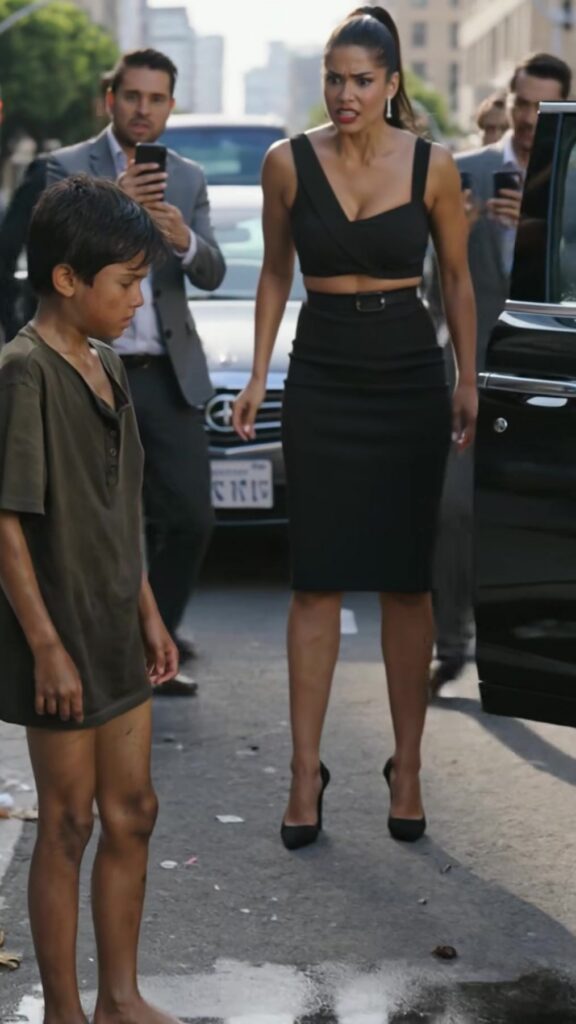
The back door opened. A woman stepped out, crisp as a magazine cover. She wore a white suit that didn’t belong in this neighborhood and sunglasses that looked like they’d never seen dust. Her heels clicked on the broken pavement as if the street should apologize to her.
“Are you insane?” she snapped, voice slicing clean through the quiet. “Do you know what you just did?”
Eli stood there, dripping bucket at his side. His chest rose and fell fast, but his eyes didn’t flinch. “Yeah,” he said. “I did it on purpose.”
The woman took a step toward him like she was approaching a stain. “You’re going to pay for this. I will have you—”
“You ruined everything,” Eli cut in, and the words came out rough, like they’d been stuck in his throat for a year.
That stopped her. Not because she felt guilty—guilt wasn’t an emotion she wore easily—but because his tone didn’t match the scene. Kids who throw dirty water at rich cars usually ran or begged or laughed. This kid sounded like he was delivering a bill.
She lowered her sunglasses a fraction. “What did you say?”
Eli’s hands trembled now, the adrenaline catching up. He swallowed. “You don’t remember me,” he said, “because you didn’t look at me. You looked through me.”
People started edging closer. A man near the curb lifted his phone. Another followed. Screens rose like curious flowers.
Eli nodded at the car, now wearing the city’s grime like an accusation. “Last winter,” he continued, “you came down this street in that same car. The driver hit my mom. Not hard enough to make the news. Hard enough to make her fall.”
The woman’s mouth tightened. “That’s absurd.”
“You got out,” Eli said, voice shaking but steadying as he spoke, “and you asked if the car was damaged. Not if she was okay. You told your driver to leave because ‘these people’ would swarm.” He looked around at the crowd. “We did swarm. Not to rob you. To help her breathe.”
The woman’s face had drained of color so quickly it looked like someone had erased her. Her hand clutched the edge of her purse, knuckles whitening. She didn’t deny it—at least not with words. Her silence did something to the crowd; it made their curiosity feel justified.
Eli’s voice got smaller. “She died two days later. Not from the fall. From the hospital refusing to treat her without money up front. I tried to sell her ring. It wasn’t enough.” He lifted his chin. “You were the last person who could’ve helped, and you didn’t. You just drove away.”
Someone in the crowd muttered, “Oh my God.” Another person whispered, “Is this real?” The phones held steadier now, hungry for proof.
The woman’s jaw worked as if she was chewing on something bitter. “I… I didn’t know,” she said, but it sounded thin, like paper trying to be a blanket.
“You didn’t want to know,” Eli shot back. “That’s different.”
For a moment, the woman looked like she might explode the way she’d arrived—lawsuits, threats, the full weight of her world landing on a barefoot kid. Instead, she did something that confused everyone, including herself.
She stepped closer.
Not a dramatic stride. Not a stomp. A careful, almost cautious approach, like she was walking toward an animal that might bolt. The driver stayed frozen behind the wheel, eyes forward, pretending he wasn’t part of the story.
Eli didn’t back up. He kept his feet planted on the hot pavement, toes curled slightly against the grit. His heart pounded so loudly he thought it might be picked up by the phones.
The woman stopped an arm’s length away. Her perfume fought with the street smell and lost, but it tried. She looked at Eli’s face like she was searching for something she’d misplaced.
Then she leaned in.
The crowd held its breath. Phones zoomed. A kid on a bicycle almost toppled over trying to get a better angle.
The woman whispered into Eli’s ear, and whatever she said hit him like a shove. His eyes widened. The bucket slipped a little in his hand, and he caught it before it fell, fingers suddenly clumsy.
“What?” Eli blurted, louder than he meant to.
The woman straightened, expression unreadable behind the lowered sunglasses. She glanced at the phones, then at the people, then at Eli again as if deciding whether the world deserved to hear what she’d just said.
Somebody shouted, “Say it again!” Another voice yelled, “What did she say?”
Eli’s mouth opened, but no words came out. The shock sat in his throat like a stone.
The woman took out her phone with a trembling hand and typed something fast. She didn’t dial. She didn’t call the police. She didn’t call a lawyer. She typed like she was sending a message that could change a timeline.
Eli stared at her, searching her face for a lie, for cruelty, for anything that would make the whisper make sense.
And just as the crowd surged closer and the phones lifted higher—right as the whole street leaned toward the truth—the closest camera jolted, the frame tilted wildly, and the recording cut off.
All anyone could see in the last frozen second was Eli’s stunned face and the woman’s hand reaching toward him like she was about to pull him out of the street and into a story nobody had expected.