No one paid attention to the girl at first, which was kind of the point of places like Westbridge Galleria. Everybody came to be around other people and then pretended none of those people existed. If you weren’t holding a shopping bag or wearing a blazer, you were basically furniture.
So when the girl hovered near the fountain—mud on her knees, hair in knots, feet bare like she’d misplaced the concept of shoes entirely—most folks did what they do best: glanced once, decided she was somebody else’s problem, and aimed their eyes at anything more comfortable. Phones. Storefronts. Their own reflection in a chrome column.
Mara had come to the mall for one simple reason: a replacement clasp for a bracelet she’d broken the night before while arguing with her closet. She had a meeting in two hours, and her brain was in that picky, hyper-focused mode where one tiny flaw felt like the end of civilization. She marched out of a jewelry kiosk with a tiny velvet bag and a receipt, already composing the apology she’d make to her assistant for being late.
Beside her, Julian—her fiancé, technically, though he’d started calling himself “future husband” like it was an investment—walked with the purposeful stroll of a man who believed the world rearranged itself to let him pass. His phone was pressed to his ear, his free hand gesturing at invisible charts.
“No, we’re not delaying the roll-out,” he said, voice sharpened like he was cutting fruit. “We’re accelerating. The board can complain after the numbers come in.”
Mara nodded like she had any idea what he was talking about. She was halfway to mentally selecting a lunch salad when the girl moved.
It wasn’t dramatic. No running, no scream. Just a small step closer, like a moth drifting toward a light. She stopped directly in Mara’s path, forcing Mara to slow to a reluctant halt.
The girl’s eyes were enormous, a muddy green that looked like they’d seen too much. She stared at Mara’s left hand.
Mara’s first instinct was annoyance, then guilt for being annoyed. She tried to soften her expression the way she did in charity galas. “Hey, honey,” she said, voice light. “Are you lost?”
The girl didn’t answer. She lifted one finger—thin, grimy, trembling—and pointed at Mara’s ring.
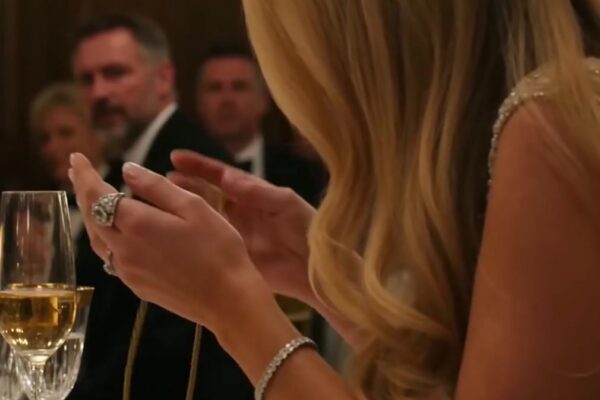
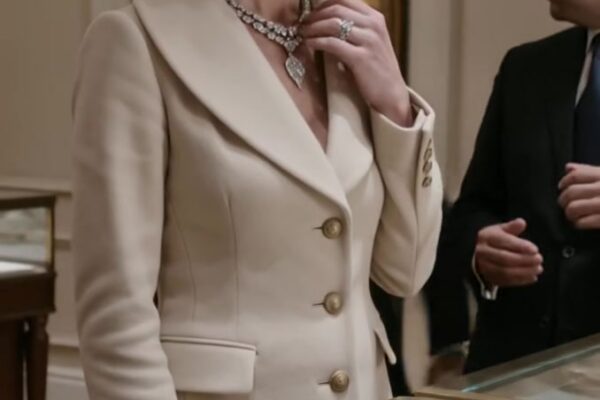
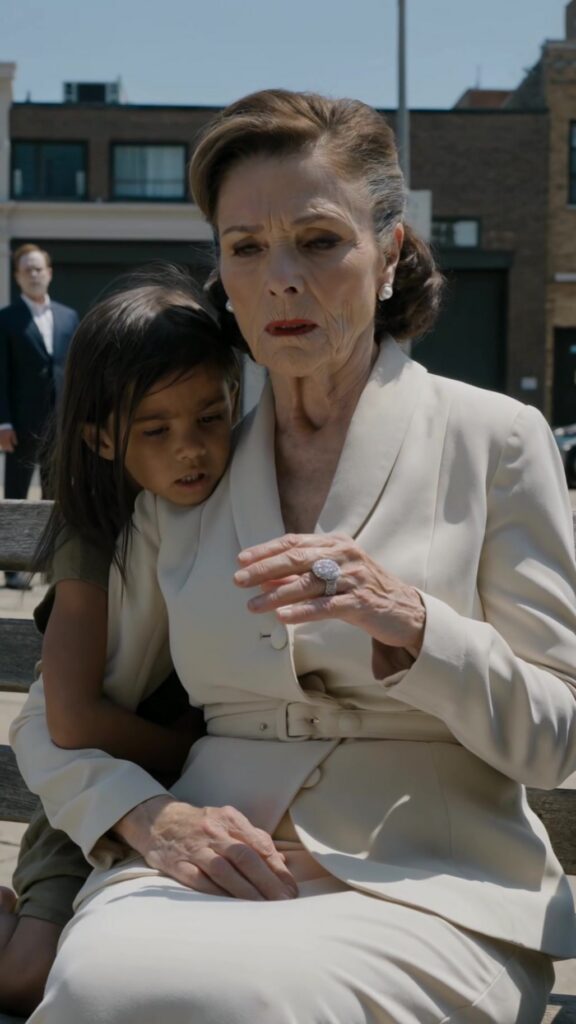
It was a vintage piece, the kind that looked like a story. An oval stone, pale and cloudy like moonlight trapped in glass, surrounded by tiny diamonds that caught the mall’s harsh lighting in sharp sparks. Mara wore it not because it matched her outfit, but because she loved the way it made her feel: old-money mysterious, like she’d inherited secrets.
The girl’s finger hovered inches away. “My mommy had that exact ring,” she said.
The sentence didn’t land like a cute coincidence. It landed like a dropped tray in a quiet restaurant—clatter, then silence.
Mara’s hand reflexively curled, shielding the ring. Her smile froze in place, then cracked at the edges.
“That’s… sweet,” Mara managed, but her voice lost its practiced warmth. “Lots of rings look similar.”
The girl shook her head, a slow, stubborn motion. “No. The little scratch is there.” She pointed again, closer now, and Mara felt her pulse jump because the girl wasn’t guessing. She was identifying. “Right on the side. Like a tooth mark.”
Mara’s stomach tightened. She knew that scratch. She’d nicked the band on a cabinet handle the first week she wore it and had complained for days. Julian had joked it gave it “character.”
Julian’s phone call had gone silent. He stood slightly behind Mara, his face tilted, listening. A man who could talk through an earthquake had stopped speaking.
Mara tried to laugh it off. “It’s an antique. I bought it from an estate jeweler. Your mom probably had a similar one.”
The girl’s gaze lifted to Mara’s face, unblinking. “She called it her moon ring,” she said. “She said if you hold it under a lamp you can see a tiny star trapped inside.”
Mara felt the blood drain from her cheeks. She had never told anyone that. She hadn’t even noticed it at first; the jeweler had shown her under a spotlight, smiling like he’d just revealed a magic trick. “See?” he’d said. “A star in the stone.”
Mara swallowed. “Who are you?”
The girl glanced past Mara, toward the fountain’s edge where shoppers flowed like water around rocks. “I’m Leni.” She said it like it didn’t matter, like names were temporary. “My mommy’s name was Elara.”
Mara blinked hard. “No,” she whispered, and she didn’t know who she was arguing with—Leni, the universe, or the memory she’d shoved into a locked drawer years ago. “That can’t—”
Julian stepped closer, his voice low, too controlled. “Mara,” he said, and there was something in it she hadn’t heard before. Not irritation. Not impatience. Alarm.
The girl kept going, words tumbling out as if she’d been holding them in for ages and the dam had finally cracked. “She said the ring was from a man who promised her things. She said he took it back. She said she never should’ve trusted him.” Leni’s chin tipped toward Julian, as if she’d known the direction all along. “She said his name was Julian.”
Time did a weird thing then. The mall didn’t stop, exactly—music still played faintly from some store, a baby still cried somewhere, a cart still squeaked—but Mara felt like she’d stepped into a glass box where sound couldn’t quite reach her.
Julian’s expression changed in one sharp flicker, like a lightbulb burning out and leaving something colder behind. Fear, yes. Not the normal kind—more like the kind you see in animals that realize the cage door is open and they’re the one trapped inside.
He looked down at the girl, and his mouth tightened. Then he leaned in close to Mara’s ear, careful, like he didn’t want anyone to read his lips.
“That’s not possible,” he whispered. “Because Elara didn’t have a child.”
Mara’s breath caught. The way he said it—flat certainty, not confusion—hit her harder than the girl’s accusation. It wasn’t can’t. It was didn’t, like he’d been present for the final chapter.
Mara’s eyes snapped to his. “How do you know that?” she whispered back.
Julian’s jaw flexed. For half a second he looked like he might speak, might lie, might do whatever he always did to smooth the world back into shape. But Leni saved him the effort.
She reached into the pocket of her oversized hoodie and pulled out something small wrapped in tissue paper that looked like it had survived rain, dirt, and being clutched too tightly. She opened it carefully, reverently, like it was fragile as a wing.
Inside was a photograph.
Mara recognized the background first: the lakeside patio at a rental cabin, string lights drooping between trees. She’d been there once, years ago, during a weekend Julian claimed was “an easy getaway.” Mara had thought it was romantic. Looking at the photo now, she realized it had been… convenient.
In the picture, Elara stood smiling, her hair swept by wind, her hand lifted to show the moon ring. Julian’s arm was around her shoulders. And Elara’s other hand rested on a small, unmistakable swell in her belly.
Mara’s knees went soft.
Leni held the picture up like evidence in court. “She kept it hidden,” the girl said quietly. “In a book. I found it when I ran away. I came here because she told me if anything ever happened, to find the man with the ring and the woman who wears it now.”
Mara stared at Julian, her mind spinning through memories she’d filed as harmless: the way Julian had insisted on buying her the ring as an engagement gift, the way he’d acted almost relieved when she accepted it; the estate jeweler who had avoided her eyes; Julian’s sudden mood swings when she asked about his past relationships.
“Mara,” Julian said, voice turning soft, coaxing. “Listen. This is some kind of scam. Someone put her up to it. We need to—”
“Stop,” Mara said, and her own voice surprised her. It wasn’t loud, but it was sharp enough to cut through his smoothness. She looked down at Leni. The girl’s bare feet were planted on the polished tile like she’d chosen this spot on purpose, like she’d decided this was where the truth would be dragged into the light.
“Where did you come from?” Mara asked.
Leni blinked, and for the first time her tough composure cracked into something small. “A place that’s not nice,” she admitted. “They said my mom left me. They said she didn’t want me.” Her eyes flicked to the ring again, hungry for some confirmation of the story she’d built. “But she did. She told me about the star inside it. She told me not to forget.”
Mara’s fingers trembled as she turned the ring slightly, catching the overhead lights. For a moment, the stone flashed, and there it was—tiny, bright, like a trapped spark. A star.
Julian inhaled like he was about to take control of the scene the way he took control of everything. Mara beat him to it. She stepped sideways, positioning herself between him and the girl, an instinct she didn’t understand until it was already happening.
“We’re going to sit down,” Mara said, voice steady now. “Right there. And you’re going to tell me everything you know about Elara.” She looked over her shoulder at Julian, and the air around them felt suddenly thin. “And you—” she said, letting the words sharpen into something dangerous, “are going to explain why you sound so sure she couldn’t have a child.”
Julian’s eyes flicked around, calculating exits, witnesses, angles. The casual mall noise kept flowing, clueless. Somewhere a cash register chimed. A couple laughed at a joke that didn’t matter.
Leni stood very still, like she’d finally found the place she’d been walking toward for a long time. “He knows,” she said, almost gently. “He knows what happened to her.”
Mara stared at Julian, and the ring on her finger felt heavier than it ever had, like it wasn’t jewelry at all anymore. It was a handcuff. A clue. A promise stolen from someone who’d never gotten to cash it in.
Julian swallowed, then spoke again, his whisper barely audible, meant only for Mara—except Leni’s head tilted, catching it too.
“If she’s really Elara’s,” he murmured, “then someone lied about the body.”
And just like that, the entire story Mara thought she was living cracked open, revealing another one underneath—darker, older, and already in motion.