Marcus Bennett’s favorite sound used to be a boardroom going quiet. Not because he liked silence, but because it meant he’d said something that landed. A number, a threat, a promise—whatever tool he chose that day—would drop into the room like a stone, and everyone would do what he needed them to do.
He’d built his company that way: logistics, real estate, private security, and a sleek little data firm that “helped” city councils modernize traffic patterns and resource allocation. He didn’t call it control. He called it efficiency. Cities ran smoother when someone smart had their hands on the levers.
Then Lila started bumping into doorframes.
At first it was cute, the way little kids misjudge distance. Then she started missing steps. Then she began holding her hand out in front of her face like she was swimming through fog. On a Tuesday that felt like it lasted a month, her teacher called to say Lila had cried during art because she couldn’t tell the green crayon from the brown one anymore.
Marcus did what Marcus always did: he threw money at the problem until it flinched. He flew specialists in. He booked private appointments under fake names. He bought the kind of genetic testing that came with a binder and a compliment about how “proactive” he was being. Every consultant had the same carefully practiced voice when they delivered the verdict.
Progressive. Degenerative. No known cure.
He’d learned a new kind of quiet: the quiet after a doctor leaves the room and there’s nowhere left to negotiate.
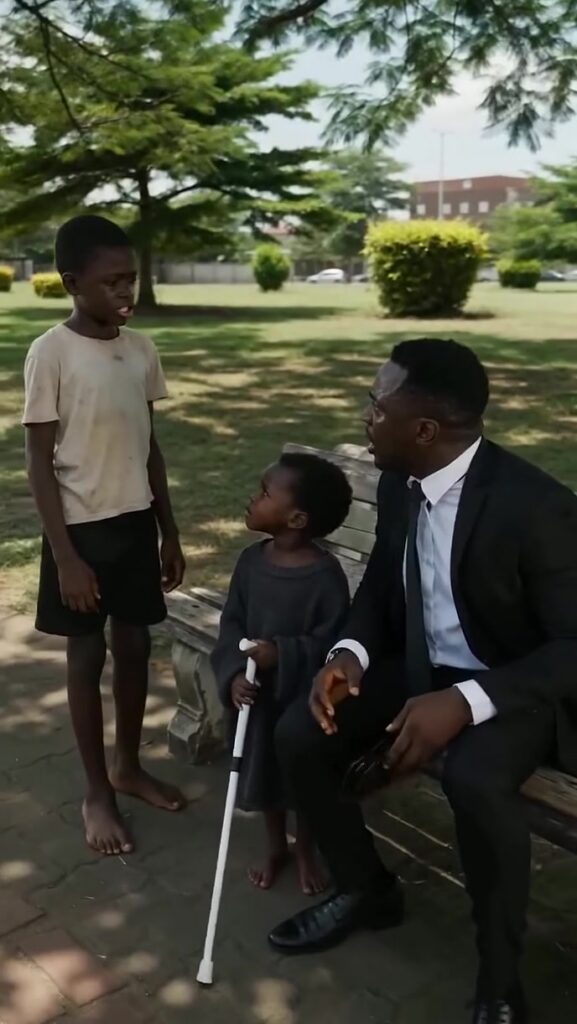
Six months later, he found himself sitting in the shade of a palm tree on the edge of his own property, watching his daughter shuffle along the stone path with a child-sized white cane. It was too big for her hand and too bright for the day, but Lila insisted. It made her feel “official,” she said, like the brave kids in the videos her therapist showed her.
Marcus pretended not to notice that the cane tapped too softly. Like she was afraid the world might hit back.
“Daddy,” Lila asked, her head tilted toward the sun like she could hear the light, “is it nighttime already?”
Something in his chest cracked, a neat break like glass under pressure.
“No, bug,” he said, forcing his voice into a steady line. “It’s still afternoon. The sun’s just… behind a cloud.”
There wasn’t a cloud in the sky. The day was sharp and bright. His lie tasted like pennies.
He was still holding that taste when someone spoke from the edge of the driveway.
“Your kid isn’t sick.”
Marcus turned so fast he nearly knocked over his iced coffee. A boy stood there barefoot, skin dusty, shirt too big, hair like it had lost a fight with a hedge. He looked maybe twelve, maybe older. Hard to tell with street kids; they carried extra years in their eyes.
Marcus’s security team had a blind spot, apparently. That alone irritated him. He stood up, his phone already in his hand, thumb hovering over a call that would make people run.
“You lost?” Marcus asked, voice tight.
The boy didn’t flinch. “No. I’m right where I’m supposed to be.” He nodded toward Lila, who was tapping her cane in a careful half-circle, trying to orient herself. “And she’s not going blind on her own. Someone’s taking it.”
Marcus felt his stomach drop like an elevator cable snapped. “What are you talking about?”
The boy stepped closer, stopping just outside the reach of Marcus’s shadow. His eyes tracked the cane, the way it moved, the way Lila’s shoulders tightened when it hit a pebble. Like he was reading a language Marcus couldn’t.
“It’s a trick,” the boy said. “Not magic like movies. Just… chemistry and timing and people who know where you’ll be. Somebody’s been dosing her.”
Marcus laughed once, sharp and ugly. “You expect me to believe a kid off the street knows more than the best ophthalmologists in the country?”
“Doctors see symptoms,” the boy replied. “They don’t see who benefits.” He looked Marcus dead in the eye. “And you don’t want to hear who benefits.”
Marcus’s hand tightened around his phone. “Say it.”
The boy’s gaze flicked toward the house—Marcus’s glass-and-stone monument with its perfect landscaping and its perfectly curated family photos in the foyer. “Your wife,” he said.
The air got heavier. Even the palm fronds seemed to pause.
Marcus wanted to reject it outright. He had trained himself to reject anything that threatened his structure. His marriage, his image, his home—those were pillars. Pillars didn’t move. Pillars didn’t poison children.
And yet—somewhere deep under the layers of denial—something had been scratching for weeks. Elaine had been… distant. Smiling too fast. Asking too many specific questions about Lila’s medications, about appointment times. She’d insisted on ordering supplements from a “wellness clinic” Marcus had never heard of. She’d started hiring new staff without running it by him, citing “privacy” and “reducing stress.”
Marcus had let it slide because fighting at home felt like admitting he was losing.
Lila turned her face toward him, sensing the change in his breathing. “Daddy? Why are you shaking?”
Marcus crouched, forcing his hands still, pressing his forehead gently to hers. He could smell her strawberry shampoo. Something simple and innocent that had no business living next to the word poison.
“I’m okay,” he whispered, then looked up at the boy. “What’s your name?”
“Noah,” the boy said. “Doesn’t matter.”
“It matters if you’re accusing my wife of hurting my daughter.” Marcus stood again, and this time his voice was quieter, the kind of quiet he used right before a contract got signed or a rival got ruined. “Why are you here, Noah?”
Noah hesitated, then lifted his chin toward the road. “I saw your wife two weeks ago. Not at your house. In the back lot behind the old pharmacy on Stonebridge.” He swallowed. “She met a guy in a gray van. They traded a cooler. She looked… happy. Like she was buying a present.”
Marcus’s mind snapped into motion, gears catching. Stonebridge. The pharmacy had been shut down for months, but the building still had cameras—his cameras. He’d bought the block last year through a shell company to push the city into rezoning. He hadn’t even remembered it existed.
“Why didn’t you go to the police?” Marcus asked, already knowing the answer.
Noah gave a short laugh. “Because police don’t listen to kids like me. They don’t listen to anyone unless there’s a press conference.”
Marcus stared at him, then at Lila, who had started humming softly to herself, a nervous habit she’d picked up as her world dimmed. Marcus felt the old version of himself—the one who believed everything was solvable—kick the door down inside his chest.
Control wasn’t a luxury. It was a weapon. And he’d been using it on the wrong things.
He pulled out his phone and made a call. Not to security. Not to his assistant. To the head of his data team—the one person who could open any camera feed in the city like it was a toy.
“I need footage from Stonebridge,” Marcus said, voice flat. “Two weeks ago. Back lot. Every angle. And I need it now.”
He ended the call and looked at Noah. “If you’re lying—”
“I’m not,” Noah said, and there was a sadness in it, like he wished the world was nicer than the truth he carried around. “And if you don’t move fast, she’ll finish the job.”
Marcus’s throat tightened. “Why help me?”
Noah’s eyes flicked to Lila. “Because she asked if it was night,” he said. “And you lied to her. You did it because you love her. I can tell. People who love like that don’t deserve to be played.”
Marcus didn’t have a response for that. He just reached for Lila’s hand, wrapping his fingers gently around hers. Her grip was small but fierce.
“We’re going inside,” Marcus told her. “We’re going to have a talk with Mommy.”
“Is Mommy in trouble?” Lila asked, voice tiny.
Marcus looked toward the house, where the curtains hung perfectly still. Somewhere inside, Elaine was probably pouring tea, practicing her concerned face, ready to be the calm center of the storm she’d created.
“I don’t know yet,” Marcus said honestly, for the first time in months. “But I’m going to make sure you’re safe. I promise.”
Lila squeezed his hand. “Okay,” she said, like that was enough. Like her dad’s promise could still anchor the world.
Marcus guided her toward the door, then glanced back at Noah. “You coming?”
Noah shifted his weight. “I don’t go in houses like that,” he said. “They swallow kids like me.”
Marcus held his gaze. “Not today,” he replied. “Today, you’re with me.”
Noah blinked, surprised, then nodded once. Together, the three of them walked toward the dinner table Marcus suddenly feared—because for the first time in his life, he couldn’t tell which fork was for salad and which one was for betrayal.
And he was done eating blind.