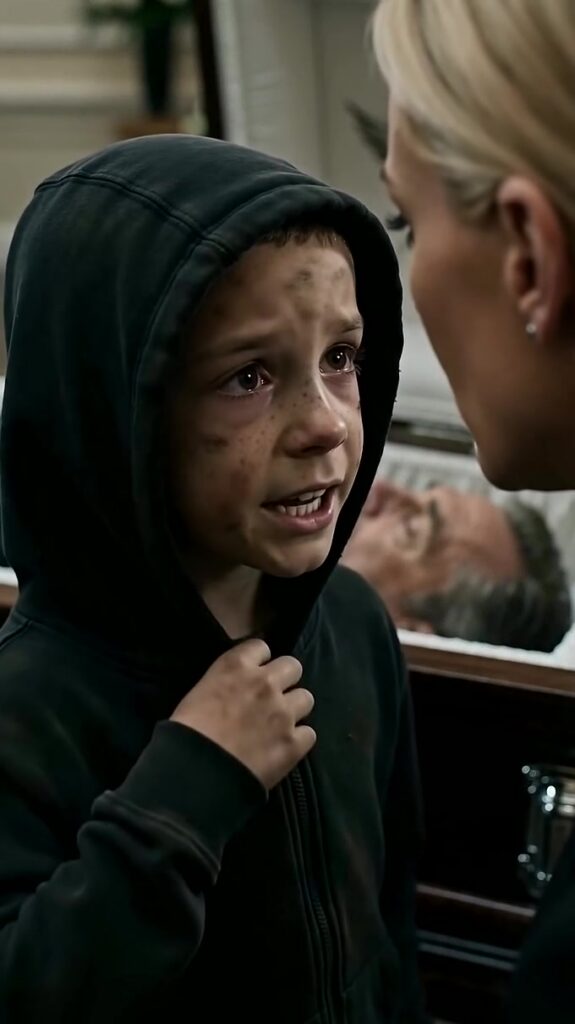
The boy didn’t move while the crying was loud. He stood near the back of the chapel like a shadow that had gotten lost on its way to somewhere else, half-hidden behind a fake ficus and a row of glossy programs. He looked like he’d walked in from a different world—black hoodie too big in the shoulders, jeans torn at the knees, sneakers with the kind of grime that doesn’t come off even when you try. His face was smudged, like he’d wiped it with the sleeve of his own grief and only made it worse.
Up front, everything was polished into perfection. White flowers arranged so carefully they didn’t look real. Brass candle stands that caught the light. People in expensive black clothes that fit like they’d been made for a single purpose. There were handshakes and murmured condolences and that soft, breathy sound people make when they want everyone to know they’re holding it together while also not holding it together at all.
The elegant widow stood nearest the open casket. She didn’t sit. She kept her back straight and her chin slightly lifted like posture could stop your heart from caving in. One hand kept drifting up to the necklace on her throat, fingers pressing at the pendant there like she could anchor herself by touching something solid. Her eyes were red but dry now, the worst of the sobbing already spent in private rooms and closed doors.
The boy watched the crowd like he was waiting for a bus. Not impatient—just exact. He waited until the last hug ended, until the last shaky breath quieted, until the chapel’s noise thinned into sniffles and shuffling shoes. When the room finally settled into that tired hush that comes after too many tears, he stepped forward.
No one stopped him at first. Maybe they assumed he belonged to someone. Maybe nobody wanted to be the person who told a kid he didn’t have the right to walk up to the dead.
He moved down the aisle in small, careful steps, eyes fixed on the casket. The man inside looked peaceful in a way that felt unfair. His suit was tailored, his hands folded neatly, his hair combed as if he’d be late for a meeting if he didn’t get up soon. If the boy had known him only like this—clean, still, perfectly arranged—he might’ve believed the man had always been like that.
But the boy knew other versions. A man in a thrift-store coat, laughing too loud in a diner booth. A man kneeling to tie a shoelace in the middle of a sidewalk. A man smelling faintly of motor oil and peppermint gum, slipping a folded card into a small hand like it was contraband.
When the boy reached the casket, he stopped. He didn’t touch the edge. He didn’t lean in. His hands trembled anyway, fingers curled into fists that were trying very hard to act like hands.
Then he looked up at the widow.
“He told me,” the boy said. His voice was steady in the way a too-tight knot is steady—holding because it has to. “If anything ever happened to him… you would keep your promise.”
The widow blinked, thrown off not just by the words but by the fact that they’d been aimed at her. She turned her head, scanning his face as if she might find a name tag somewhere between the dirt smudges and the too-old bruise fading along his jaw.
“Take care of you?” Her voice cracked and she hated that it did. She straightened again, forcing control. “Who are you?”
The boy swallowed. His throat bobbed like the question had hands and had grabbed him. He glanced down at the man in the casket, like he needed permission.
“He came every birthday,” he said quietly. “He said he couldn’t stay. But he never forgot.”
That sentence hit the widow like a cold towel. Her fingers froze on her necklace. Her expression shifted—first confusion, then the quick, sharp math of realization trying to solve a problem that shouldn’t exist.
“That’s not…” she started, but the words fell apart before they reached the end. She looked around, as if someone else might explain this. But the room was watching now. People had that look: polite curiosity draped over discomfort. A few moved closer, pretending they were simply adjusting their view of the flowers.
The boy’s hands shook harder. He seemed annoyed at them for it, as if his own body was being rude.
“He said you’d understand when you saw it,” the boy said.
He reached under his hoodie, into the collar where his shirt met his neck. For a second, the widow tensed like he might pull out something dangerous. But what he brought out was thin and silver: a chain that caught the light with a small, stubborn shine. Hanging from it was half of a heart-shaped pendant—broken down the center like someone had snapped it clean.
The chapel’s air changed. The quiet became heavier, like the walls had leaned in to listen.
The widow’s hand flew to her own necklace, not gracefully, not elegantly—just fast. Her fingers fumbled at the pendant she’d been touching all day without thinking, the one she wore like a habit. She drew it out from beneath her black dress, and there it was: the other half of the heart.
It didn’t match in a cute, novelty way. It matched in the brutal way of things that were once whole and were not anymore. The break line was jagged but exact. The small engraving on each half—faint now—formed a phrase when imagined together.
The widow stared at it like it had just spoken.
“No,” she whispered, and the word sounded like it came from somewhere deep and old.
The boy’s eyes went glossy. His jaw clenched. He refused to let the tears fall, like crying was a luxury he couldn’t afford in this room full of people with cleaner hands and softer coats.
“He said you still had the other side,” he murmured. “He said you kept it even when you were mad.”
The widow’s breathing turned shallow. Her gaze snapped from the pendant to the boy’s face. She studied him now the way you study a photograph you’ve been avoiding for years. The shape of his eyebrows. The tilt of his chin. The way his ears stuck out just slightly, the same way the man in the casket’s did when he smiled.
Her lips parted, searching for a sentence that wouldn’t destroy the entire room.
“Where is your mother?” she asked, and there was something raw in her tone—less accusation, more pleading. Like if the boy said the wrong name, the truth might still be pushed back into a box.
The boy hesitated. “She’s not… around,” he said carefully. “It’s been me for a while.”
Someone in the second row made a small sound, like their throat had tried to swallow the moment and couldn’t.
The widow’s eyes flicked to the casket again, to the man’s folded hands. Her voice dropped to almost nothing. “He never told me,” she said, not to the boy exactly, but to the space between them.
“He tried,” the boy said. “I think he tried a bunch of times.” He took a breath that wobbled and steadied again. “He said you were the only person he ever promised something to and meant it.”
The widow’s fingers tightened around her half of the pendant until her knuckles went pale. Her polished composure finally slipped. For the first time that day, her face looked less like a statue and more like a person being asked to survive an impossible story.
The boy lifted his chin, forcing the words out like they were heavy. “He was my father too.”
The room didn’t exactly go silent—silence implies emptiness. This was fuller than sound. This was every person holding their breath at once. A man near the aisle cleared his throat and stopped halfway, embarrassed by the noise he’d made.
The widow snapped her eyes toward the dead man as if he might sit up and correct the situation, as if he might say, Sorry, I meant to mention that. But he stayed still, perfect and unreachable in the expensive suit she’d picked out yesterday with shaking hands.
She looked back at the boy. The anger came first, quick and bright, because anger is easier than grief with edges. “Why didn’t he bring you here?” she hissed softly. “Why didn’t he tell me you existed?”
“He said he messed up,” the boy replied. “He said he made a decision that hurt everyone and he couldn’t undo it. And then every year he’d show up with a cupcake or a card and act like that was… something.” The boy’s voice trembled for the first time. “But he kept the chain. He told me it was proof that at one point he had something real.”
The widow’s eyes shimmered. She blinked hard, trying to keep the tears from spilling. She didn’t entirely succeed. One tear slid down, slow and obvious, and she didn’t wipe it away.
“What promise?” she asked, voice hoarse.
The boy glanced around the chapel. All the strangers. All the flowers. All the money in the room that couldn’t buy back a single missed day. “He said you promised that if anything happened to him,” the boy said, “you’d make sure I didn’t end up lost in the system. He said you promised because you knew what it was like to be alone.”
The widow flinched, as if he’d read a page from her life she’d torn out and hidden. She inhaled slowly, then exhaled like she was letting go of something she’d held for years—some old pride, some old plan.
“What’s your name?” she asked.
“Eli,” he said. “Eli Carter.” He paused, then added, quieter: “He gave me his last name. Not because it fixed anything. Just… because he wanted me to have something that sounded like I belonged somewhere.”
The widow repeated it under her breath, testing the weight of it. Then she looked down at the two halves of the heart pendant—his in his fist, hers pressed to her throat.
She stepped closer to the casket and, with a tenderness that surprised even her, reached out and touched the man’s folded hand. “You absolute idiot,” she whispered, not cruelly. Almost lovingly. Then she turned to Eli.
Her eyes were still wet. Her posture was still straight. But something in her had changed, like a door had opened and refused to close again.
“Come with me,” she said, and the words weren’t a command. They were an offer that cost her everything and meant it anyway. “We’ll talk somewhere quieter. And… and you’re not going back out there alone.”
Eli’s shoulders sagged, just a little, like he’d been carrying a backpack full of rocks and someone had finally taken the straps. He nodded once, sharply, like if he nodded too slowly he’d start crying and never stop.
As they walked away from the casket together, the widow’s hand hovered near his back—not touching, not yet, just there. A bridge under construction. In the hush behind them, the broken heart pendants swung gently on their chains, two halves moving in the same rhythm for the first time in years.