The storm hit the mansion gates like it wanted to tear them down. Not the polite kind of rain that makes the city smell clean for ten minutes—this was the kind that punched sideways, rattled iron, and made the hedges look like they were trying to crawl away from the wind. The gates of Hawthorne Manor stood there anyway, black and sharp and expensive, as if money could out-stubborn weather.
The driveway beyond them glowed warm under hidden lights. A line of cars eased up like shiny beetles: long hoods, tinted windows, headlights sliding across wet stone. Guests spilled out in designer coats and brave little smiles, lifting umbrellas that immediately flipped inside out. They hurried toward the double doors, laughing too loudly, pretending the storm was charming rather than violent.
At the gate, a kid stood still.
He wasn’t more than nine or ten, thin as a fence rail, with wet hair stuck to his forehead and a jacket that had once been blue, maybe, before dirt and time got involved. He hugged a small wooden box to his chest like it was a breathing thing. Rain bounced off the lid and ran down his arms, darkening his sleeves all the way to his fingers. He didn’t look up at the cars. He didn’t look at the mansion. He looked at the gate, like he’d made a deal with it.
“Hey!” a voice snapped, sharp enough to cut through the weather.
Cal Brenner—head of security, ex-military, known for making grown men apologize to him—strode out from the guard booth with a flashlight in one hand and annoyance in every step. His suit was under a rain slicker, but even that looked expensive. He stopped a few feet from the boy, eyes narrowing.
“You can’t be here,” Cal said, like the kid had personally ordered the storm as cover for something shady.
The boy’s grip tightened on the box. “She told me to come,” he said. His voice was small, but it didn’t wobble.
Cal blew out a breath, already done with this. “Who’s ‘she’? Move along before you get yourself hurt.”
The kid didn’t move. His face was streaked with clean lines where rain carved paths through the grime on his cheeks. He looked like he’d walked a long way and didn’t have the option of walking back.
Cal reached for his arm. Not gently.
It happened fast: a shove meant to get the kid away from the gate, the kid’s feet slipping on slick stone, and the wooden box popping loose like it had been knocked out of his ribs.
It hit the iron bars with a sick, hollow crack that turned heads all the way up the driveway. For half a heartbeat the storm seemed to pause just to listen.
The lid split. Wooden pieces skittered across the wet path. Something small slid out between them and landed with a soft clink: a ring, old and heavy-looking, tangled with a ribbon that had once been red but now looked like rust. Rain hit the ribbon and the stain spread darker.
One of the arriving guests—a woman with diamonds at her throat—made a sound like she’d swallowed ice. A few other people slowed, drawn by that weird gravity of a moment that isn’t supposed to happen at a fancy event.
Cal frowned, confused despite himself, and bent as if he could just scoop the situation back into order. “What is this?” he muttered.
“Don’t,” the boy said quickly, almost a warning.
But Cal’s fingers hovered anyway—until another presence entered the circle of rain.
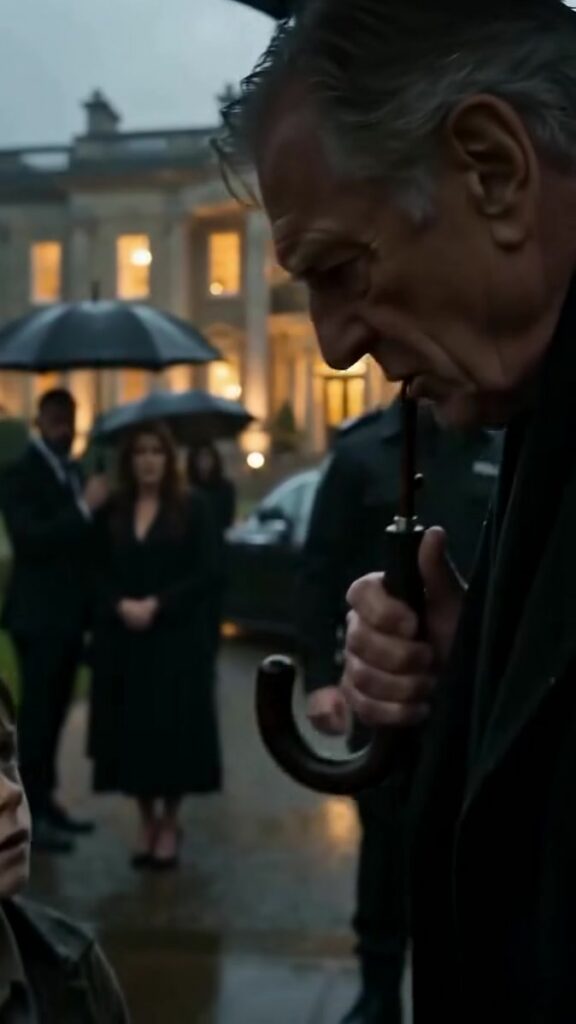
An umbrella appeared first, black and wide. Under it walked a tall older man with silver hair combed neatly back, his expression carved from the same stone as the mansion. He wore a dark coat that fell perfectly on his shoulders, like it had never known wrinkles. People stepped aside without being asked.
Graham Hawthorne.
The owner of the manor, the name on half the buildings in the county, the man whose parties were written up in glossy magazines and whose temper was rumored to shut down boardrooms. He looked irritated in the way powerful people get when inconvenienced by anything that can’t be fired.
Then he saw the ring.
His face changed so suddenly it was almost scary. The annoyance vanished, replaced by something raw, like a door opening onto a room he’d kept locked for decades.
He crouched with more effort than grace, eyes fixed on the crest cut into the metal—a hawk with spread wings, a tiny crack along one side like a scar. His lips parted, but no sound came out at first.
Cal straightened, startled. “Mr. Hawthorne, I was just—this kid—”
Graham lifted a hand without looking at him. Cal stopped talking mid-sentence like the air had been switched off.
Graham’s gaze moved from the ring to the boy. “Who sent you?” he asked. His voice wasn’t loud, but it carried.
The boy swallowed. His free hand—shaking now that the box wasn’t giving him something to hold—reached into the inside pocket of his soaked jacket. He pulled out a folded letter, edges soggy and ink threatened by the rain. He held it out with both hands, as careful as if it might crumble.
“My mom,” he said. “She said… you’d understand.”
Thunder rolled so close it made the iron gate hum.
Graham stepped forward, umbrella tilting, letting rain hit his shoulders. His fingers closed around the letter, and for the first time anyone there saw his hands tremble.
“Where is she?” he asked, softer now, like he was afraid of the answer.
The boy’s eyes shone with water that wasn’t all rain. He forced his chin up. “Gone,” he said.
The word landed hard. Graham’s breath caught, and for a second the old man looked older than the manor, older than the storm itself. He blinked, once, as if that might change what he’d heard.
He unfolded the letter slowly, sheltering it with his body. His eyes moved across the page. Whatever was written there pulled his face through a whole series of emotions—shock, anger, grief, and something like regret that didn’t know where to go.
He stopped halfway through and looked up. “What did she call you?” he asked, voice rough around the edges like it hadn’t been used for tenderness in a long time.
The boy drew a breath that shook. He was drenched, freezing, and still standing like the gate couldn’t intimidate him anymore.
“Eli,” he said. Then, because he understood he had to say the whole thing, he added, “Eli Hawthorne. She said it’s mine.”
Behind them, the party lights glowed warm and careless. Guests stood frozen under umbrellas, their whispers swallowed by wind. Cal looked like his brain was trying to reboot.
Graham stared at the child as if the storm had delivered him like a verdict. His umbrella slipped from his fingers and hit the stone with a wet slap. Rain soaked his hair, ran down his cheeks, and nobody could tell what was water and what wasn’t.
“My… grandson?” he said, the words barely there.
Eli nodded once, tiny and steady. “She told me to give you the ring. She said you’d know it. She said… you’d have to listen this time.”
Graham’s throat worked. He glanced at the ring, then at the broken box, then back to Eli—like he was piecing together a life he’d refused to acknowledge.
Cal cleared his throat, cautiously. “Sir, I can escort the boy inside. Get him dry. Call—”
“No,” Graham said, and the single word carried enough force to shut down the storm if it could. He turned fully toward Eli and, with a hesitation that felt almost human, held out his hand.
“Come in,” he said. “Not as a guest. As family.”
Eli looked at that hand like it was a bridge made of glass. Then he placed his cold fingers in Graham’s palm.
The gates didn’t open themselves, but Cal moved like he’d been given a new purpose and swung them wide. The iron groaned, the way old things do when they’re asked to change.
As they walked up the glowing driveway, rain chased them, wind snapped at coats, and the mansion loomed ahead—huge, expensive, and suddenly not as untouchable as it had been five minutes ago. Somewhere inside, music played for people who had no idea a storm had just rewritten the family story at the front gate.
Eli held his head up. Graham didn’t let go of his hand.
And behind them, the broken wooden box lay in the rain, emptied of its secret, like it had finally done the one job it was built for.