Rain hammered the roof of the biker bar so hard it almost drowned out the jukebox. Almost. The old place—Greasy’s Roadhouse, if you believed the bent neon—shivered with every gust, like it was remembering storms from a hundred years ago and deciding it hated this one most of all.
Inside, the air was hot and thick with fried food, wet leather, and the kind of cigarette smell that got into the wood and never left. Somebody had fed the jukebox three dollars’ worth of angry country, and the song was trying its best to fight the weather.
The men at the bar weren’t exactly listening. They weren’t exactly talking, either. They were doing that biker thing where conversation is mostly grunts and glances and the occasional laugh that sounds like a cough. A few patches showed in the dim light: BLACKHOLLOW MC. Different roles. Different stories. Same hard edges.
At the center table, in the one spot nobody sat unless invited, the President watched the front doors like he could see through them. His name was Wes, but nobody who wasn’t family called him that. Up close he looked like a brick wall that had grown a beard. He wasn’t yelling, wasn’t acting like he owned the room. He didn’t have to. The room had agreed a long time ago.
Then the double doors opened.
The rain came with them, cold and sharp, and for a second it was like the storm had stepped inside to point at everyone and say, Surprise.
A tiny girl stood in the doorway, barefoot, soaked through in a white nightgown so big it hung off her shoulders. Her hair was plastered to her cheeks. Her knees were red from cold. She shook so hard her teeth clicked together like a wind chime.
The bar went silent in a way that wasn’t dramatic. It was worse than dramatic. It was instant and complete, like someone had unplugged the room.
Wes turned.
He didn’t rush. He didn’t bark orders. He just pushed his chair back, slow enough not to spook her, and crossed the floor with the kind of careful control that made people move out of his path without thinking.
The girl flinched anyway. Her body didn’t seem to believe in safe approaches.
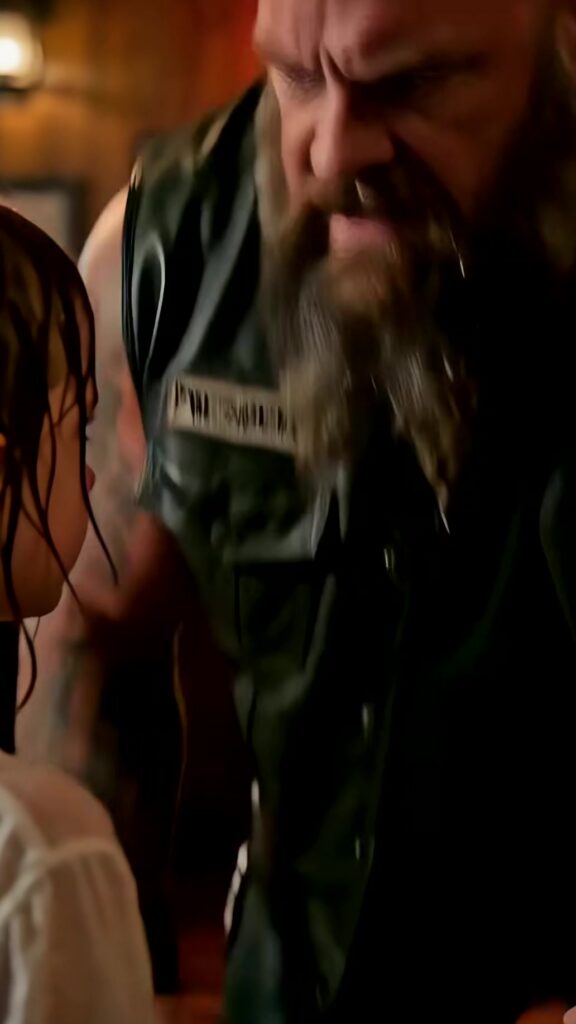
Wes stopped a couple feet away and crouched, lowering himself until his eyes were level with hers. His voice came out gentle, like he was borrowing it from someone else.
“Hey,” he said. “You lost?”
She tried to answer. Her mouth opened. Nothing came out. Her eyes darted behind him, taking in the vests, the boots, the dark faces, and deciding she might have made a terrible mistake.
Wes noticed what she was trying to hide by pulling her nightgown collar up with both fists. Purple fingerprints, fresh enough to look wet, ringed her throat. There were smaller marks too, like a hand had grabbed her and not cared what it broke.
Something shifted across Wes’s face. Not louder. Not wilder. Just darker, the way a sky changes before hail.
“Kid,” he said softly. “Who did that?”
The girl’s eyes filled. Rainwater ran down her lashes and mixed with tears like they were the same thing. She shook her head too hard, like she was trying to shake the words off her tongue.
“He said not to tell,” she whispered, barely loud enough to beat the rain.
Behind Wes, the club went still in that dangerous kind of quiet where violence is already standing up, just waiting for a name.
Wes took off his leather jacket and draped it around her shoulders. It swallowed her. The patch on the back—BLACKHOLLOW—looked huge against her small body, like armor she didn’t understand she’d just been given.
“You’re safe here,” he said. “What’s your name?”
She stared at him for a second like names were risky. Then, carefully: “Lena.”
“Lena,” Wes repeated, holding the syllables steady. “Okay. You did real good coming here.”
One of the older bikers at the bar, a grizzled guy everybody called Doc because he used to be a combat medic, slid off his stool and approached with his hands open. He kept his voice calm, like he was talking to a stray dog that might bolt.
“Let me see your feet, sweetheart,” Doc said. “You’re gonna get frostbite out there.”
Lena glanced at Wes for permission. Wes nodded once. Doc knelt, gently lifting one tiny foot. Mud clung to her toes. There were cuts, and one toenail had bent back. Doc’s jaw tightened, but he didn’t say anything yet. He didn’t want the first words she heard to be anger.
Wes looked up, eyes sweeping the room. “Nobody scares her,” he said, quiet but sharp. “You hear me?”
Every head dipped. Even the biggest guys suddenly looked like they’d shrunk a little.
Wes leaned closer to Lena. “Where’d you come from?”
Her lip trembled. “The white… the white house on wheels.”
“An RV?” Wes asked.
She nodded. “He parked by the trees. He… he said we were camping. But it’s not… it’s not fun.”
Wes didn’t ask who “we” was. Not yet. His eyes flicked to Doc, who gave a small shake of his head—no other kids’ marks that he could see, but also too early to know.
Wes stood, very slow. He didn’t take his eyes off Lena for long, but he looked over his shoulder at his club. “Start the bikes,” he said.
It wasn’t loud. It didn’t need to be.
Chairs scraped. Boots thudded. Somebody killed the jukebox mid-chorus, the sudden silence making the rain feel even louder. Men grabbed helmets and gloves. The front of the bar became a controlled storm of movement.
Lena backed up instinctively, bumping the doorframe. Wes immediately crouched again and placed his big hand flat against his own chest, like he was reminding himself to breathe.
“Hey,” he said. “You’re coming with me, okay? You can hold on as tight as you want. Nobody’s gonna let you fall.”
She stared at his hand, then at his face. Something tiny and broken flickered in her eyes: the first sign she wanted to believe him.
Outside, the rain hit like thrown gravel. Headlights carved pale tunnels through the dark. The parking lot was a puddled mess, and the bikes looked like black animals eager to run.
Wes lifted Lena like she weighed nothing, keeping her wrapped in his jacket. She made a small noise—more surprise than fear—then clutched his vest with both hands like it was the only solid thing left in the world.
He set her carefully in front of him on his motorcycle, tucking her feet in where they wouldn’t slip. Doc handed over a spare helmet, way too big, and stuffed it with a bar towel so it wouldn’t swallow her whole. Lena’s eyes went wide, but she didn’t fight it.
Wes leaned in so she could hear him through the rain. “When I tap your leg twice, hold on tight. That means we’re moving. You got it?”
She nodded, jaw clenched.
Wes tapped twice. Lena’s arms locked around him like a seatbelt made of bones and bravery.
The pack rolled out in a roar that made the storm feel smaller. Mud and water fanned behind them. Red taillights blurred into a single ribbon in Wes’s mirrors, a line of men who didn’t talk much but knew exactly what to do when something innocent wandered into their den bleeding.
They hit the back road, the one that ran past the quarry and down toward the tree line. Wes remembered seeing a white RV earlier that week, parked like it belonged there. He’d clocked it, filed it away, and then forgotten about it because the world was full of harmless-looking things.
Now he saw it again through the rain, sitting alone with its lights off, like it was trying to pretend it wasn’t real.
Wes slowed just enough to signal the others. Two bikes swung wide to block the road behind. Another pair flanked the tree line. The rest rolled in silent formation, engines idling low, like predators controlling their breath.
Inside the RV, a man moved near the window. His face appeared for half a second—sweaty, pale, eyes darting like trapped rats.
He saw the headlights.
He saw the vests.
The color drained out of him so fast it was almost impressive.
Wes felt Lena’s grip tighten. Her small hands shook against his stomach like she could feel what was about to happen.
He reached down and covered one of her hands with his glove. Not a promise of gentle outcomes—he couldn’t offer that. A promise of proximity. A promise she wouldn’t be alone again.
“Stay right here with Doc,” Wes said, nodding toward the old medic who was already dismounting and moving to take her. “Close your eyes if you want. You don’t have to see anything.”
Lena hesitated, then allowed Doc to lift her off the bike. She clung to Wes’s jacket even as she left him, like she didn’t want to give it back. Wes let her keep it.
He turned toward the RV.
The rain didn’t let up. The wind shoved at his shoulders. The world tried to be chaos.
But Blackhollow moved like a machine, boots sinking in mud, hands steady, faces set. Not because they loved violence. Because sometimes violence showed up first, and you didn’t get to be polite about sending it away.
Wes stepped to the RV door and knocked once—soft, almost courteous.
Then he spoke, voice low and final, carried through the storm like a gavel.
“Open up,” he said. “We’re taking the kid.”
Inside, something crashed.
Wes didn’t flinch. Behind him, the club waited in that same deadly silence, the kind that comes right before the world learns what happens when a monster picks the wrong child in the wrong town on the wrong night.
And somewhere behind Wes’s shoulder, wrapped in leather too big for her, Lena watched with the smallest spark of hope trying not to go out.