The hotel room was supposed to feel perfect. That was the whole point of paying extra for the “romance package,” as if a hotel could manufacture feelings the way it manufactured tiny soaps and fluffy towels.
Rose petals were scattered across the cream-colored bed like someone had tried to recreate a movie scene from memory. A champagne bucket slumped in the corner, melting quietly and making a little puddle that crept toward the baseboard. Two warm lamps threw honey-colored light across gold wallpaper and burgundy curtains, turning everything softer than it had any right to be. Even the air smelled expensive, like vanilla pretending not to be nervous.
Mara stood in the doorway for a second too long, suitcase handle still in her fist, and tried to let herself feel happy. She’d spent the entire cab ride rehearsing what she’d say when Jonas walked in. Something light, something funny. Something that didn’t sound like Please don’t change your mind about me.
Jonas had been in the lobby when she texted she was upstairs, so he arrived fast. Too fast, like he’d been waiting around the corner. He knocked once, then again, and when she opened the door he looked the way he always did—put together in that effortless way that made her feel like she should start using moisturizer on her elbows.
“Wow,” he said, taking in the room, and Mara felt an actual spark of pride, like she’d built it herself with her bare hands. “You went all in.”
“It’s cheesy,” she admitted, laughing, “but I figured… why not?”
“Not cheesy,” he said. “Perfect.”
That word landed warm in her chest. Perfect. Like the room. Like the night. Like the version of herself that believed things could go smoothly for once.
He set a garment bag on the chair and crossed to her, hands finding her waist as if they already belonged there. The kiss was gentle, unhurried. Mara let her suitcase drop open on the luggage bench, gray shell yawning wide like an animal. She’d packed in a rush, tossing clothes in without folding them, making sure to include the one thing she never left behind: a little gold pendant on a thin chain.
She didn’t wear it often. It wasn’t really her style, and it carried too much weight for something so small. But it was the only thing her mother had insisted she keep close, the only object she’d ever treated like it was alive.
“Give me two minutes,” Jonas said, stepping back. “I’m going to freshen up.”
“Sure,” Mara said, already moving to the bed to shake out a dress. The rose petals stuck to her palm like confetti that refused to quit.
Jonas disappeared into the bathroom. Mara heard the faucet run, heard him humming—some tune she couldn’t place. The whole moment was almost too pretty. She could feel her nerves trying to sabotage it, could feel her brain reaching for the nearest worry the way a tongue worries at a loose tooth.
Then Jonas came out.
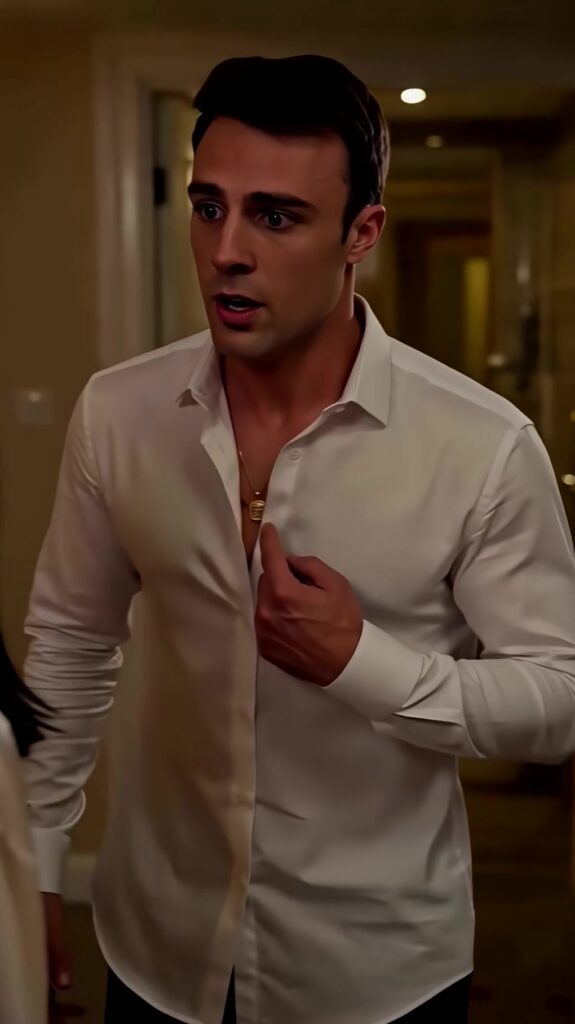
He’d taken off his jacket and loosened his tie, and the top buttons of his white shirt were open. It made him look younger and less corporate, like a version of him she hadn’t met yet. He walked toward her with a grin, and Mara smiled back automatically—until her eyes snagged on something against his chest.
Two things, actually.
A scar, dark and old, crossing the left side of his ribs like a crooked brushstroke. And just below it, on a chain tucked under his collar, a small gold pendant that flashed as he moved.
Mara’s smile shut off like a light.
She sat down hard on the edge of the bed, robe belt slipping loose, her skin turning cold in a room that had been warm seconds before. Her breath didn’t exactly stop; it just started coming in tiny, useless bites.
Jonas slowed. “What’s wrong?”
Mara’s eyes flicked from his chest to her open suitcase. The same pendant—same shape, same tiny notch on one side—lay on top of her clothes where she’d dropped it earlier while changing. Like a dare. Like proof.
“Oh my God,” she whispered. It came out too quiet, like someone else’s voice. “What is that?”
Jonas looked down, then up, and panic rose in his face so quickly it almost made him look like a kid caught sneaking cookies. He lifted both hands, palms out. “Please,” he said. “Let me explain.”
Mara’s head started shaking before she gave it permission. “No. No, no.”
She backed across the bed, rose petals sticking to her knees, as if the air around him had suddenly become sharp. Jonas took a small step forward.
“Please don’t do this,” he said, voice cracking on the last word.
That made everything worse. Mara scrambled to the suitcase, fingers shaking so badly she could barely grab her clothes. She started shoving them inside without folding anything, without even checking what she was grabbing. The zipper caught and scraped. Her hands fumbled like they didn’t belong to her.
Jonas came closer. “Don’t run.”
Mara spun toward him, tears already hot in her eyes. “Who are you?”
The question hit him like a slap. He stopped so abruptly his shoulders jerked. For a second all he could do was stare at her.
Then his gaze dropped to the bed.
Something had slid loose from her messy pile of clothes—a faded baby photo she kept tucked inside the inner pocket of her wallet. The picture slipped out and landed between them on the coverlet, half-covered in petals.
Jonas stared at it like it was a ghost.
“Where did you get that?” he asked, and the panic in his face changed into something deeper. Something broken open.
Mara swallowed, throat aching. “My mother gave it to me before she died.” She wiped at her cheeks with the back of her hand and failed; the tears kept coming. “She said it was the only photo she had left.”
The room went dead quiet except for the faint hiss of melting ice in the champagne bucket.
Jonas’s eyes moved from the baby photo to her face, then to the pendant in her suitcase, then back to the scar on his chest as if he could read it like a map. His jaw clenched. His voice came out low, almost horrified.
“Then you’re the girl from the fire.”
Mara laughed once, a sharp little sound that didn’t match her face. “What fire? My mother never—”
“The apartment building on Lark Street,” Jonas said quickly, like he was afraid if he paused he’d lose the nerve. “Ten years ago. I was… I was there. I was sixteen. My dad was a firefighter. He dragged me along because I wouldn’t stay home, and he thought it would scare me straight.” Jonas swallowed, Adam’s apple bobbing. “It didn’t. It just—” He touched the scar, fingers trembling. “It just branded me.”
Mara stared at him, brain sliding around the words like they were on ice. Lark Street. She knew that name. It lived somewhere deep in her chest like a bruise that never fully healed.
“I don’t remember,” she whispered. “I was little.”
Jonas nodded, eyes shining. “You were maybe five. There was smoke everywhere, and people were screaming and the stairwell was black. I—” He exhaled hard, like breathing hurt. “I heard someone crying behind a door. Everybody was telling me to get out, but I couldn’t. I just couldn’t leave that sound.”
Mara’s fingers found the pendant in her suitcase without looking. Cold metal, familiar weight.
Jonas stepped closer, slow, cautious, like approaching a wild animal. “I got the door open. You were in there with a woman. Not your mom. Someone older. She had you wrapped in a blanket and she kept saying, ‘Take her, take her, take her.’” His eyes flicked down to the baby photo. “That photo… that’s you in the blanket. Same one.”
Mara’s throat tightened. “My mother always said I was adopted,” she managed. “She said… she said she found me when I needed her.”
“She did,” Jonas said softly. “But the fire is how. That night, I grabbed you. And when we made it down, my dad was yelling at me like he’d never yelled before. He thought I was dead.” Jonas’s lips pressed together. “The woman who gave you to me—she shoved something into my hand. This pendant.” He lifted his chain so it caught the light. “She said it was yours, that it would help you remember where you came from someday.”
Mara’s mind stuttered. “Then why do I have one?”
Jonas’s eyes went wet. “Because after the ambulances and the chaos, when I finally looked down, I realized I’d grabbed two chains by accident. They were tangled together. I… I kept one.” He shook his head, disgusted with himself. “I told myself I’d find you and give it back. I told myself I’d do the right thing once everything calmed down. Then life happened. College, jobs, moving cities. It became this… secret weight I carried around.”
Mara clutched her pendant. “And you didn’t recognize me?”
Jonas let out a helpless laugh, full of pain. “I didn’t know your name. I never saw you again. You were a kid with soot on your cheeks. How would I—” He stopped, eyes widening as if the final piece clicked into place. “Until you told me your mother’s name last month. Evelyn.” He said it like it burned. “That was the woman who adopted you. She was the one who came forward later and said she’d take you, that she’d lost her own daughter years before.”
Mara’s knees went weak. She sank onto the bed, petals shifting under her. “My mom never told me any of this.”
“Maybe she didn’t want you haunted,” Jonas said. “Maybe she wanted you to be… just you.”
Mara stared at him. At the scar. At the pendant. At the face of a man she’d been falling for, who suddenly felt like a stranger and a mirror at the same time. “So why are you here?” she asked, voice small. “Why—why date me?”
Jonas’s eyes held hers. “Because I didn’t know,” he said. “Not at first. I swear. When we met at that stupid networking thing, I just thought you were funny and sharp and kind. Then you laughed at my terrible joke and I thought, okay, I’m doomed.”
Mara’s breath hitched, a tiny, unwilling smile trying to form and failing.
Jonas continued, quieter. “When you said Evelyn was your mom, I went home and dug through every box I own. I found the old report my dad kept. I found a newspaper clipping. I found… this.” He tapped the pendant. “And I realized.”
“So this—” Mara gestured helplessly at the room, the petals, the champagne, the soft light that now felt like a spotlight. “—was what? A confession dinner?”
Jonas winced. “No. It was supposed to be a good night. I wanted it to be perfect because I thought I could tell you gently. I thought maybe we could talk and it wouldn’t feel like a trap.” He looked around, miserable. “Clearly I’m bad at planning.”
Mara hugged the pendant in her fist like it could anchor her. Her whole life had been built on a story her mother told with careful gaps, and now those gaps were filling in so fast she could barely keep up.
She looked down at the baby photo, then up at Jonas. “The woman in the apartment,” she asked, voice shaking. “Was she… was she my real mother?”
Jonas’s face tightened. He took a breath like it hurt to take. “I don’t know,” he admitted. “I never found out. My dad tried. The records were a mess. The building owner disappeared. A lot of people didn’t make it out.” He paused, eyes glossy. “But you did.”
Mara pressed her lips together and nodded once, because if she opened her mouth she might make a sound she couldn’t take back.
Jonas sat down slowly at the other edge of the bed, leaving space between them. He didn’t reach for her. He just sat, hands clasped, staring at the petals like they were fallen leaves.
“You can hate me,” he said. “You can leave. I won’t stop you.” He looked up, voice thin. “But I had to tell you the truth. And I had to give you this.”
He slid his pendant off over his head and held it out, chain dangling between his fingers.
Mara stared at it for a long time. Two matching pieces of a story she never asked for. Proof that fate had a weird sense of humor and absolutely no chill.
Finally, she reached out and took it—not as acceptance, not as forgiveness, but as something she’d earned the right to hold.
The room was still beautiful. The lighting was still warm. The champagne was still chilling itself into water in the corner.
But perfection had cracked, and what spilled out wasn’t romance.
It was history.
And Mara, holding two pendants in her hands, realized she wasn’t running from Jonas.
She was running toward the part of herself she’d never been allowed to meet.
“Okay,” she said, voice rough. “Start at the beginning. And don’t leave anything out.”