Maria was already halfway into the river when the man’s voice tore across the winter air, sharp enough to cut through the sleet. It wasn’t even a shout, not really. It was the kind of command you didn’t have to raise, because it had been practiced for years in kitchens and pews and at the edge of fields—quiet authority that expected the world to obey.
“Cross that water, Maria, and you’re done,” the voice carried. “Dead to this family.”
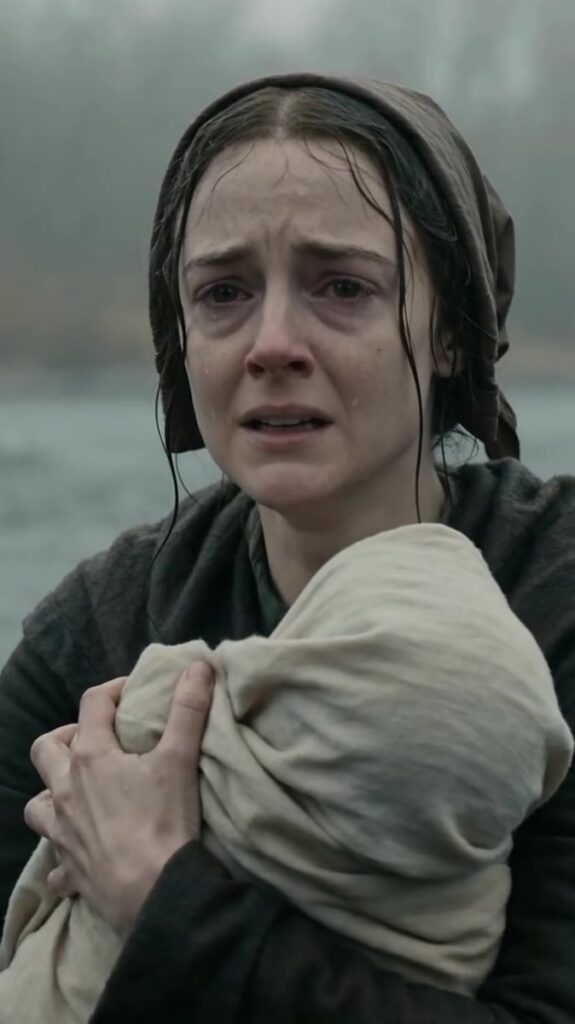
The river didn’t care. It kept grinding past her knees, black as iron and just as cold. The current tugged at her coat like a spiteful hand. She clamped her arms tighter around the bundle pressed to her chest, the baby wrapped in a pale cloth that was already damp at the edges. Every gust of winter wind found its way through her seams and down her spine.
Behind the voice stood the rest of them, bunched along the muddy bank like a row of statues. Gray sky, gray faces, all of it softened by the drizzle. They watched her the way people watch a cart crash in slow motion: horrified, but not enough to move.
Maria turned back, carefully, because one bad step could pull her under. Her breath came out in ragged clouds. Rain and tears blurred her sight until the family on the bank looked like a watercolor of disappointment.
The man who’d spoken—Uncle Dario, though he’d insisted she call him “sir” once she got old enough—stood just ahead of them. His coat was dry. His boots were clean. He didn’t have to feel the river sucking at him. He had rules instead, and rules were warmer than water.
“Come back,” he said, as if he were telling her to fetch another loaf from the pantry. “Hand the child over. We will do what needs doing.”
Maria’s mouth shook. Her voice didn’t. “Better I’m dead to you,” she said, tasting the words like metal, “than alive with you.”
A flinch moved through the line of faces behind him. Not sympathy—more like discomfort, like someone had opened a window in a room they’d filled with smoke on purpose. Someone—her aunt, maybe—took a half-step forward and then stopped when Dario’s hand rose.
Maria faced the river again. Her legs were numb now, her skin aching with cold. She forced herself to lift one foot, plant it, then the other, working against the pull. The baby gave a soft, fussy sound, a squeak more than a cry, and Maria bent her chin over the bundle like she could shelter it with her breath alone.
She had planned this in pieces: leave before dawn, wrap the baby tight, cut across the orchard, keep to the hedgerows until she reached the river. She hadn’t planned for them to find her at the bank. She hadn’t planned for Dario’s voice to land on her shoulders like a weight.
But she had planned to keep going anyway.
The river deepened until the water pressed against her waist, then higher, slapping at the bottom edge of the cloth. Her coat, heavy with water, tried to drag her down. She leaned forward, almost a bow, and took another step.
That’s when something inside the bundle caught the weak winter light.
A tiny flash. Quick. Wrong. Like a star had fallen into her arms.
Maria froze mid-step. The current shoved at her thighs. She tightened her grip and stared down, blinking away rain. The cloth had shifted. The baby’s fist—so small it hardly looked real—had wriggled free, and in that fist was something that didn’t belong there.
Metal. A thin chain. A pendant the size of a coin, glinting as it swung against the baby’s knuckles.
Maria’s stomach dropped so hard she thought she might throw up into the river.
She knew that pendant. Everyone in that town knew it. They pretended they didn’t, because knowing meant admitting there were other rules besides Dario’s.
The pendant was stamped with a crest: a tower and three waves beneath it. The mark of the River Guard—old as the stone bridge upstream, older than the church that Dario loved to sit in like he owned the altar. People whispered the Guard had vanished. People said the last captain died years ago. People said lots of things when they wanted to sleep at night.
Maria’s fingers, stiff with cold, fumbled under the edge of the cloth until she found the chain’s clasp. It was tucked into the wrap like someone had hidden it there deliberately. Her throat tightened. The baby blinked up at her with unfocused eyes, mouth opening in that searching way newborns had, like they were constantly trying to understand what world they’d arrived in.
“Where did you get this?” Maria whispered, as if the baby might answer.
On the bank, Dario’s certainty cracked so visibly it looked like a twitch. His gaze locked onto the glinting pendant. For the first time since Maria could remember, he didn’t look like the owner of the room. He looked like a man caught trespassing.
“Maria,” he called, and the word came out wrong—smaller, strained. “You bring that back. Do you hear me? Bring it back.”
Her family, the silent row, stirred like a flock startled by a gunshot. Her cousin Toma leaned forward, eyes wide. Her aunt clasped her hands to her mouth. Someone muttered a prayer that didn’t sound like the ones Dario liked.
Maria looked from the pendant to the shore. She watched Dario’s face shift through emotions he usually kept locked away: calculation, anger, and, underneath, something that made her skin prickle.
Fear.
That pendant wasn’t just jewelry. It was a key. A claim. A reminder that some promises were older than family names.
Maria’s heart hammered. She remembered, suddenly, a night two weeks earlier when she’d been half-asleep and heard voices downstairs. Dario talking to someone in the parlor. A man with a rough cough. Words drifting up the stairs: “There are people asking,” and, “It’s safer if it disappears,” and Dario’s cold reply, “Nothing disappears unless I say so.”
She’d chalked it up to business. Dario always had business. Later that same night, her mother had slipped into Maria’s room without knocking, sat on the edge of the bed, and placed a hand—shaking—on Maria’s cheek. “If you ever have to run,” her mother had whispered, staring at the floor like it might crack open, “run to the water.”
Maria hadn’t understood then. She understood now.
The baby made a tiny sound again, and Maria felt, through the cloth, the warmth that stubbornly remained in that little body. Warmth that deserved a life bigger than rules and locked doors and family meetings that ended in someone being sent away forever.
She lifted the pendant up, letting it swing where everyone could see. The chain looked delicate, but it held. It held like truth does: thin, but unbreakable once it’s in the open.
“So that’s what you’re afraid of,” Maria said softly. Her voice didn’t carry as far as Dario’s, but the river carried it for her, rushing and loud like it was on her side. “Not me crossing. Not the baby. This.”
Dario took a step toward the water. His boots sank into the mud. He didn’t like getting dirty. He did it anyway. “You don’t know what you’re holding,” he snapped, and then, as if he realized anger wasn’t working, his tone changed. “Maria. Listen. Give it to me, and I’ll make sure you’re… taken care of. You can come home. We can forget all this.”
Forget. That was his favorite word. Forget the girl sent to the convent and never spoken of again. Forget the cousin who’d “moved away” after asking too many questions. Forget the bruises explained as clumsiness.
Maria’s hands steadied around the baby. She felt something in herself click into place, like a latch releasing. The river pushed, impatient. It wanted her to decide.
She turned her head slightly, looking downstream where the far bank curved into reeds and bare willows. Past that was the road to the next town. Past that, if the stories were true, was a small guardhouse where an old bell still hung, and where people who had been wronged could make noise loud enough that even Dario couldn’t pretend not to hear.
“I know exactly what I’m holding,” Maria said.
The pendant gleamed again as she tucked it back into the cloth, this time not hidden—protected. She shifted the baby higher against her chest, pressed a kiss to the damp fabric, and took another step forward.
The water surged to her ribs. Cold punched the air from her lungs. She bit down hard and kept moving.
Behind her, the bank erupted with voices—her aunt crying her name, her cousin shouting, Dario barking orders like he could command the river to turn around. Someone splashed into the shallows, then stopped when the current grabbed at their ankles. The river didn’t negotiate. It only took.
Maria didn’t look back again. She couldn’t afford it. Every second was a bargain with the current, every step a decision she couldn’t undo.
Halfway across, her legs nearly buckled when she hit a deeper channel. The baby’s weight—small, but precious—pulled her off balance. Panic flashed hot in her chest. She waded sideways, feeling for the riverbed with her toes until she found a ridge of stones. Her boots scraped. She steadied, breath shaking, and whispered, “I’ve got you. I’ve got you.”
The far bank came closer, reeds shivering in the wind like they were waving her on. She shoved through the last stretch of current and stumbled onto the muddy edge, falling to her knees. The ground felt like a miracle: solid, ugly, real.
She didn’t rest. She crawled a few feet away from the water, behind a curtain of reeds, and finally dared to look back.
On the near bank, Dario stood at the edge, rain slicking his hair and darkening his shoulders. His family hovered behind him, unsure whether to cling to him or step away. Even from here, Maria could see it—the way the pendant’s existence had shifted the whole scene. It wasn’t just a girl running anymore. It was evidence moving out of his reach.
Maria tucked the baby closer and rose, trembling, soaked, and alive. The pendant pressed against her palm through the cloth like a promise with an edge.
“We’re going to the bell,” she told the baby, though maybe she was telling herself. “We’re going to make noise.”
Then she turned from the river, from the bank, from the cold faces and colder rules, and started walking toward whatever came next—each step squelching, each breath burning, each heartbeat saying the same stubborn thing: not today. Not us. Not anymore.