The birthday dinner looked flawless, in that way expensive things do when they’re trying to convince you the world is simple. The chandelier above the table didn’t just glow—it dripped warm light like honey. Crystal glasses stood in neat ranks, each one catching tiny moons of reflection. Candles marched down the middle of the table in glass sleeves, flames swaying like they were listening.
I’d been hired as the event coordinator, which meant I was the person everyone smiled at while quietly blaming me for anything that wasn’t perfect. The servers moved like practiced ghosts. The pianist in the corner played something soft and elegant, as if he’d been born wearing a bow tie. The guests—investors, lawyers, and spouses who wore their wealth like a second skin—laughed at jokes that weren’t particularly funny. They were all there for one reason: to celebrate Malcolm Ardis turning forty-five and to remind themselves they were part of the kind of life that didn’t have loose ends.
Malcolm sat at the center of the long table, his young wife, Eliana, beside him. She was maybe thirty, maybe less, with perfect hair that looked like it had never met humidity. She smiled the entire night, not because she was happy, exactly, but because the room demanded it. Malcolm’s grin was easy, the kind that could close deals and shut down questions. Every few minutes someone would clink a glass and toast his “vision,” his “generosity,” his “rise.”
Behind the scenes, the staff had been whispering about the cake. It was a towering, ridiculous thing—three tiers, dark chocolate with gold leaf, and sugar flowers that looked too real. Malcolm wanted it wheeled out at precisely nine-twelve. He’d insisted. “It’s sentimental,” he’d said, but his eyes didn’t soften when he said it. They narrowed, like he was daring the clock to disobey.
At nine-ten, I did my usual scan. Table aligned. Napkins folded. Gift table curated. Security posted, discreet and thick-necked, by the marble entryway. The mansion’s dining room had no real corners to hide in—everything was open, symmetrical, designed to showcase, not conceal.
Then something happened that made my stomach tilt in a way I recognized from weddings and galas: the room changed temperature without changing temperature. A hush tried to creep in, like a shadow looking for a place to land.
A small box hit the table.
It didn’t slide gently onto a placemat. It landed with a sharp wooden knock, decisive and wrong. Forks clinked. A wineglass trembled. Conversation collapsed as if someone had pulled the plug.
Every head turned toward the far end of the table where the sound had come from.
There, between two stunned guests, stood a kid who looked like he’d fallen out of a different world. He was filthy in the way children get when there’s no one left telling them to wash. His clothes were too thin, torn at the knees and cuffs. Bare feet on polished marble. His hands shook so hard I thought he might drop the box again.
I had no idea how he’d gotten past security. I looked toward the entryway and saw one of the guards staring as if his brain had just quit. The other guard was gone.
Malcolm rose slowly from his chair. His first expression was almost amused—like a magician seeing an unexpected rabbit. Then irritation tightened his mouth. Then the amusement drained away and his face cooled into something sharp enough to cut.
“Who brought him in here?” Malcolm asked. Not loud, but every syllable carried. The room waited, holding its breath like it might break something expensive.
The boy swallowed, eyes shining with the effort not to cry. He looked straight at Malcolm as if he’d taped Malcolm’s face inside his eyelids and practiced in the dark.
“My mom told me to give you this today,” he said.
Eliana’s smile faltered. It didn’t disappear right away; it slid off her face slowly, like it had to obey some contract first. She looked from the boy to Malcolm, searching for a script she hadn’t been given.
Malcolm reached for the box. His hand was steady, but his jaw wasn’t. He took it like he owned it and like taking it would end the interruption.
He opened the lid.
I couldn’t see what was inside from where I stood near the service door, but the room reacted before I could lean. A few guests made tiny, involuntary noises—the kind people make when they see something private out in public.
Malcolm stared down at whatever lay in the box. The color drained out of his face like someone opened a valve. His lips parted. His eyes, which had been so controlled all evening, suddenly looked younger and terrified, like a boy himself.
“I buried this…” he said, and it came out as if he wasn’t speaking to anyone but the thing in his hands.
Eliana turned her head fast. “Malcolm?” she whispered. Her voice had the thin edge of someone realizing she’s standing on a floor that isn’t as solid as she thought.
Malcolm didn’t answer her. He lifted the item out of the box, and the candles threw light over it.
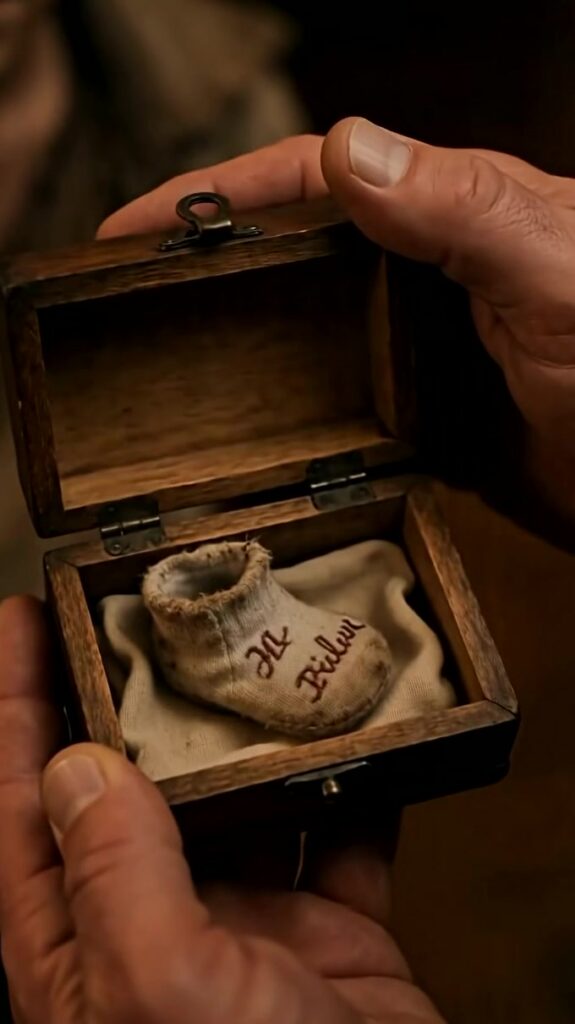
It was a baby shoe. Tiny, old, carefully kept. The leather was scuffed but loved, the stitches too precise to be accidental. Along the inside edge, thread had once been bright, now faded, forming initials.
M.A.
Malcolm’s fingers tightened, then loosened, as if the shoe burned and soothed him at the same time. He looked up at the boy.
“Where did you get it?” Malcolm asked. His voice was lower now, stripped of performance.
“My mom kept it under her bed,” the boy said. His hands finally stopped shaking, or maybe they were shaking and he just didn’t care anymore. “In a tin. With letters.”
The air in the room felt thick. Somewhere the pianist had stopped playing. No one told him to; he just knew. The kind of silence that followed wasn’t polite—it was predatory.
Malcolm swallowed hard. “Who is your mother?” he asked.
Eliana’s eyes widened as she watched him. Her fingers pressed into the white tablecloth, bunching it slightly, the only imperfect thing in the entire setup.
The boy’s lips trembled. He blinked quickly. When he spoke again, his voice was so small it barely crossed the table, but it cut through everyone anyway.
“She said you buried the shoe… but not the baby.”
Malcolm’s hand opened like it had lost its instructions. The shoe dropped softly back into the box. The sound wasn’t loud, but it made several people flinch.
“That’s not…” Eliana began, but she couldn’t finish the sentence because she didn’t know which version of Malcolm she was supposed to defend.
Malcolm looked at the boy as if he were a mirror held up at an angle Malcolm had avoided for decades. His throat worked. “Where is she?” he asked.
“She’s outside,” the boy said. “She didn’t want to come in. She said you’d try to make her disappear again.”
A few guests shifted in their seats, suddenly desperate to be anywhere else. Someone set their napkin down with careful, shaking fingers. I saw one woman glance at the exit like she was calculating how fast gossip traveled compared to money.
Malcolm took a step away from the table. The chair behind him scraped the floor, loud as a gunshot in the quiet. He looked toward the entryway, toward the hall that led out to the front steps and the driveway lit with garden lights.
Eliana stood, too, on instinct. “Malcolm, what is happening?” she asked. Her voice cracked on the last word.
He didn’t look at her. He looked at me, finally noticing I existed, like I was part of the house itself. “Mara,” he said—he remembered my name, which surprised me. “Get everyone out. Now.”
“Sir—” I started, because that was my job, to speak in solutions, but the word died when I saw his eyes. He wasn’t asking for event management. He was asking for damage control on a life.
The boy stayed where he was, planted on the marble like he’d grown there. He watched Malcolm the way you watch a door you’ve been told will open, even if you don’t know what’s behind it.
Malcolm walked toward the hall, faster now, leaving his own flawless birthday behind like it was a set he’d outgrown. The guests stayed frozen, too shocked to follow, too curious to look away. Eliana took one step after him, then stopped, hand pressed to her mouth as if she could hold reality inside.
I moved, finally, pushing into motion like a switch flipped. I gestured to the staff, murmured for the guards, tried to shepherd the room into a gentler kind of chaos. But as I did, I couldn’t stop staring at the box still sitting on the linen cloth, the tiny shoe inside like a punctuation mark at the end of a sentence Malcolm thought he’d erased.
Outside, through the tall windows, I saw a figure near the fountain—someone in a dark coat, standing very still under the garden lights, waiting as if she’d waited before and learned patience the hard way.
The dinner really had looked flawless.
It turned out flawless was just another word for carefully covered.