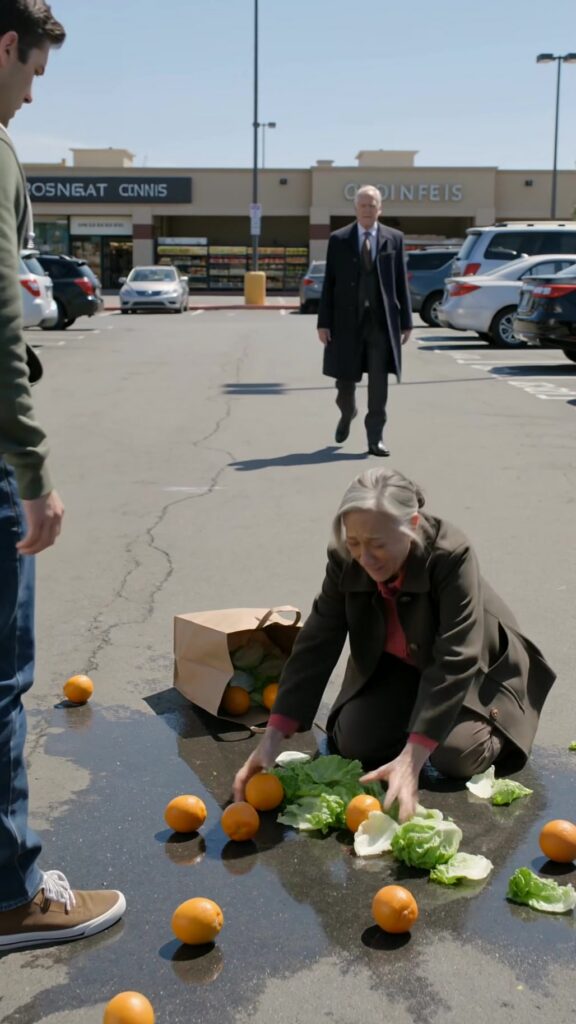
The parking lot was loud in the ordinary way. Carts clacked in their metal corral. Someone’s hatchback beeped because they left the key fob in their pocket. A kid shrieked about wanting a donut, and a radio somewhere played an old song that sounded like it was being chewed by static. Even the sunlight felt noisy, bouncing off wet asphalt like it had something to prove.
It had rained earlier, one of those quick storms that makes everything smell like pennies and leaves. Now the pavement still held shallow mirrors where clouds had been. The air was clean enough to notice the sharp scent of oranges when the automatic doors whooshed open and a woman stepped out with a paper grocery bag hugged to her chest.
She was small, elderly, bundled in a beige cardigan that looked like it had survived multiple decades and still refused to quit. Her hair was white and pinned back with a clip that seemed too big for her head. She paused at the edge of the crosswalk and stared at the row of cars, as if the whole parking lot was a complicated math problem.
Not far away, Milo pretended to scroll on his phone while waiting for his rideshare. He’d been doing that thing where you stand in a spot that feels neutral, like you’re not in anybody’s way even though you’re absolutely in the way. His day had already been rough: a voicemail from his landlord, a missed shift because the bus didn’t show, and the kind of headache that makes you angry at light. He’d come to the store for cheap instant noodles and a carton of eggs, and even that felt like a negotiation.
Then the paper bag hit the ground.
It wasn’t an accident like a gentle slip. It arrived with force, like someone had decided gravity needed help. The bottom tore open on impact. Fruit rolled out like it was trying to escape. A head of lettuce skidded across the wet pavement. Something liquid splashed when a carton split, and a loaf of bread flopped into a puddle with a soft, hopeless slap.
The woman stood frozen for half a second, like her brain couldn’t accept what her eyes were reporting. Her face changed slowly, collapsing inward, and then her mouth opened.
“That was my last money,” she said, but her voice shook so badly it sounded borrowed.
She dropped to her knees fast—too fast for her age, too fast for her joints—and started grabbing at things like she could put the moment back together if she was quick enough. She pressed the soggy bread against her cardigan. She tried to push oranges into a pile with her palms. She kept repeating it, not louder, just more broken each time.
“My God… that was my last money.”
Milo’s first thought was, Somebody tripped her. His second thought was worse: Somebody did it on purpose.
He looked up and saw the young guy standing over her. The guy was in his twenties, maybe. Clean sneakers, sharp haircut, the kind of face that looked like it had never had to apologize for anything. He was breathing hard, not like he’d run, but like he’d been worked up. His hands were still lifted slightly, palms open, as if he’d just finished a gesture and forgot to put his arms away.
“You were in my way,” the guy said, like that explained physics and morality at the same time.
The woman didn’t answer. She just scooped and scooped, trembling, trying to save at least the oranges that hadn’t rolled into a tire track.
Milo stepped forward before he realized he was doing it. “Hey,” he called, voice sharper than he meant. “What the hell?”
The young guy turned his head like Milo was a fly that had learned to talk. “Mind your business.”
And maybe Milo would have stopped there—maybe he would have muttered something and then done the normal, cowardly thing of walking away—except the parking lot shifted. Not physically. Just… the temperature of the moment changed.
An older man in a dark overcoat emerged from between two parked cars. He moved like he had time. He didn’t look in a rush to be a hero. He looked like someone who had already decided what the right thing was and was simply walking toward it.
He stopped a few feet away, not too close, but close enough that the young guy’s swagger had to account for him.
“That’s enough,” the older man said.
He didn’t raise his voice. He didn’t add any extra words. The sentence landed heavy anyway, like a door closing.
The young guy tried to roll his eyes, but his face didn’t quite complete the motion. His confidence hesitated, like it had hit a speed bump.
“She—” he started, pointing toward the woman as if she were the problem with legs.
The older man cut him off with a look. Not anger. Not disgust. Something else. Recognition, almost like he’d seen this exact posture before, this exact way of holding power in the hands like a toy.
The older man’s gaze dropped to the spilled groceries and then back to the young guy’s face.
“You throw food exactly like your father did,” he said quietly.
It was the kind of sentence that didn’t make sense at first and then made too much sense all at once.
The young guy’s jaw moved like he was chewing on a response. “You don’t know my father.”
“I do,” the older man said. “Not the way you wanted him. The way he was.”
The woman looked up from the puddle, her cheeks wet. “Excuse me,” she whispered, as if she’d wandered into a conversation that didn’t belong to her even though she was the one on the ground.
Milo crouched down beside her. He started gathering oranges gently, rolling them into his hands and wiping them on his shirt. “It’s okay,” he said to her, though he wasn’t sure it was. “We’ll get you sorted.”
The older man removed his coat slowly and draped it over the woman’s shoulders like it was normal to do that in a parking lot. Underneath, he wore a plain sweater and a tie that had seen better days. He seemed less like a stranger now and more like someone’s uncle who had been carrying a bad memory for a long time.
He turned back to the young guy. “Your dad used to come here,” he said, nodding toward the store. “Same attitude. Same need to prove he could mess up someone else’s day and get away with it.”
The young guy’s nostrils flared. “My dad’s dead.”
“I know,” the older man said. “I went to the funeral. Not because I forgave him. Because I wanted to see if you’d show up and look different.”
That sentence cracked the air. Milo felt it, like a snap in a rope.
The young guy shifted his weight, the way people do when their body wants to run but their pride refuses to let it. “So what, you’re gonna lecture me in a parking lot?”
“No,” the older man said. “I’m going to fix this.” He reached into his pocket and pulled out a wallet that looked worn at the edges. He opened it, took out cash without counting like he already knew the number, and held it out—not to the young guy, but to the woman.
She stared at it like it might be a trick. “I can’t—”
“You can,” the older man said gently. “Because you needed groceries today, and because he decided you didn’t deserve them. That’s not how this works.”
Milo watched the woman’s hands hover, uncertain, then finally accept the money with fingers that shook so hard it looked painful.
“Thank you,” she breathed. “I didn’t… I didn’t have anything left.”
“I know,” the older man said. “I’ve been there.”
The young guy scoffed, but it sounded thinner now. “This is ridiculous. She shouldn’t have been—”
The older man’s voice stayed calm. “Say you’re sorry.”
“I’m not—”
“Say it,” the older man repeated, and for the first time his tone sharpened. Not loud. Just edged. “Not because it fixes the bread in the puddle. Because it’s the first time you’ll do something you don’t want to do for someone else.”
The young guy’s face went through a whole argument without speaking. Then his eyes flicked around the parking lot. People had slowed. A couple near a minivan had stopped pretending not to watch. Someone with a cart stood still, hands on the handle, like they were holding their breath.
The young guy swallowed. “Sorry,” he muttered, barely aiming it at the woman.
It wasn’t good. It wasn’t full. But it was a crack.
The older man nodded once, like he’d just marked a starting point, not a finish line. “Now help,” he said.
“What?”
“Pick up the oranges. Don’t make it about you. Just pick them up.”
For a second, Milo thought the guy would bolt. Instead, the young guy crouched awkwardly, like his knees had never done that motion for anyone. He grabbed an orange, then another, moving stiffly. His hands were clean, and he looked surprised to be touching something sticky from the burst carton.
Milo kept collecting what could be saved. Lettuce was a lost cause, but the oranges were mostly fine. A couple cans had rolled under a car. Milo slid on his stomach a little to reach them and came out with wet sleeves and a can of soup like a trophy.
“You didn’t have to do that,” the woman said to Milo, voice still trembling but steadier.
“Yeah,” Milo said, wiping his arm. “I did.”
The older man gestured toward the store. “I’m going to walk you back in,” he told the woman. “We’ll replace what’s ruined. And we’ll do it before you talk yourself out of accepting help.”
She tried to laugh and it came out as a hiccup. “You sound like you’ve done this before.”
He gave a small, tired smile. “More times than I’d like.”
The young guy stood up with an orange in his hand, like he didn’t know where to put it now. He looked at the older man. “Why do you care?”
The older man took the orange from him and set it gently with the others. “Because nobody stopped your father early enough,” he said. “And because I’m tired of watching the same cruelty get passed down like it’s an heirloom.”
For a moment, the parking lot went back to being loud in the ordinary way. Carts rattled. Cars rolled. Sun flashed off wet asphalt like nothing had happened at all. But Milo could feel the difference anyway, like someone had quietly changed the rules.
As they helped the woman to her feet and started toward the store, the young guy lingered behind, staring at the puddle where the bread had been. He looked less like a villain now and more like a person who’d been caught mid-story and didn’t know how to rewrite the next part.
Milo didn’t know if the older man’s words would stick. He didn’t know if the apology would grow into something real. But he watched the woman clutch the coat around her shoulders and take a steadier step forward, and that felt like a win you could actually carry.
The automatic doors opened with a whoosh, swallowing them into bright fluorescent light, and behind them the parking lot kept going—ordinary, loud, and for once, not cruel.