The first time I saw them, I honestly thought it was a stunt. Like one of those weird social media things where everyone pretends to be a statue until somebody screams “surprise” and confetti happens.
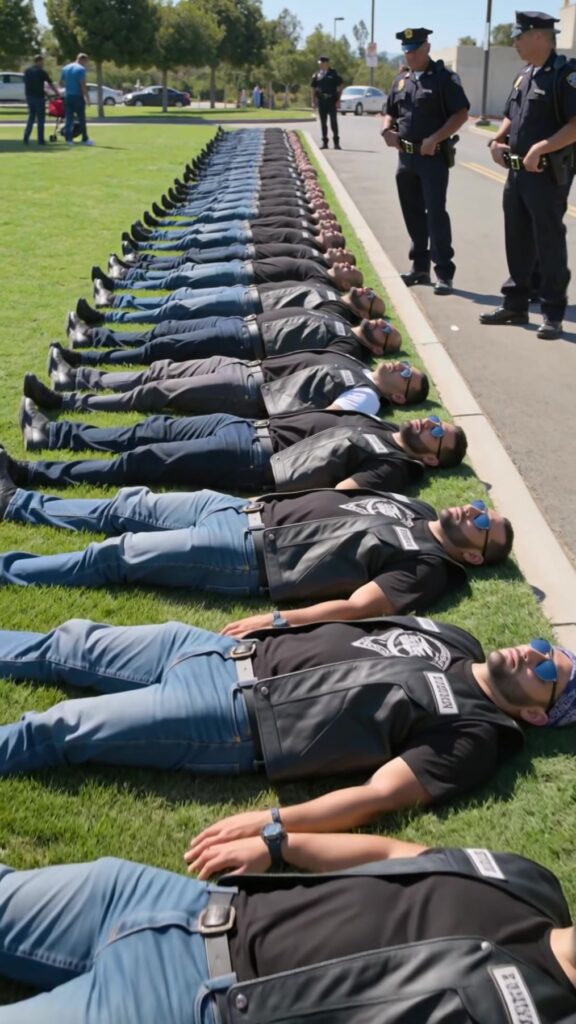
But there was no confetti. No music. No chanting. Just a line of men—big, bearded, leathered-up biker guys—flat on their backs across the courthouse lawn like someone had dropped a row of dominos and told them not to breathe too loud.
The grass was ridiculously green, the kind the city brags about, and their black vests looked like ink spilled across it. They were shoulder to shoulder, boots pointed toward the sky, faces turned up like they were waiting for rain. Each of them had one hand pressed to his chest, fingers splayed, like they were keeping something from escaping.
I parked my news van crooked because my hands were shaking. Not fear, exactly. More like my brain couldn’t locate the category this belonged in, so it defaulted to panic.
Two officers were posted on the path with that stiff, careful posture cops get when they’re trying not to escalate something they don’t understand. Their radios were quiet. Their eyes kept flicking up and down the line like they expected one of the bodies to sit up and start yelling at them.
“You know what this is?” I asked one, lifting my press badge like it was a magic key.
He didn’t even look at it. “Nope,” he said. “And I’ve been doing this twelve years. I have seen protests. I have seen flash mobs. I have seen a guy ride a lawnmower into a fountain because he ‘missed his ex.’ This?” He nodded at the bikers. “This is new.”
People kept walking past like they were late for appointments. A woman pushed a stroller and pretended not to stare. A couple of teens slowed down anyway and filmed, whispering, laughing the way you laugh when you’re uncomfortable. Somewhere a dog barked once, then shut up, like even it felt rude.
I started walking along the line, my camera operator, Miles, trailing behind me. The bikers didn’t move. Not really. Just the shallow lift of a chest, the slight shift of a jaw as someone swallowed. One wore mirrored sunglasses that reflected nothing but sky. Another had a bandana pulled down low like he was hiding from the world. An older guy—white beard, sun-weathered face—had a wet track drying along his temple, like a tear had escaped and he’d been too determined to wipe it away.
“If this is a protest,” Miles murmured, “it’s the quietest one I’ve ever seen.”
“Maybe it’s performance art,” I said, and heard how dumb that sounded as soon as it left my mouth.
Halfway down the row I noticed it: a flash of white tucked beneath a palm. At first I thought it was gauze, or maybe some kind of folded paper. Then I saw another, and another. Every biker had the same little strip of white peeking from his vest.
“Wristbands,” I whispered.
Miles zoomed in. “Hospital,” he said, voice suddenly flat.
The officer I’d talked to earlier stepped closer to the line, cautious like he might be approaching a nest of snakes. He crouched at the edge of the grass, squinting. “Why won’t they get up?” he muttered, more to himself than anyone.
No one answered. Because at the far end of the lawn, past the last pair of boots, there was something that made your throat close up before your eyes fully processed it.
A tiny white casket.
It sat on a low stand, as small and wrong as a dollhouse piece left in the real world. Around it, the air felt thinner. The city noise—cars, a distant siren, somebody’s ringtone—seemed to slide away like it knew it didn’t belong here.
“Oh,” Miles said softly. “Oh no.”
I’d covered enough tragedies to recognize the smell of grief. It’s not a literal smell, not exactly—more like the way everyone moves differently when something awful has happened. Slower. Quieter. Like the ground is fragile and might break.
A woman stood a few feet from the casket, hands clasped so tight her knuckles were pale. Her dress was plain, black, too formal for a Tuesday morning. Her eyes were dry in the way eyes get when they’ve cried themselves empty and are now just… surviving. Next to her, a man in a suit stared at his shoes like they were the only thing he could control.
Behind them was a cluster of bikers who weren’t lying down. They stood in a loose semicircle, helmets tucked under their arms, patches sewn to their backs: names, symbols, little pieces of identity. One patch caught my eye because it was stitched in soft pink thread instead of the usual aggressive colors. It said: LILY’S CREW.
I didn’t plan to cross the grass. My job was to observe, to document, to keep a respectful distance. But my feet moved anyway, like something in me needed to know the why of it, needed the story to have an explanation so it wouldn’t feel like random cruelty.
One of the standing bikers noticed me and held up a hand—stop. His beard was thick and neatly braided. He looked like a man who could lift an engine block without grunting, yet his eyes were raw.
“No interviews,” he said quietly.
“I’m not trying to—” I started, then stopped because my voice sounded too loud in the hush. I swallowed. “I just… I want to understand.”
He studied me for a second, weighing something. Then he nodded once, a tiny permission. “Then watch,” he said. “And don’t make it ugly.”
I promised with a nod, because words felt insufficient.
That’s when the little girl appeared.
She stepped out from behind the tiny casket like she’d been hiding there, or like she’d just needed a second away from the adults. She was maybe six, maybe seven. Black dress, black shoes, hair pulled back with a clip shaped like a star. Her face had that careful, too-old composure kids get when they’ve learned the world can change without asking them first.
She looked at the line of bikers as if she was counting them. Her eyes traveled from boots to faces to the white wristbands tucked under their hands. Her lips moved, silently at first, like she was saying their names in her head.
The woman in black shifted forward instinctively—mom reflex—but didn’t reach out. Like she knew this moment belonged to the child.
The girl took a few steps onto the grass, stopping just before the nearest biker’s shoulder. She didn’t touch him. She just stared, breathing shallow, as if she was afraid breathing too hard would knock something over.
“Hi,” she whispered, and her voice carried anyway because the whole lawn was listening.
The biker closest to her blinked once. That was it. He kept his hand on his chest, wristband tucked beneath, like a vow.
The girl turned her head toward the tiny casket, then back to the men on the ground. Her eyes were shiny but she didn’t cry. Not yet.
“Daddy said…” she began, and her voice wobbled like a bike wheel hitting gravel. She cleared her throat like she’d seen adults do. “Daddy said they’d lie down so I wouldn’t be alone.”
A sound went through the crowd that wasn’t a word. A collective inhale, a soft breaking.
Miles lowered the camera without me telling him to. Even the cops on the path looked like someone had punched them in the heart.
“Who’s Daddy?” I asked myself, too quietly for anyone to hear.
The braided-beard biker answered anyway, as if he’d heard the thought. “Her dad was one of us,” he said. “He was also… he was also the kind of man who carried stickers in his saddlebag because he’d promised her he’d put one on every stop sign they passed on rides.”
He swallowed hard. “Cancer doesn’t care about promises.”
The girl stood very still, then pointed at the white strip under the nearest biker’s hand. “That’s his,” she said. “From the hospital.”
“Yeah,” the biker said. “We all kept ours. Visiting him. Sitting with him. Being tough when he couldn’t be.”
The girl’s gaze moved down the line. “He said I could borrow you,” she whispered, like she was asking permission from the universe.
Something shifted then—nothing dramatic. No one sprang up. But the stillness changed flavor. It was no longer strange, no longer threatening. It was deliberate, shaped like protection.
The braided-beard biker rubbed his eyes with the heel of his hand. “He told us,” he said, “that the scariest part wasn’t dying. It was thinking she’d have to stand at a tiny casket with nobody who understood what it cost.”
He nodded at the men on the grass. “So we made a line. A long one. And we laid down.”
I looked again at the bikers’ hands over their chests, at the wristbands like folded prayers. I understood then, in a way that had nothing to do with headlines.
They weren’t blocking anything. They weren’t protesting. They weren’t performing.
They were making a road.
A path of bodies and leather and stubborn loyalty, stretched across the lawn so a little girl could walk beside grief without feeling like it was swallowing her whole.
The girl took one step forward, then another, walking along the line as if each biker was a milestone. As she passed, a few of them blinked, one of them let out a shaky breath, another’s jaw tightened like he was holding in a sob. None of them sat up. None of them broke the shape.
When she reached the center, she stopped and looked down at a biker with a patch that read ROAD CAPTAIN. His beard was peppered gray, and his lips trembled even though he tried to keep them still.
“Did Daddy hurt?” she asked him.
His sunglasses were off, revealing eyes so red they looked bruised. “Yeah, kiddo,” he said, voice cracking. “He did.”
She nodded as if that confirmed something important. “But he didn’t quit,” she said, more statement than question.
“No,” he whispered. “He didn’t.”
The girl exhaled slowly, like she’d been holding her breath for days. Then she looked toward the tiny casket, toward her mother, toward the knot of adults trying not to fall apart. She lifted her chin.
“Okay,” she said softly. “Then I won’t either.”
Behind me, the officer on the path cleared his throat and turned away, pretending to look at his radio. His shoulders rose and fell once in a way that wasn’t breathing.
I didn’t record the girl’s face after that. I filmed the line from a respectful distance—the boots, the hands, the white wristbands tucked like secrets. I filmed the sky reflected in sunglasses. I filmed the way the green grass looked too alive for what was happening on it.
And when my station asked me later for a simple explanation, something neat and caption-friendly, all I could think was: sometimes love looks like a row of tough men choosing to be the ground.
Sometimes the hardest thing you can do is lay down and stay there—so someone small can stand up and keep going.