The Desert Rose Diner looked like every other stubborn little place clinging to Route 66: sun-bleached sign, parking lot dust that never really settled, and a door that jingled like it had opinions. If you’d driven past, you’d remember the shape of it for maybe three seconds before your brain replaced it with the next billboard.
I only noticed it because my bike was coughing like it wanted to die dramatically in public. I rolled in on fumes and bad luck, parked between a minivan and a rusted pickup, and pushed inside hoping for coffee strong enough to restart my soul.
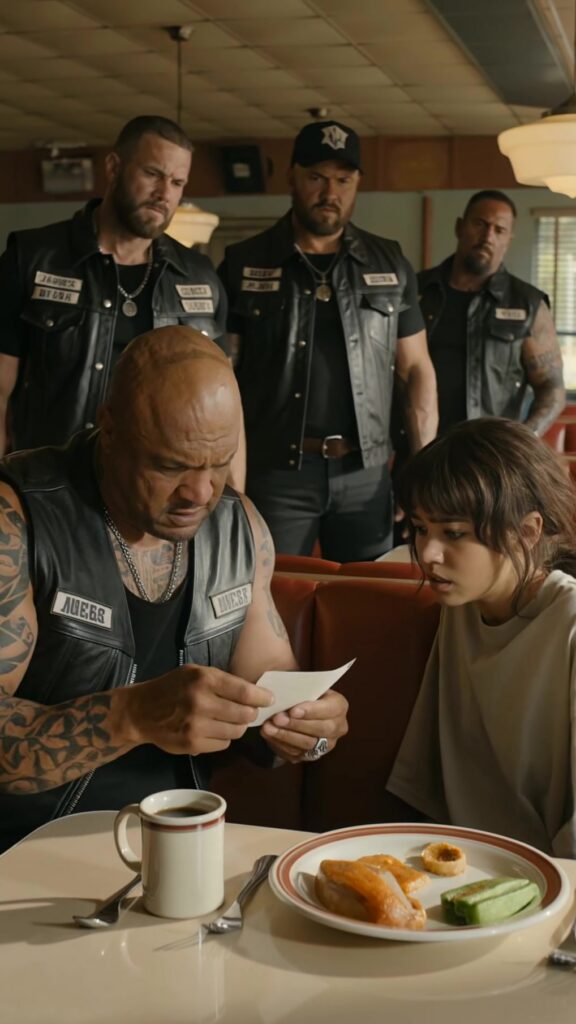
The place smelled like bacon, old vinyl, and somebody’s cinnamon air freshener fighting for its life. Red booths lined the windows. A few truckers hunched over plates. A waitress with a silver streak in her hair poured coffee like she’d been doing it since the invention of coffee.
I slid into a booth near the back, close enough to the kitchen that I could hear the cook muttering at a spatula. I’d barely wrapped my hands around the mug when I saw her.
A kid—maybe twelve, maybe younger—stumbled in like she’d been dropped out of the sky. Oversized beige t-shirt swallowing her knees, hair knotted and dirty, cheeks pale like paper. The part that made my stomach sink was her arms: faint bruises, and angry red bands where tape had been wrapped too tight, the skin puffed like it had tried to escape.
She scanned the room like a trapped animal, then locked eyes with me. Not because I’m handsome. Because I’m big, bald, tattooed, and—according to the stereotype menu—most likely to be useful in a panic.
She headed straight for my booth and didn’t ask permission. She slid in opposite me, hands shaking under the table. Her gaze flicked to the front window, then to the door, then back to me.
“You alone?” she whispered.
“Yeah,” I said. “You hurt?”
She nodded once, like that was too obvious to waste words on. Then she leaned forward and said, “Don’t look. But they’re coming.”
My instinct was to check anyway, but something about her voice—flat with terror, like she’d already screamed herself empty—made me keep my eyes on her. I dipped my chin, like I was listening to some normal kid drama, and moved my body so I could see the front window in the reflection of the napkin holder.
Outside, nothing yet. Just heat shimmer and dust. A couple of crows on a telephone wire like they owned it.
“Okay,” I said softly. “Tell me what’s going on.”
She tugged the sleeve of her t-shirt down, then up again, like she couldn’t decide whether to hide or show what happened. Finally she pushed her arm across the table. The tape marks were up close now, the kind that come from someone wrapping too fast and too tight. I reached for my pocketknife, then stopped. Blade might scare her.
“I can get that off,” I said. “Slow. You tell me if it hurts.”
She nodded again. Her mouth trembled, but she stayed still while I peeled the last bit of adhesive away with the careful patience you use on a bandage stuck to hair. When I finished, she let out a breath like she’d been holding it since yesterday.
“What did they do to you?” I asked.
Her eyes went shiny, but she blinked it back. “They moved me around. A lot. Said I was… cargo.”
My jaw tightened. There are words for people who use that word about a kid. None of them are polite.
She fumbled inside the collar of her t-shirt, fingers searching like she was afraid it had disappeared. Then she pulled out a small plain envelope—no return address, no name, nothing. Just one black symbol stamped in the corner. Simple. Clean. Wrong, the way a single mark can feel wrong when you recognize it.
She pushed it across the table to me. “Read it. Quick. Before they find me.”
I didn’t touch it right away. My eyes caught the symbol and the room shifted, like someone changed the pressure. I’d seen that mark once before—years ago, on a crate at a back-alley chop shop in Oklahoma City. I’d asked the wrong question and gotten a pistol in my face as an answer. The guy holding it had whispered one word like it was a curse: “Harrow.”
I swallowed. “Where did you get this?”
She shook her head hard. “They made me keep it. Said if I lost it, I’d regret it.”
Behind the counter, the waitress clinked cups. A trucker laughed at something on his phone. Normal noises, normal life, all of it suddenly fragile.
In the reflection of the napkin holder, a smudge rose at the horizon—dust, moving fast. More than one vehicle. My throat went tight.
I grabbed the envelope.
That’s when she reached across and clamped her hand over mine with surprising strength. Her nails bit my skin. “If they come in, don’t let them take me back,” she said. “Please.”
“Hey,” I said, voice low. “I’m not handing you over to anybody.”
I slid out of the booth and crouched beside her, blocking her from view as best I could. “What’s your name?”
“Lena,” she said, then added like it mattered more, “They don’t call me that.”
“Alright, Lena. I’m Cal.”
The dust outside got thicker. Engines, plural, buzzing closer. The sound crawled under the diner’s door like smoke.
I tore open the envelope with my thumb.
Inside was a single folded page, thick paper like it came from a fancy office printer. My hands went cold as I unfolded it.
The first thing I saw was my own name.
CALEB ROURKE.
Underneath, three lines of information I’d never given to anyone: my birth date, the county I was born in, and my mother’s maiden name. Then a short paragraph that made my vision narrow.
Cal,
If you’re reading this, it means she found you. It means my worst fear is already rolling down the highway. Lena is your daughter. I never wanted to drag you into this life, but they don’t care what I wanted. They want her because of what she saw and because of what you used to be to them. Don’t trust badges. Don’t trust bikers with clean hands. The symbol means Harrow. If you see it, you’re already late.
There was more, but my brain snagged on one sentence like a fishhook.
Lena is your daughter.
My mouth opened, but nothing came out at first. I looked at the kid pressed into the booth seat, eyes wide, waiting for me to become someone else.
“…She’s my daughter?” I whispered, like saying it louder would make it real.
Lena flinched like she expected me to shove her away. “I didn’t know,” she said fast. “I swear, I didn’t know until they said your name. They said you’d come if it mattered. They said you’d understand the symbol. I just—”
The diner’s front window filled with motion. Motorcycles—too many—pouring into the lot in a sweeping arc, kicking dust up in curtains. Behind them, a white box truck with no markings rolled in like a silent threat, too clean for this road, too blank to be innocent.
The bells over the diner door jingled again, but this time it wasn’t friendly.
I crumpled down beside the booth and pulled Lena with me, my body covering her. My eyes flicked to the other patrons. They were still chewing, still drinking, still pretending the world wasn’t about to change in the next ten seconds.
I shoved the letter into my jacket, then glanced toward the counter where the waitress had finally noticed the dust storm outside. Her face tightened, not surprised, just annoyed—like this wasn’t her first time with trouble stopping for pie.
“Back room,” she muttered, eyes on the door, voice aimed at me like we were old friends. “Now.”
I didn’t ask questions. I grabbed Lena’s hand. Her fingers were ice, but she held on.
As the first bootsteps thudded on the diner’s porch, I thought about the last line I’d read—Don’t trust badges—and the symbol that meant I was late.
Late for what, exactly, I didn’t know yet.
But I did know one thing: whoever Harrow was, and whatever I used to be to them, they’d picked the wrong day to come reclaim their “cargo.”
I squeezed Lena’s hand once. “Stay close,” I said. “No matter what you hear.”
Then the door swung open, letting in a blast of daylight, dust, and engines.
And the Desert Rose Diner stopped being forgettable.