The rooftop engagement party looked like it had been assembled by a team of people who got paid to make other people feel underdressed. White roses crawled along the glass railing like they’d been trained. A champagne tower blinked in the last sun like it was trying to be a chandelier. Someone had hired a violinist who kept drifting from table to table, making pop songs sound expensive.
Lena stood near the edge in a white dress that wasn’t technically a wedding gown, but absolutely had wedding-gown energy. Her fiancé, Grant, was doing the rounds, hand on her back, introducing her like she was the final feature of the evening. “My future wife,” he kept saying, like he was testing out the words.
Her best friend, Tessa, pressed a flute into Lena’s hand. “You look unreal,” she whispered. “Like one of those girls in a jewelry ad who’s about to ruin my life.”
Lena laughed, but it came out thin. She felt like someone had tightened a ribbon around her ribs. It wasn’t fear exactly. It was the weird sensation of being watched, even though everyone was technically watching her.
Grant clinked a spoon against his glass and the conversations smoothed down into a hush. “Okay,” he said, smiling the smile that made investors relax. “Before we get lost in the night, I want to do one thing.”
He reached into his jacket. A server appeared at his elbow with a velvet box like they’d rehearsed it. The skyline behind him flared orange, dramatic on purpose. Even the violinist stopped.
Lena knew what it was. She’d known for days. Still, when Grant lifted her wrist and opened the box to reveal a diamond bracelet, the crowd made the sound crowds make when they see money. Phones floated up like glowing little moons.
“For the woman who makes everything better,” Grant said. “Even me.”
Her smile stayed in place like it was pinned there. Lena was halfway to saying the correct words—oh my god, it’s beautiful—when a blur shoved between two guests near the bar.
At first, people thought it was a kid from downstairs who’d wandered into the wrong event. Then the blur became a girl, maybe seven or eight, all sharp elbows and wind-tangled hair. Her clothes were too big in some places and too small in others, like she’d been dressed by chance. Her sneakers were split at the toe. She was running hard, like she’d already been chased.
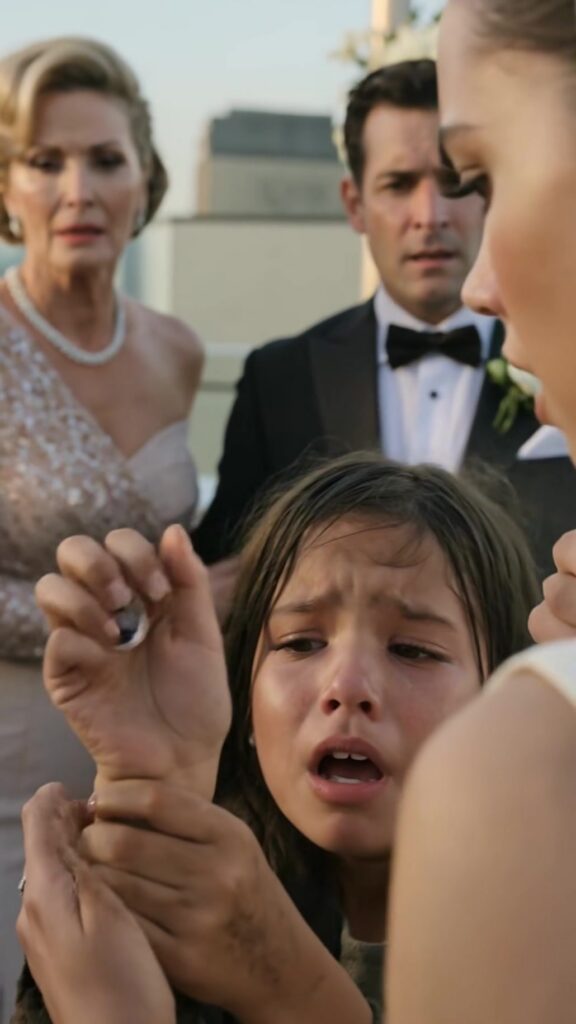
Security moved, but the crowd was thick and slow, tipsy and wearing heels. The girl darted around a waiter, skidded on spilled champagne, caught herself, and then—before anyone could think to block her—latched onto Lena’s wrist.
“Hey!” someone shouted.
“Oh my God,” Tessa breathed, stepping forward.
Lena jerked back on instinct. The girl’s hand was cold and her grip was desperate. Her eyes were huge, rimmed red like she’d been crying for hours, or days.
“Get her off me,” Lena blurted, horrified at how it sounded, but the fear made her voice ugly.
The violinist lowered their bow. A glass clinked and fell, the sound loud in the sudden quiet. The girl clung harder, shaking so badly Lena could feel it in her bones.
“Don’t marry him,” the girl said. It came out ragged, like the words had to climb over something to get free.
The rooftop, which a second ago had been all music and laughter, went flat and stunned. People did that thing where they look at one another for permission to react.
Grant’s smile faltered. “What is this?” he said, voice too calm. “Who brought a child up here?”
The girl didn’t look at him. She stared up at Lena like Lena was the only person who mattered. “Please,” she whispered. “Please don’t.”
Lena swallowed. “Honey—” she started, because that’s what you say to kids you don’t know when you’re trying not to panic. “Where are your parents?”
The girl shook her head so hard her hair whipped her face. Then she slowly opened her other hand.
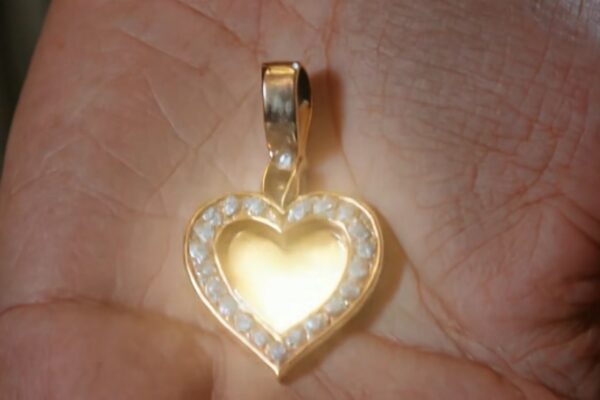
In her palm was half of a silver locket, broken jagged right down the middle, like it had been snapped in anger. The metal was scratched and dull. Inside, behind cloudy plastic, was a tiny photograph—faded, water-warped, but still recognizable as a woman’s face. The woman’s smile looked like it used to be easy. Like she used to trust people.
Lena’s breath went stuck. She knew that locket.
Her fingers rose to her throat without her permission. Under the collar of her dress, hidden on a thin chain, rested her own half-locket—something she’d worn since she was seventeen. She’d never taken it off, not even when she was getting measured for this dress. She’d always told people it was sentimental. That it belonged to her mother.
Which was true, in a complicated way.
Her nails caught the chain. She pulled it out into the open. The silver flashed in the sunset, and the guests leaned in like they were watching a magic trick go wrong.
The two halves looked at each other across the air. Same size. Same filigree detail. Same tiny engraved flower near the hinge. Even the break lines—sharp, uneven—seemed to know where they belonged.
Someone near the back made a noise, small and strangled. An older woman in a navy dress—one of Grant’s family friends, Lena thought—went pale, her hand flying to her mouth like she might be sick.
Grant moved. Just a step. But his eyes flickered, and in that flicker Lena saw something that didn’t match the man who brought her soup when she had the flu. Something clipped and calculating.
“That’s…” Grant said, and then stopped, as if the sentence had teeth.
Lena’s throat dried out. She looked back to the girl. “Where did you get that?”
The girl’s eyes flooded. “My mom,” she said. “She made me promise not to lose it. She said if I ever saw a lady wearing the other piece, I had to stop her.”
Lena’s fingers trembled so hard the locket on her chain tapped against her collarbone. “Stop her from what?” she asked, though part of her already knew. Her stomach had gone cold in a way that didn’t feel like nerves. It felt like memory.
The girl blinked, tears spilling down her cheeks. “From thinking he’s different,” she whispered. “From believing him.”
The city wind tugged at Lena’s veil, lifting it, twisting it around her shoulder like a warning flag. Grant’s hand reached toward her wrist—the one the girl still held—but he hesitated, watching the crowd, watching the phones.
“This is insane,” Grant said, loud enough for everyone. “Lena, give me that. Whoever this child is, she’s been fed some story.”
Tessa stepped between them without even thinking, one hand out like a barrier. “Don’t touch her,” she said, voice low.
Lena stared at the older woman in navy, the one who’d gone pale. The woman’s eyes wouldn’t meet hers. She looked at Grant instead, terrified, like a person who had been trained to stay quiet.
Lena looked down again at the girl. “What’s your name?”
“Maya,” the girl whispered.
Lena repeated it, tasting it. Then she looked at the picture inside the broken locket half—at the faded woman’s face. The features were blurred by age, but something about the smile hit Lena like a wave.
“My mother…,” Lena began, then stopped. Her mind tried to stitch facts together and kept catching on old pain. Her mom had left when Lena was little. That was the official story. She’d disappeared. People didn’t like to talk about it. Lena didn’t like to ask.
Maya nodded fast, like she’d been waiting for Lena to say it. “My mom said he did it before,” she whispered. “He makes ladies feel safe. Then he takes their money and their names and their everything. And if they try to tell… he makes them disappear from their own lives.”
The rooftop felt like it tipped. Lena’s knees went loose. Grant’s face tightened, the calm cracking at the edges. “Lena,” he warned softly, and the softness was worse than shouting.
Lena stared at him—at the man she’d been ready to marry—and for the first time, she noticed how the party wasn’t for her at all. It was for him. His friends. His donors. His shiny future. She was just part of the branding.
She held her locket half out toward Maya’s. The jagged edges hovered a hair apart, then clicked together as if they’d been pulled by a magnet. Perfect match. No doubt. No explanation that could make it normal.
A murmur rolled through the guests. Someone’s phone camera zoomed in. The older woman in navy made a small choking sound, and this time Lena caught it: not shock. Guilt.
Lena lowered the joined locket pieces into her palm, feeling the cold metal like a verdict. She looked at Maya, this trembling kid who’d sprinted through strangers to grab a bride’s wrist.
“Where is your mom now?” Lena asked.
Maya’s mouth crumpled. “She’s not…,” she started, then swallowed the rest. “She’s gone. But not like dead. Like… like she’s not allowed to be her anymore.”
Lena’s heart thudded in her ears. She pictured her own mother’s empty closet, the way everyone had rushed to label it abandonment so they wouldn’t have to ask harder questions. She pictured the locket on her own neck, the only thing her mother had left behind, and realized it hadn’t been left behind. It had been split, on purpose, like a breadcrumb. Like a warning that needed time to reach her.
Grant’s voice sharpened. “Security,” he snapped.
Two guards stepped forward, uncertain. The crowd parted just enough to give them a path, then closed again like a mouth.
Lena lifted her chin. “No,” she said, surprising herself with how steady it sounded. She tightened her hand around the locket until it bit her skin. “Nobody touches her.”
Grant stared at her like she’d changed languages. “Lena,” he said, smile trying to return, trying to charm its way back into place. “You’re letting a street kid ruin our night.”
Lena looked at the joined locket halves. Then she looked at Maya. The girl’s grip on Lena’s wrist finally loosened, not because she wanted to let go, but because she’d said what she came to say and didn’t know what came next.
“She didn’t come to ruin anything,” Lena said quietly. “She came to stop me from repeating something.”
The rooftop was silent in a way that felt like a cliff edge. In that silence, Lena understood a new, terrifying possibility: this wasn’t about a bracelet or an engagement party. This was about a pattern. A man who collected women the way he collected business deals. A city full of people who looked away because the skyline was pretty and the champagne was free.
Lena took Maya’s hand—gentle this time—and stepped back from Grant. “Come with me,” she said to the girl, and to herself. “We’re going to find out what that locket belongs to.”
Grant’s jaw tightened. The older woman in navy began to shake. And somewhere behind them, the violinist finally remembered to breathe.
As Lena walked toward the elevator with Maya beside her, the guests didn’t follow. They just watched, frozen, like the party had turned into a courtroom and nobody wanted to be the next person called.
Grant’s voice chased after her, sweet on the surface, sharp underneath. “Lena, don’t do this,” he said. “You’ll regret it.”
Lena didn’t turn around. She felt Maya’s small fingers wrap around her own, and she squeezed back.
“I think,” Lena said, staring straight ahead as the doors opened, “I already regret the part where I didn’t know sooner.”