The teller almost didn’t look at him. Tuesday mornings were always a parade of the same faces: retirees with neatly folded deposit slips, small business owners carrying zippered bags, a guy who always smelled like expensive cologne and complained about the parking. So when the front doors sighed open and a kid wandered in, it barely registered. Denim jacket, skinny backpack straps cutting into his shoulders, hair that looked like he’d combed it with a napkin. He stood there like he wasn’t sure if banks were supposed to bite.
Martin, the senior teller with the good posture and the better memory, glanced up out of habit and then went back to counting. Kids came in sometimes with parents, usually sticky and loud, usually holding a lollipop like a tiny sword. This one was alone. Too young to be alone in a place full of stone floors and quiet money. The kid didn’t wander toward the candy bowl or the brochure rack. He walked straight to Martin’s window and stopped, hands at his sides, waiting. Not nervous. Not fidgety. Just… waiting.
Martin finished the stack, tapped it square, and forced the customer-service smile onto his face. “Morning,” he said. “What can I do for you?” Behind the kid, a security guard glanced over and then looked away, bored already. The kid didn’t answer. He leaned forward, not rude exactly, but with a kind of clear impatience, like he’d been told to do this and he was not going to mess it up. He set something on the counter with both hands: a brown canvas sack, frayed seams, stained like it had lived under truck seats and in damp basements. It hit the marble with a dull thud that was too heavy for the size.
That got Martin’s attention. He stopped smiling. “Okay,” he said, voice lowering without him meaning it to. “What’s in the bag?” The kid’s face didn’t change. He worked the metal clasp open, slow and careful, like the bag was a sleeping animal. Then he folded the top down and turned it slightly so Martin could see inside.
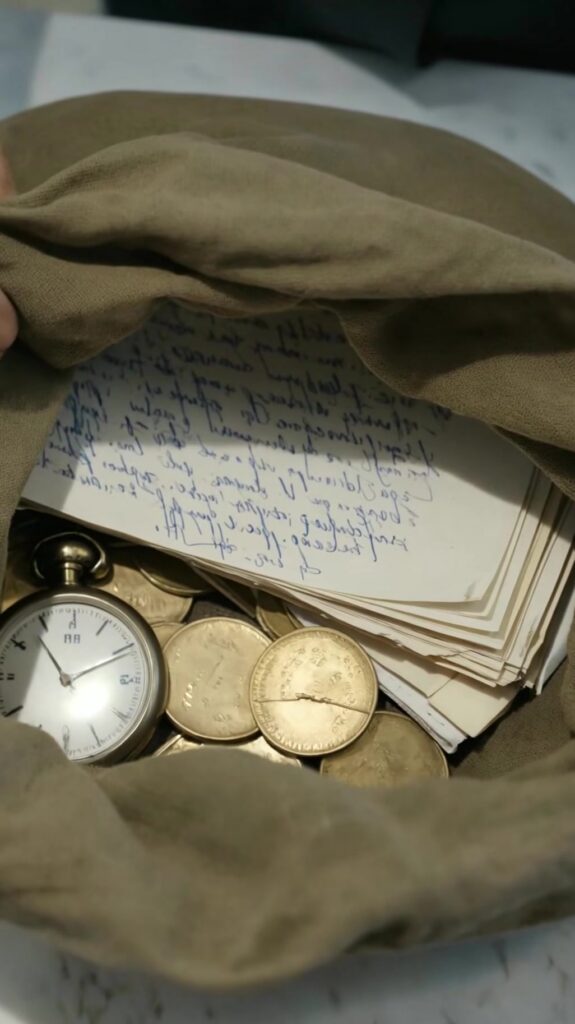
It wasn’t cash. Not even jewelry. It was… history. A stack of old papers, edges soft and browned, tied with a faded ribbon. A few thick gold coins that didn’t shine so much as glow, the way old metal does when it’s been handled a lot. And on top, sitting like it owned the place, an antique pocket watch in a scratched silver case. The watch had a dent on the rim, a small crescent like a bite mark, and the chain was attached to a key-shaped charm.
Martin’s throat went dry so quickly it felt like he’d swallowed flour. His hands hovered over the counter, suddenly unsure whether this was something you touched or something you called someone about. He’d seen a watch like that before. Not “similar.” Not “kind of.” That exact dent. That exact charm. A memory snapped up so hard it was like a door slamming: late night, twenty years ago, the bank closed, lights dimmed, Martin still new and eager and staying late to reconcile a ledger. A man had been escorted in through the employee entrance—suit too nice for the hour, eyes too tired for the amount of money he carried. He’d asked for a private safe deposit box under a name that didn’t fit his face. He’d put that watch on the desk like a calling card and said, very calmly, “If anything ever happens, this is how you’ll know it’s my family.”
Martin looked up at the kid again, and the longer he looked, the worse it got. The kid had the same set to his jaw. The same steady stare. It wasn’t just resemblance; it was the sensation of seeing the past printed onto the present. Martin’s chair creaked as he straightened. “Where did you get these?” he asked, and it came out sharper than he meant. The kid blinked once. “They’re my dad’s,” he said. His voice was even, like he’d practiced. “He told me if something happened to him, I should bring them here. He said you would know what to do.”
Martin’s heart did something ugly in his chest, like it wanted to run away without the rest of him. He glanced toward the security guard. The guard was now looking, not bored anymore. Martin forced himself to keep his expression neutral, the way you do when you don’t want a lobby full of strangers to start listening. “What’s your name?” Martin asked quietly. “Evan,” the kid said. He didn’t offer a last name. He didn’t need to. Martin already felt it sitting there, unspoken, between them.
Martin reached for the documents with hands that suddenly didn’t feel like his. The paper was thicker than modern office stuff, with that old fiber bite to it. A page slipped loose and fluttered half-open. Across the top was a company name printed in faded ink—one Martin hadn’t seen in decades. The kind of name that used to appear on plaques and donation walls and then vanished overnight like someone had scrubbed it out of the city. Martin knew the story the way everyone in certain circles knew it: a disappearance, a lawsuit that died before it was born, a quiet directive from people who didn’t send directives unless they had power to back them up. And the bank had been told, in very polite language, to forget it ever held anything connected to that name.
Martin’s mouth went tight. He slid the loose page back into the stack like he was hiding a weapon. “Did your father tell you anything else?” he asked. The kid nodded, reached into his denim jacket pocket, and pulled out a folded note. It wasn’t in an envelope. It was just paper, creased a lot, like it had been opened and closed and squeezed in a fist. He placed it on the counter and pushed it toward Martin with the same careful steadiness he’d used with the sack.
Martin unfolded it. His eyes found the line immediately. It was short, written in blocky handwriting that Martin recognized with a sick twist of certainty. If my son is standing in front of you, it means they found me before I could reach the vault. Martin read it twice anyway, because sometimes your brain tries to negotiate with reality. He felt the color drain out of his face in a hot wave. He looked up and saw Evan watching him, not scared, not confused—just waiting for the next instruction.
Martin swallowed, then nodded once, like he was agreeing to something he’d already agreed to long ago. “Okay,” he said, voice low. He forced his hands to stop shaking by pressing his palms flat on the counter. “Evan, I need you to listen to me. I’m going to take this bag to the back, and I’m going to bring you to a private room. You’re not in trouble. You did the right thing.” Evan’s shoulders relaxed by a fraction, like he’d been holding them up with pure will. Martin signaled the security guard with a small gesture—nothing dramatic, just the kind that meant pay attention. Then Martin leaned in and asked the question he didn’t want to ask, because it made everything real. “When was the last time you saw your dad?”
Evan’s eyes flicked down to the watch, then back to Martin. “Two nights ago,” he said. “He told me to memorize the route here and not let anyone follow me. He said if anyone asked questions, I should say I was here to open my first account.” Evan hesitated, then added, like he couldn’t keep it in anymore, “He said you’d be scared. But he said you’re the kind of scared that still does the right thing.”
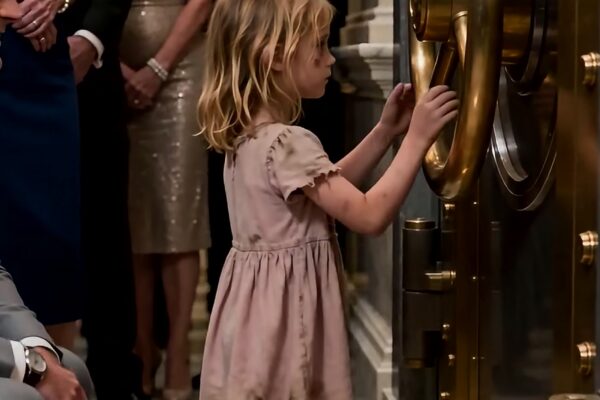
Martin let out a breath he didn’t remember taking. Somewhere behind the wall, the vault door sat heavy and silent, holding other people’s secrets. Martin had spent his whole career telling himself he was just a keeper of money, a polite machine in a suit. But the weight of the canvas sack, the old documents, the watch—those weren’t deposits. They were a message delivered by a kid who shouldn’t have been walking into a bank alone. Martin carefully closed the bag, like he was tucking in something fragile, and slid it out of sight beneath the counter. Then he leaned forward, met Evan’s steady gaze, and said, “All right. Let’s go see what your dad left us.”