The bell over the diner door had a cough to it, like it was tired of announcing anyone’s arrival. It jingled anyway—out of habit, out of duty, out of the same stubbornness that kept the place running on burnt coffee and second chances.
Inside, the warmth wasn’t comforting so much as familiar. Amber lights drooped from the ceiling like sleepy moons. The booths held old vinyl scars of their own: cracks, patched seams, a few mysterious stains that had survived half a century of scrubbing. People ate and talked under the soft illusion that daylight at the front windows could make danger act civilized.
The scarred man sat in the far-back booth, the one with a clear view of the door and the side windows. He’d chosen it without thinking, like someone choosing the only seat in a room that mattered. The waitress—Val, according to her name tag—had asked if he wanted anything else.
“Coffee,” he’d said, and his voice sounded like gravel rolled in a glove.
He hadn’t smiled. He hadn’t scowled. He’d simply existed, shoulders squared, hands calm on the table, eyes doing the quiet work of counting exits and measuring strangers. His face looked like it had once been in an argument with fire and refused to lose. A web of pale ridges ran from his temple down toward his jaw, slicing across his cheekbone and disappearing into stubble.
No one in the diner knew his name. In a place like this, that wasn’t unusual. They just knew he didn’t belong to the usual cast of regulars. He wore a battered leather jacket like it was a second skin and kept his back away from the wall. People tried not to stare and failed in small, polite ways.
The door opened again, and a gust of cooler air slipped in. No one looked up at first. It could’ve been a trucker, a delivery guy, a college kid hunting pancakes.
Then a chair scraped back.
Too loud. Too sharp. Like metal on bone.
Heads turned. Forks froze midair. A woman with syrup on her lip stopped chewing and blinked like she’d woken up inside someone else’s dream.
A little boy in a red hoodie stood near the middle of the diner, crying so hard he couldn’t find a steady breath. He looked seven, maybe eight. His face was blotched and wet, his nose running, his eyes wide with that raw terror kids get when they’ve already tried being brave and it didn’t work.
He stumbled straight toward the scarred man’s booth and didn’t slow down.
He grabbed him.
Not a polite tug. Not a hesitant touch. Both fists twisted into the sleeve and lapel of the leather jacket like it was a rope on a cliff’s edge. The kid clung hard enough to tilt himself up on his toes.
The scarred man rose immediately.
Not confused. Not annoyed. No startled flinch, no instinct to shake the boy off.
Ready.
That was the first thing about him that made the room feel colder without the thermostat changing.
The second was how quiet everyone got when he stood. Not because he demanded attention, but because his body language did. Like a guard dog that hadn’t barked yet, but everyone could feel it thinking.
He didn’t look down at the boy. His eyes went straight to the diner door.
Through the glass, daylight looked thin and washed out. Beyond it, two figures moved across the parking lot. Dark hoodies. Hands in pockets. Their pace wasn’t fast, but it wasn’t casual either. They walked like they already owned the next thirty seconds.
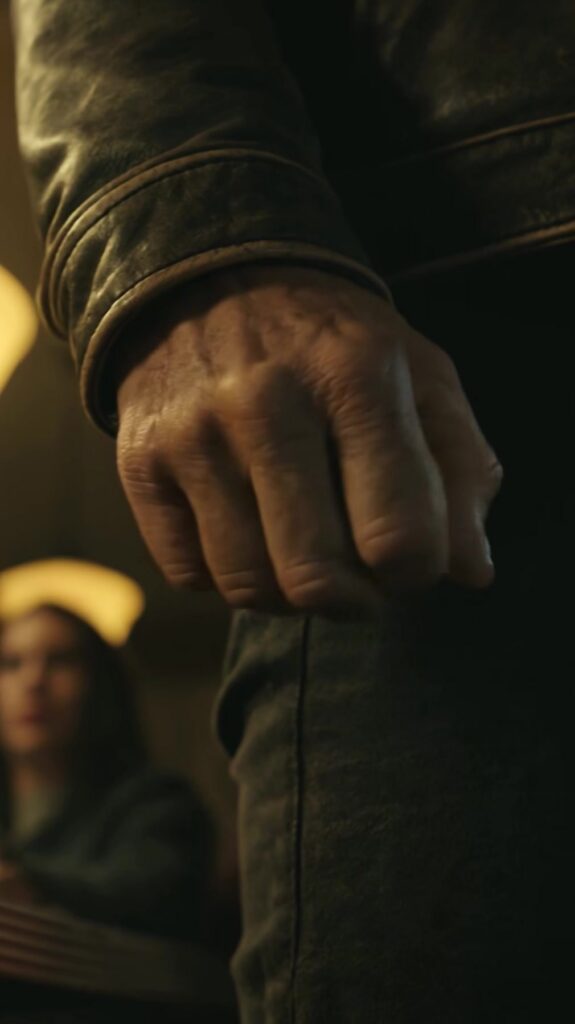
The boy shifted, half hiding behind the man’s leg, trembling so hard his shoulders jerked. His fingers tightened until the leather creaked. The man’s right hand closed slowly at his side—no drama, no show. Just a fist forming around something invisible.
Val, the waitress, had stopped mid-step with a pot of coffee. She stared as if she was trying to decide whether this was an argument or a storm warning.
The two hooded figures reached the door. One of them held it for the other. The bell coughed again, forced to announce them like it announced everyone.
The scarred man’s expression changed when he got a clear look at them.
Not fear.
Recognition—hard and old, the kind that doesn’t care how many years you’ve spent trying to build a new life over it.
The boy’s voice came out in a broken whisper, just loud enough for the nearest booths to catch it.
“They found me where you said they would.”
That sentence dropped into the diner like a coin into a well. Everyone heard it. Nobody wanted to be the one to react first.
The scarred man finally looked down at the kid. His gaze softened a fraction—not gentle, not warm, but focused in a way that said: You’re here. You made it.
“Eli,” he said quietly, like he’d been saying the name in his head for days. “You shouldn’t have come inside.”
The boy—Eli—sucked in a shaky breath. “I saw them outside first,” he said. “I didn’t know where else to go.”
The man’s jaw tightened. He glanced toward the kitchen door, then toward the bathrooms, then back to the front. Calculating. Moving pieces on an invisible board.
The hooded men stepped in fully. They didn’t look around like normal customers. They looked for one thing and only one thing. Their eyes landed on the scarred man and the boy. Both of them stopped walking at the same time, like a decision made together without words.
One of them pushed his hood back. He had a neat haircut, too clean for someone dressed that rough. The other kept his hood up, chin tucked, face hidden except for a slice of cheek and a mouth that didn’t smile.
Neat Hair raised a hand like he was greeting an old friend. “Well,” he said, voice smooth as an ad on the radio. “Look at that. Family reunion.”
The scarred man didn’t move from where he stood, but the boy felt him shift—subtle, protective. Eli’s knuckles were white around the leather.
“You’re in the wrong place,” the scarred man said.
Neat Hair’s eyes flicked around the diner. He took in the witnesses, the coffee pot frozen in Val’s hand, the old man by the window pretending to read the menu like it held an escape plan. “We’re exactly where we need to be,” he said. “We’ll make it quick. We’re not monsters.”
“Not in front of the kid,” the scarred man replied.
The hooded one finally spoke. His voice was lower, like it had lived in the bottom of a barrel. “The kid is the point.”
A few customers stood up—slow, uncertain. Someone’s chair legs squealed. Val set the coffee pot down with a tiny clink, hands trembling. She looked toward the phone behind the counter, but she didn’t move yet. In small towns, people learned fast: some trouble punishes bravery first.
The scarred man’s eyes stayed on the two men. “You shouldn’t have brought this to a diner.”
Neat Hair shrugged. “You shouldn’t have stolen what wasn’t yours.”
Eli’s breath hitched. The scarred man lowered his head just enough to speak without turning away from the threat. “Listen to me,” he murmured. “When I say run, you run. You don’t look back. You go to the kitchen. There’s a door by the pantry. You push through and keep going until you hit the alley. You understand?”
Eli shook his head violently, tears flying. “No. They’ll take me. They said—”
“They won’t,” the man said, and for the first time his voice carried something close to a promise. Not because he wanted to be trusted. Because he needed the boy to believe it long enough to move.
Neat Hair took a step forward. The hooded one drifted to the side, angling toward the counter like he wanted to cut off any phone calls. Their coordination was practiced.
The scarred man’s left hand reached behind him, calm as checking for a wallet. It slid along the bench seat, and his fingers found something taped underneath. He peeled it free in one smooth motion.
A small key. Old brass. It caught the light for a second.
Eli saw it and blinked through tears. “That’s—”
“Shh.” The man pressed the key into Eli’s palm and closed the boy’s fingers around it. “You remember the storage unit?”
Eli nodded, a tiny jerk of motion.
“Good. That’s where the truth is,” the man said. “Not what they told you. Not what I told you. The actual truth.”
Neat Hair noticed the exchange. His smile thinned. “Hand the kid over,” he said, voice still calm but tightened underneath. “You walk away, and nobody in here gets hurt.”
The scarred man’s eyes flicked to Val. Not pleading. Not asking. Just a glance that said: when it happens, do what you can. Val swallowed and, with a bravery that arrived late but arrived all the same, slid her hand behind the counter toward the phone.
The hooded one saw it. He started toward her.
That was the moment the scarred man spoke, not loudly, but with a sharp edge that cut through the diner like a snapped thread.
“Eli,” he said. “Run.”
The boy hesitated—one heartbeat, two—then bolted, red hoodie flashing between tables. He nearly tripped over a chair leg but caught himself, clutching the key like it was a live thing.
Neat Hair lunged, but the scarred man moved first. He didn’t swing wildly. He stepped into the space with a precise violence, shoulder and forearm driving forward, knocking Neat Hair off-balance into a booth. Plates clattered. Someone screamed. Coffee splashed, hot and bitter, across the table like a warning.
The hooded one spun back toward the scarred man, but the moment of hesitation was enough. Eli disappeared through the kitchen door, and Val’s hand finally found the phone.
The scarred man planted his feet, putting his body between the two men and the path to the kitchen. He looked, for a second, almost tired. Like he’d hoped this would end some other way. Like he’d known it wouldn’t.
“You should’ve let the kid stay lost,” Neat Hair spat, pushing himself upright, face twisted with anger now that the diner had turned into a scene.
The scarred man’s mouth barely moved. “He wasn’t lost,” he said. “He was hidden.”
Outside, a siren began to wail in the distance—faint, far, but coming closer. Whether it was for them or for something else didn’t matter yet. In that diner, time narrowed down to fists, footsteps, and the red blur of a boy carrying a key toward a truth someone had tried to bury.
And the boy hadn’t grabbed the scarred man because he trusted him.
He’d grabbed him because he’d seen the men outside first.
But as the scarred man squared his shoulders and faced the past walking toward him in dark hoodies, Eli sprinted into the alley with the key in his fist and a new thought flickering through the panic—small and stubborn and dangerous in its own way.
Maybe trust wasn’t something you started with.
Maybe it was something you earned in the seconds when it counted.