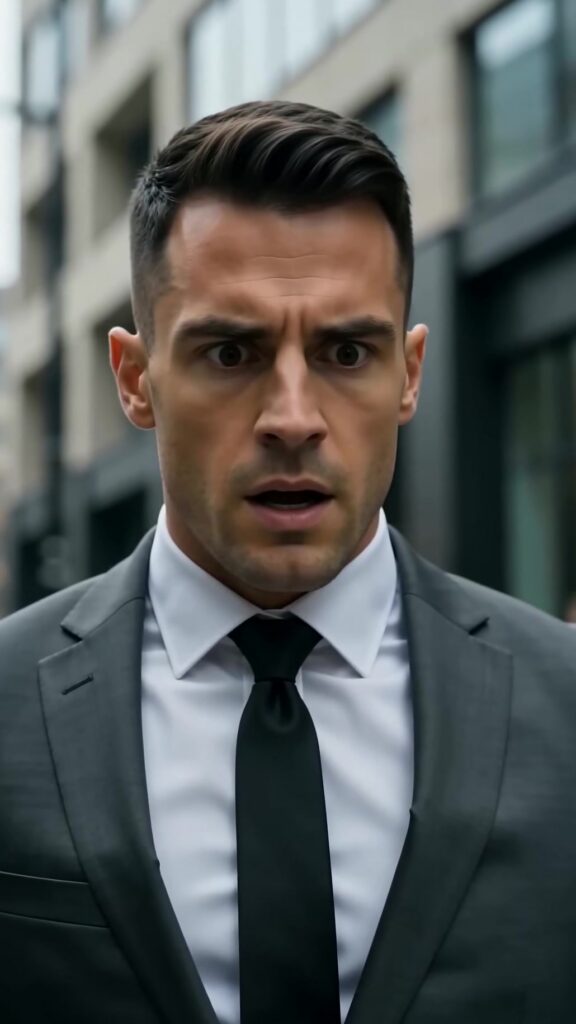
Daniel Hartwell stepped out of the black sedan like the whole city belonged to him, and honestly, most days it kind of did. The curb outside Hartwell Tower was a private lane in everything but the signage. Security in dark coats. A doorman who knew everyone’s name before they said it. Cameras tucked into corners like metal birds. Daniel adjusted his charcoal suit jacket with the lazy precision of a man who’d had it tailored three times just to get the shoulders right, and his shoes flashed a clean, bright polish that looked ridiculous against the slushy gray of late winter.
Above the revolving doors, the name HARTWELL sat in brushed steel letters, tall enough to be seen from across the street. It wasn’t just a sign. It was a reminder. Daniel’s grandfather had started with a warehouse and a handshake; his father turned it into real estate, finance, and an empire of “strategic partnerships.” Daniel had inherited the whole thing like a family heirloom—some people got a watch, he got a skyline.
People flowed around him fast, heads down, thumbs moving, earbuds in. The city perfected the art of not noticing. Not noticing the dented bus stop bench. Not noticing the argument in the crosswalk. Not noticing the woman sitting near the metal bollards, back against the cold stone, a cardboard sign propped against her knees.
PLEASE HELP US.
Three little boys stood beside her in matching olive jackets. They looked like someone had tried very hard to make them presentable with very little money—clean zippers, hats that didn’t quite cover their ears, sneakers that had seen better days. Their hands were tucked into their sleeves, shoulders hunched like they’d been taught that warmth was something you guarded.
Daniel almost walked past. He had a meeting at nine with city council, a noon call with his lawyers, and a charity gala he’d promised to “stop by” tonight. Someone would take care of it, he told himself. Someone always did. That was the point of having a whole building full of someones.
Then the woman looked up.
“Please,” she said, soft enough that it barely cut through the street noise. “Anything helps.”
Daniel’s hand paused near his coat pocket, out of habit as much as guilt. He carried cash for moments like this because it was easier than feeling. He started to pull out a bill without really looking—until her voice hit him before her face did.
It was the same voice that used to call him a show-off when he revved his old motorcycle. The same voice that laughed into his shoulder at two in the morning on a cheap balcony in Barcelona. A voice he hadn’t heard in years, but his brain kept a perfect recording of it anyway.
He turned.
The city noise didn’t actually fade, but it felt like it did. He saw her clearly then: chapped lips, hair pulled into a tired knot, cheeks hollowed by stress and bad sleep. Yet her eyes were unmistakable, wide and dark and sharp like she was always watching for the next thing to go wrong.
“Emma?” The name came out of him like a cough.
The cardboard sign slipped from her fingers and flopped face-down on the pavement.
“Daniel?” She said it like she wasn’t sure if it was him or a trick her mind was playing because she was cold and desperate.
For a moment, neither of them moved. Daniel stared at the worn coat that didn’t fit right, at the thin gloves with holes in the fingertips. He stared at the boys, their faces partially hidden behind their collars, and felt a slow, unpleasant pressure build in his chest.
“What are you doing here?” he asked, voice low. “I thought you left the country.”
Emma’s throat worked. “I did. I tried. I…” She swallowed like the words were too big. “I tried to find you.”
Daniel shook his head, confusion coming out as anger because anger was easier to hold. “No. You disappeared.”
Emma flinched as if he’d raised his hand, which made something hot and ugly twist inside him. “You think I wanted to?” she whispered. “You think I wanted any of this?”
One of the boys tugged at her sleeve, eyes fixed on Daniel with a curiosity that wasn’t scared yet, just cautious. “Mama… who’s that man?”
Mama.
Daniel’s gaze dropped to the child, then to the other two. Three sets of eyes looking back at him. Same shape. Same dark brown. Same odd little tilt at the outer corners that Daniel had inherited from his mother’s side—an old family trait that photographers always tried to capture because it made him look like he knew secrets.
Emma pulled the boys closer, as if she could physically block Daniel’s sightline, but it was too late. Daniel felt the blood drain out of his face so fast it left him dizzy.
The oldest-looking boy—maybe six, maybe seven—tilted his head and said, “Mama… he has the same eyes as us.”
Daniel didn’t hear the honk of a cab or the shuffle of commuters. He heard his own heartbeat and the sharp buzz of memories trying to rearrange themselves. Barcelona. Emma’s small apartment above a bakery. A fight on the phone with his father. Emma telling him she couldn’t do this “halfway,” that she needed him to choose something.
He’d chosen the skyscraper. He’d told himself it was temporary, that once he stabilized things at Hartwell, he’d go back for her. Then his father had a stroke, then the board got jumpy, then the tabloids found a photo of him with Emma and called her “mystery girl,” then his assistant said Emma had stopped answering. Disappeared. Gone. No forwarding address. Like she’d never existed.
Daniel’s mouth went dry. “Emma,” he said slowly, “are they…?”
Her eyes flashed. “Don’t,” she said. “Don’t do that thing where you ask a question like you already know the answer but you want me to say it so you can react.”
He exhaled, shaky. “I’m not reacting. I’m—” He stopped, because what was he? A billionaire standing over a woman on the sidewalk like she was a problem to solve?
Emma lifted her chin even though it trembled. “Yes,” she said. “They’re yours.”
The words landed hard. Daniel’s first instinct was denial, because the timeline in his head didn’t want to cooperate. His second instinct was to count backward, to do mental math like that could change anything. His third instinct—small, quiet, and surprisingly clear—was a wave of something that felt like grief, like he’d missed an entire life and only now realized it had been happening without him.
“Why didn’t you tell me?” he asked, and it came out rough.
Emma laughed once, humorless. “I tried.” She pointed with two fingers, as if she’d learned not to waste energy on full gestures. “I wrote. I called. I sent messages to numbers that stopped working. Your assistant told me you were ‘unavailable.’ Your father’s security chased me away from the building when I showed up in person.”
Daniel’s jaw tightened. He could picture it too easily: his father’s people, the gatekeeping, the neat cruelty disguised as protocol. “That shouldn’t have happened.”
“But it did.” Emma’s voice cracked on the last word, and she looked away quickly, blinking hard. “I left the country because I was scared. Not of you. Of what your family can do when they decide someone is… inconvenient.”
Daniel felt a surge of anger that finally had the right target. “My father?”
Emma didn’t answer directly. She just pulled the boys closer and said, “I didn’t want them to grow up being used as leverage.”
The youngest boy—smallest, round-cheeked—peered out from Emma’s coat and whispered, “Are you… are you a bad guy?”
Daniel’s throat tightened. He crouched down, ignoring the fact that his suit pants would hate him for it. At their level, he could see details that made it worse: a missing front tooth, a faded sticker on a mitten, a faint bruise-yellow mark on a kid’s wrist like someone had grabbed too hard somewhere.
“No,” Daniel said softly. “I’m not.” He hesitated, then added, “At least… I’m trying not to be.”
The middle boy stared at him with the blunt honesty kids carried like a weapon. “Do you have food?” he asked.
Emma’s cheeks flushed, embarrassment rising fast. “Ben,” she whispered, as if she could hush hunger into politeness.
Daniel stood up, decision snapping into place with a clarity he didn’t feel in boardrooms. “Come inside,” he said.
Emma’s eyes widened again, not with recognition this time but with suspicion. “Daniel—”
“Inside,” he repeated, gentler. “It’s warm. There’s food. And there’s a conference room where we can talk without an audience.” He looked toward the entrance, where the doorman had started watching in that careful, professional way. “No one’s going to touch you. Not today.”
Emma hugged the boys tighter. “You don’t get to say that like it’s a promise you can keep.”
Daniel met her gaze. “I can,” he said. “Because this building has my name on it. And for once, I want that to mean something useful.”
He reached into his pocket, not for cash this time, but for his phone. He texted his head of security two words: HOLD EVERYTHING. Then, to his assistant: CLEAR MY MORNING. PRIVATE FAMILY MATTER.
Emma watched his fingers move as if she expected the trap to spring any second. But the boys, sensing warmth and the possibility of food, shuffled closer on their own, tiny shoulders bumping into Daniel’s polished world like they’d always belonged there and no one had bothered to make space.
As Daniel guided them toward the revolving doors, he felt the weight of the past six years settle onto him—heavy, unfair, and completely real. He didn’t know what fixing it looked like. He didn’t know what his father had done, or what Emma had survived, or how three kids were supposed to fit into a life built on meetings and headlines.
But when the oldest boy slipped his hand into Daniel’s—casual, like it was the most normal thing in the world—Daniel held on like he’d been waiting his whole life to learn how to do that.
Outside, the city kept rushing, heads down, pretending not to see. Inside, the doors turned, and Daniel Hartwell walked into his own building with a family he never knew he had, already planning who he’d have to fight to keep them safe.
And for the first time all morning, he wasn’t thinking about whether the city belonged to him.
He was thinking about whether he could finally belong to someone else.