The red toy was the kind of bright, cheap plastic that somehow looked like it had a soul. It bounced once, twice, then rolled away from the little boy’s hands like it had places to be. The kid lunged after it, sneakers squeaking on the tile, his tiny voice cutting through the station noise.
“My toy!”
The platform was already a mess of morning commuters—coffee cups, rolling suitcases, people watching their phones as if the universe couldn’t possibly surprise them. But the moment the toy spun toward the yellow line, the whole crowd did this collective inhale. Like the station itself realized, a little late, what was about to happen.
And just seconds earlier, the crowd had been busy doing something else: pretending not to notice an old blind man inching his way along the flow of bodies.
He had a white cane, a neat brown coat that had seen too many winters, and the careful, practiced posture of someone who knows the world won’t make room for him unless he forces it. He paused at the edge of a column, listening, orienting himself. Then a businessman in a suit sharper than the morning air shoved past him, shoulder-first, like the old man was just furniture.
“Move, old man,” the businessman snapped without even breaking his stride.
The blind man dipped his chin, absorbing the insult like it was weather. “I’m trying,” he said quietly, voice steady but tired.
Then the toy rolled. The child chased. The train horn bellowed like an angry animal.
Somebody yelled “Hey!” and someone else shouted “Stop him!” but nobody’s feet moved. You could almost see the math happening in people’s heads: distance to the kid, speed of train, the awful possibility of being the one who misjudges.
The mother’s scream cracked through all of it. “My son!”
The blind man’s head snapped toward the sound with a speed that didn’t match his age. He didn’t hesitate, didn’t ask questions. He just moved—fast, awkward, fearless—his cane clattering away as his hands reached out into the air like he could grab the moment itself.
“Stop!” he called, but not to the child. To the world. Like it might listen.
His fingers caught fabric—small, rough coat material—and he yanked. The kid stumbled backward, startled, landing hard on his butt with a squeak of shock. The train tore past in a roar, wind slapping everyone’s clothes, dragging loose hair and paper and breath toward the tracks. The red toy got swallowed by the gust and vanished, as if it had never existed.
For a second the platform sounded like nothing at all. Then noise rushed back in: gasps, a baby crying, someone’s coffee spilling, a phone clattering to the ground.
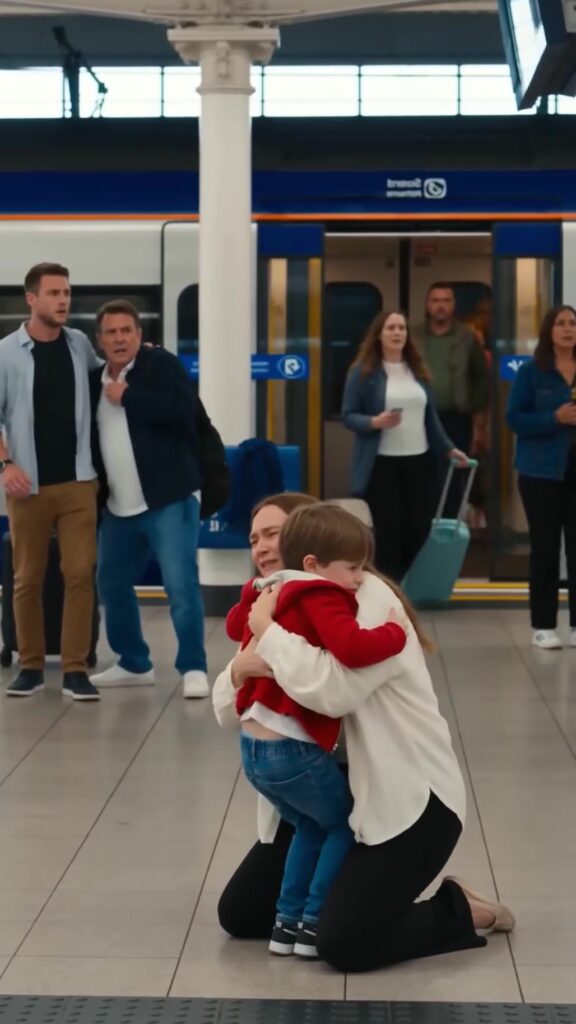
The mother dropped to her knees beside her son and wrapped him up so tight he looked like he’d disappear into her coat. “You’re okay,” she kept saying, like she had to convince herself. Then she turned, eyes wet and wild, and grabbed the blind man’s hands as if they were the only stable thing left in the station.
“You saved him,” she whispered. “You saved my baby.”
The old man’s chest heaved. He looked toward her voice and gave a tiny nod, like he didn’t want attention for it. “Just… hold him close,” he said.
Behind them, the businessman who’d shoved him stood frozen. His face had lost that polished certainty it wore like a mask. His eyes weren’t on the mother or the kid. They were locked on the blind man’s wrist.
A bracelet sat there, half-hidden under the old man’s sleeve. It wasn’t fancy. Dark leather, worn smooth, with a small metal clasp that caught the station light. Something was engraved on the clasp—too small to read from a distance—but the businessman’s entire body reacted as if he’d seen a ghost.
He stepped forward, throat working. “That bracelet…”
The blind man tilted his head. “Who’s there?”
The businessman’s hand lifted before he seemed to realize he was doing it. He hovered, then lightly touched the bracelet with fingertips that suddenly trembled. Like he was afraid it would burn him.
“My father wore this,” he said, voice thin. “Before he disappeared.”
The blind man went very still. The mother, still clutching her child, looked between them like she’d wandered into the wrong scene of a movie. Nearby commuters pretended to check schedules while absolutely listening.
“Your father,” the blind man repeated, testing the words. “Name?”
“Elliot Reed,” the businessman said. He swallowed. “I’m Grant Reed.”
The blind man’s face shifted—not into recognition exactly, but into something heavier. Something with history behind it. He turned his wrist slightly, as if feeling the bracelet’s weight in a new way. “Elliot,” he murmured. “So he finally had a son who learned to tie a perfect knot.”
Grant flinched, uncertain if that was an insult or a memory. “Where did you get it?” he demanded, then caught himself and softened, but only a fraction. “I’m sorry. I just—my dad vanished when I was fourteen. Police said accident. My mother said not to ask questions. And then one day his things were gone too, like he’d never lived with us.”
The blind man’s lips pressed together. “I didn’t steal it,” he said. “If that’s what you’re thinking.”
“I didn’t say—” Grant began, but his earlier cruelty was suddenly all over his face, reflected back at him by the station’s fluorescent lights. He’d shoved this man like he was nothing. And now the man was holding a piece of Grant’s life on his wrist.
The blind man’s fingers found the clasp by touch, slow and sure. “Your father gave it to me,” he said. “A long time ago. He said, ‘If anything happens to me, this will help someone remember the truth.’”
Grant’s jaw tightened. “Truth about what?”
“About the kind of man he was becoming,” the blind man said softly. “And the kind of man you might become if nobody stopped you.”
That landed like a slap. Grant’s eyes flashed. “You don’t know me.”
The blind man angled his face toward Grant’s voice, calm as stone. “I know you shoved a blind stranger without thinking. I know you were too frozen to move when a child ran toward a train. I know you found your courage only when you saw something that belonged to you.”
Grant’s mouth opened, but no words came out. Around them, the platform kept breathing and moving—announcements, footsteps, life continuing. Yet in that small pocket of space, it felt like time had stopped to watch Grant Reed finally meet himself.
The mother stood, her son still pressed to her hip. She looked at Grant with open disgust. “He’s right,” she said. “You were right there. You did nothing.”
Grant’s cheeks burned. “I… I didn’t know what to do.”
“Neither did I,” the blind man replied. “But my hands moved anyway.”
Grant stared at the bracelet again. Up close he could see the engraving: a set of numbers and a tiny symbol, not decorative but deliberate. Coordinates maybe. A mark. The kind of thing you’d hide in plain sight because no one expects a bracelet to be a map.
His breath hitched. “That’s… not a design.”
“No,” the blind man said. “It’s a promise. And a warning.”
Grant’s voice shook now, anger and fear blending together. “Why do you have it? Where is my father?”
The blind man’s thumb brushed the engraved metal like he was reading it with his skin. “He tried to fix something he helped break,” he said. “Powerful people don’t like being fixed.”
Grant’s eyes darted around, suddenly paranoid in the bright open station. “Are you saying he was killed?”
“I’m saying he was taken,” the old man replied. “And I’m saying this bracelet can take you to the evidence—if you’re brave enough to follow it.”
Grant let out a sharp, humorless laugh. “Brave? You think I’m—” He stopped, because a minute ago he would’ve said yes. He would’ve claimed bravery like it was part of his résumé. But a blind man had just done what he couldn’t.
“Why didn’t you come forward?” Grant demanded, desperate to shove blame anywhere but his own chest.
The blind man’s expression went distant. “Because when I did, no one listened. I was a blind street musician back then. Your father found me outside the courthouse, playing for coins. He sat with me for an hour, didn’t speak, just listened. Then he asked me to hold onto this. ‘People notice a rich man’s watch,’ he said. ‘Nobody notices a blind man’s bracelet.’”
Grant’s throat tightened. The idea of his father sitting quietly with a stranger, hearing music, felt like a memory he should have, but didn’t. “What’s the symbol?”
“A train,” the blind man said. “Funny, isn’t it?”
Grant stared at him. The station noise swelled again as another train announcement echoed overhead. Grant suddenly looked nauseous, like the universe had lined up too many coincidences in one morning.
“Listen to me,” the blind man said, lowering his voice. “If you take this bracelet, you’ll wake up things that were meant to stay asleep. And those things don’t just hurt the people who deserve it. They hurt everyone around them.”
Grant’s eyes flicked to the mother and child. The boy, now calmer, clutched his mother’s collar and stared at the blind man with the reverence kids reserve for superheroes and stray dogs. Grant’s stomach dropped with shame.
“Then why show me at all?” Grant asked, hoarse.
The blind man’s mouth curved into something that wasn’t quite a smile. “Because you mocked me,” he said. “And then you recognized me. Not with your eyes. With your guilt.”
Grant swallowed hard. “I’m sorry,” he managed. It sounded unfamiliar, like a language he didn’t use often.
“Sorry doesn’t change the past,” the blind man replied. “But it can change what you do next.” He rotated his wrist, and before Grant could stop him, he unfastened the clasp and pressed the bracelet into Grant’s palm. The leather was warm from his skin.
Grant held it like it might explode. “What do I do?”
“Go to the coordinates,” the blind man said. “And when you get there, decide what kind of man your father hoped you’d be.”
Grant’s fingers tightened around the bracelet. For the first time, he noticed the old man’s hands—scarred, strong, the hands that had yanked a child back from death. “And you?” Grant asked quietly.
The blind man reached for his cane, locating it with his foot. “Me?” he echoed. “I’ll keep listening. The world tells you everything if you stop pretending you’re too busy.”
The mother stepped closer, voice gentler now. “What’s your name?”
The blind man paused, as if deciding whether names mattered. “Jonah,” he said. “Just Jonah.”
Grant stared at Jonah like he was seeing him for the first time, though he couldn’t claim that excuse. “Jonah,” he repeated. “If I go… if I find something… can I come back?”
Jonah tilted his face toward him. “If you come back,” he said, “come back kinder.”
Grant nodded once, sharp and determined, and slid the bracelet into his suit pocket like it weighed more than gold. As he turned toward the station exit, the train wind still seemed to cling to him—cold, urgent, full of consequences.
Behind him, Jonah tapped his cane against the platform and walked on, disappearing into the crowd that still didn’t make room, except now there was a child watching him like a guardian, and a mother who moved people aside without asking.
And Grant Reed, who had mocked a blind old man an hour ago, walked into the morning carrying a bracelet that could ruin him—or finally make him worth his own name.