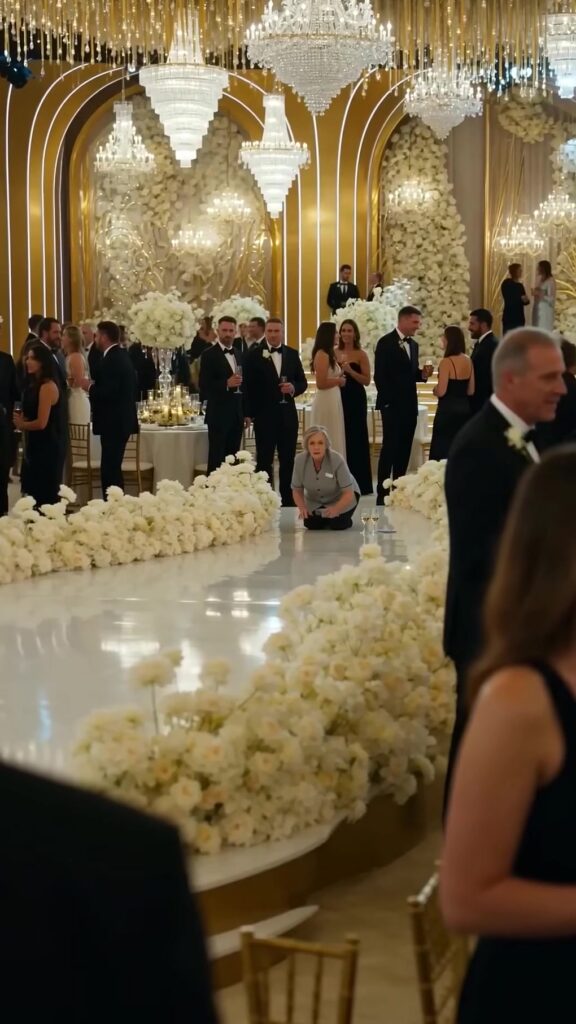
By the time the string quartet slid into something soft and expensive-sounding, the champagne had already started to lose its battle with gravity. A flute tipped near the golden aisle runner, and sparkling liquid arced down like it was trying to autograph the floor. Before anyone could gasp long enough to feel helpful, a woman in a gray cleaning uniform appeared at the edge of the crowd with a folded cloth and a small spray bottle. She knelt beside the gilded fabric like she belonged there, like she’d been invited.
No one had introduced her. No one had to. The venue had a way of producing staff the same way flowers produced petals—quiet, useful, easy to ignore.
Her name tag said MARA in thin black letters. Her hair was pulled into a tight bun that made her look younger than she probably was. She worked quickly, careful not to touch the aisle runner itself, wiping only the marble on either side as guests in black suits and dresses the color of berries stepped around her, barely lifting their hems.
“Honestly,” a voice hissed from somewhere that smelled like perfume and entitlement. “Could you not do that right now?”
Mara didn’t look up. Her shoulders made a polite little apology anyway, the kind people learn when they’ve been told sorry is safer than explanation.
“You’re ruining this wedding,” the same voice continued, louder this time, as if volume could make a person disappear.
Mara’s hands froze around the cloth. “I’m sorry,” she said, and the words fell out so small they barely reached the first row.
The voice belonged to a woman with a pearl clutch and a face that had never met consequences. She pointed toward the tall doors at the back of the hall. “Leave. Now.”
A hush ran through the guests—not the good, ceremonial hush, but the awkward one that comes when everyone pretends they aren’t watching. The bride, Liana, stood at the front beside a tower of white roses. Her smile had been pinned to her face for the last hour, and now it wobbled. She stared at Mara like she wanted to intervene but couldn’t find the correct social tool to do it.
“Stop,” Liana said, softly at first, then a little stronger. “She’s just cleaning.”
The pearl-clutch woman made a face that suggested cleaning itself was vulgar. “At a moment like this?”
Mara lowered her head, blinking fast. She stood up carefully, as if she could make her body smaller by moving slower. The cloth dangled from her fingers. “I can go,” she whispered.
As she straightened, something slipped from beneath the collar of her uniform—just a glint, like a coin catching sunlight. A thin chain. And at its end, a small ring that looked old enough to have stories stuck in its grooves.
The groom’s father, Harold Greaves, had been sitting in the front row with the posture of a man who’d paid for every chair in the room. He’d spent the morning looking pleased with himself, the kind of pleased that comes from knowing your checks clear. But the second the ring flashed, that expression drained out of him like someone had pulled a plug.
He made a sound—half inhale, half choke. One hand clutched the armrest as if the chair might float away.
“That ring…” he said, and his voice was suddenly not rich or commanding. It was thin. Human.
Mara’s hand shot up to her throat, yanking the necklace back under her collar. Panic crossed her face so fast it looked like a shadow. “Please don’t,” she breathed.
The officiant cleared his throat like he could fix the situation with paperwork. The quartet faltered, then stopped entirely, bows hovering above strings.
“Dad?” the groom, Evan, turned, confused. “What’s going on?”
Harold stood. It was not graceful. His knees protested. He stepped into the aisle without realizing he’d done it, eyes locked on Mara like she’d just walked in wearing a ghost.
“Where did you get it?” he asked.
Mara shook her head. “It’s mine,” she said automatically, then winced as if she’d spoken the wrong language.
“No,” Harold said. “No, that—” He reached out, then stopped himself, fingers trembling midair. “May I see it?”
People leaned in. Phones came up despite the signs about unplugged ceremonies. Liana pressed her bouquet against her stomach like it was armor.
Mara looked at the doors, the fastest exit. Then she looked at the faces—so many faces—and seemed to decide running would only make it worse. With a shaky hand, she pulled the necklace out again. The ring swung slightly, and you could see the metal was worn smooth where someone had once turned it over and over while thinking.
Harold took it between his thumb and forefinger like it might burn. He turned it toward the light pouring in from the tall windows. The inside of the band held an engraving—small, but clear. A date.
He swallowed hard. “My wife…” His voice broke, and the entire room changed temperature. “This is my wife’s ring.”
A murmur rippled through the guests like wind through tall grass. Evan’s face sharpened. “Mom’s ring? That can’t be right. Mom’s ring was—” He stopped because everyone knew the end of that sentence. It was buried. Lost. Gone with her.
Harold’s eyes stayed on Mara. Not angry now. Terrified. “Elise wore this every day,” he said, more to himself than anyone. “She never took it off. Not once. Not even when she… when she got sick.”
Liana took a step forward, careful in her heels. “Mara,” she said gently, “how do you have that?”
Mara’s throat bobbed. Her fingers twisted the chain until it bit into her skin. “I didn’t steal it,” she said quickly. “I swear. I didn’t even know whose it was.”
Harold’s laugh came out wrong. “You didn’t know? You’re wearing it on a necklace like a—like a keepsake.”
“Because it is a keepsake,” Mara snapped, then flinched as if she’d hit someone. She inhaled and tried again, voice softer. “Not from you. Not from her. From… from the person who gave it to me.”
There was a long, unbearable pause where everyone waited for the story to choose a shape. In that silence, Evan took a cautious step closer, eyes darting between his father and the woman in gray.
“Who gave it to you?” he asked.
Mara looked at him, and something in her expression shifted—recognition, maybe, or regret. “A nurse,” she said. “At St. Brigid’s. About six years ago.”
Harold’s face went even paler. St. Brigid’s. The hospice wing. The place they’d tried not to talk about.
“I worked nights there,” Mara continued, words spilling faster now, like she’d been holding them back with both hands. “I wasn’t cleaning venues then. I was cleaning hospital rooms. Mopping hallways. Changing trash. Whatever they’d let me do.”
She swallowed. “There was a patient. Woman with red hair. Always asked for the curtains open even when it hurt her eyes. She talked about her son like she was trying to memorize him.”
Harold’s knees bent as if the memory had weight. “Elise,” he whispered.
Mara nodded once. “She didn’t have visitors much. Not at night. Sometimes a man came during the day.” She glanced at Harold, not accusing, just stating. “One night she asked me to sit for a minute because she didn’t want to be alone. I wasn’t supposed to, but I did.”
The guests were so quiet you could hear the air conditioning click. Even the pearl-clutch woman had gone stiff, lips parted, no outrage left to spend.
“She told me she was scared her ring would end up in a drawer somewhere,” Mara said. “She said it had the date of her first dance with you.” She nodded toward Harold. “She said it was the happiest night of her life. But she didn’t want it to go to… to someone who would pawn it. She wanted it to go to someone who’d remember her like a person, not like a tragedy.”
Harold’s eyes were wet now, and he didn’t blink. “She gave it away?” he whispered, like the words were betrayal.
“She asked me to take it,” Mara said. “Not to keep forever. To hold. She said—” Mara’s voice caught. “She said, ‘If my son ever asks where it is, give it to him. Tell him I loved him loud enough for both of us.’”
Evan’s face folded. He made a sound that was half laughter, half sob, and brought a hand up to cover his mouth.
Harold stared at the ring like it had just rewritten his entire life. “She never told me,” he said, almost angry, almost devastated. “She never—”
“Maybe she tried,” Mara said, not unkindly. “Maybe you weren’t listening.”
That landed like a dropped glass. The groom’s father flinched, and for a second the rich man mask was gone entirely. Just a husband who’d missed the last request of his dying wife.
Liana stepped closer to Evan, her bouquet trembling. “Evan,” she whispered. “Are you okay?”
Evan nodded, but tears ran down his face anyway. He looked at Mara. “Why didn’t you come to us? Why wait until… today?”
Mara’s laugh was small and bitter. “I didn’t have your address. I didn’t have your last name. I didn’t even know if you’d believe me. And then one day, I saw the engagement announcement on the venue’s staff bulletin. Same face. Different suit.” She gestured helplessly at the room. “I told myself it was coincidence. Rich people all look… polished.”
She took a breath. “But when I saw him,” she nodded at Harold, “I knew. And I was going to leave it. I was going to put it in an envelope and drop it at the gift table and disappear.”
Harold stared at her. “So you wore it here?”
“Because I didn’t trust my apartment,” Mara said simply. “Because it felt safer on me. Because I’ve moved three times in two years. Because I didn’t want to lose the one thing I promised a dying woman I wouldn’t lose.”
Silence again, but different. Softer. Less entertained.
Liana exhaled slowly, as if she’d been holding her breath since “Leave now.” Then she did something that startled everyone: she stepped off the front platform, lifted her skirt slightly, and walked down the aisle toward Mara.
“I’m sorry,” she said to Mara, and the apology didn’t sound like a reflex. It sounded like a choice. “For how you were treated.”
Mara blinked, shocked into stillness.
Harold held the ring out toward Evan, not trusting his voice. Evan took it carefully, turning it in his palm, thumb rubbing over the engraved date like he was trying to feel his mother through metal.
“She remembered our first dance,” Evan whispered, almost to himself. Then he looked at his father. “Did you?”
Harold’s shoulders sagged. “I thought I did,” he said. “I thought I remembered everything that mattered.”
Evan closed his fingers around the ring. He looked at Mara with red eyes. “Thank you,” he said. “For keeping your promise.”
Mara’s chin trembled. “I didn’t mean to stop your wedding,” she whispered.
Evan wiped his face with the heel of his hand, then took Liana’s free hand and squeezed. “It’s okay,” he said. “Maybe it needed to stop for a minute.” He looked back at the guests, the phones, the pearl clutch, the stunned faces. “My mom deserves that minute.”
He turned to the officiant. “Can we… can we pause?”
The officiant nodded quickly, relieved to have a script again. “Of course.”
Liana looked at Mara. “Do you want to sit down? You shouldn’t be standing alone.”
Mara stared at the rows of expensive seats like they were booby-trapped. “I’m working,” she said automatically.
Liana shook her head. “Not right now,” she said. “Right now you’re a person who carried something precious into this room.” She glanced at the pearl-clutch woman with a look sharp enough to cut satin. “And anyone who can’t see that can step outside.”
Somewhere in the back, someone let out a breath they’d been holding. A chair scraped. The pearl-clutch woman turned red and stared at her shoes.
Evan walked to Mara and held the ring up. “Would you,” he asked, voice thick, “would you tell me about her? About the things she said? Not all at once. Just… later. When we can breathe.”
Mara nodded, tears finally escaping. “Yeah,” she said. “Yeah, I can do that.”
Harold stood there, looking older than his tailored suit. He cleared his throat. “Mara,” he said quietly, and every head turned because he’d never used a staff member’s name like it mattered. “I owe you an apology.”
Mara didn’t answer right away. She just watched him, cautious, like apology from a man like him could be another kind of trap.
“And,” Harold added, voice cracking, “I owe Elise one too.”
Liana squeezed Evan’s hand and whispered, “We’ll do this. We’ll still get married. But… we’re going to do it like humans.”
Evan nodded, holding his mother’s ring against his heart for a second before slipping it into his pocket like it was alive.
The quartet started again, tentative at first, then steadier, as if the music had also been reminded it wasn’t just background for photos. Guests shifted, some wiping eyes, some lowering phones in embarrassment.
Mara sat in the second row at Liana’s insistence, still clutching her cloth like she didn’t know what to do with empty hands. Her uniform looked out of place among silk and lace, but for the first time since she’d walked in, no one stepped around her like she was invisible.
And when the officiant asked everyone to rise, they did—together—because the wedding had stopped for a ring, yes, but what restarted it was the sudden, awkward, undeniable fact that love leaves artifacts behind, and sometimes the person carrying them isn’t who you expect.