Everyone in the cafeteria had something to eat except him, which is the kind of thing you don’t really notice until you do. Trays clattered, milk cartons popped open, and the air smelled like pizza day pretending to be fancy. The line for fries was long, the line for salads was mostly kids trying to look like they didn’t care, and the line for talking was basically the whole room.
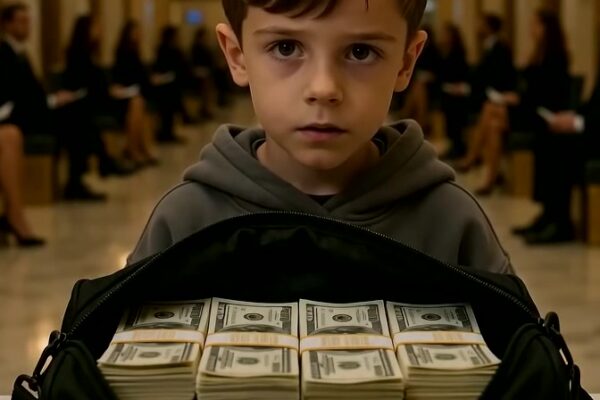
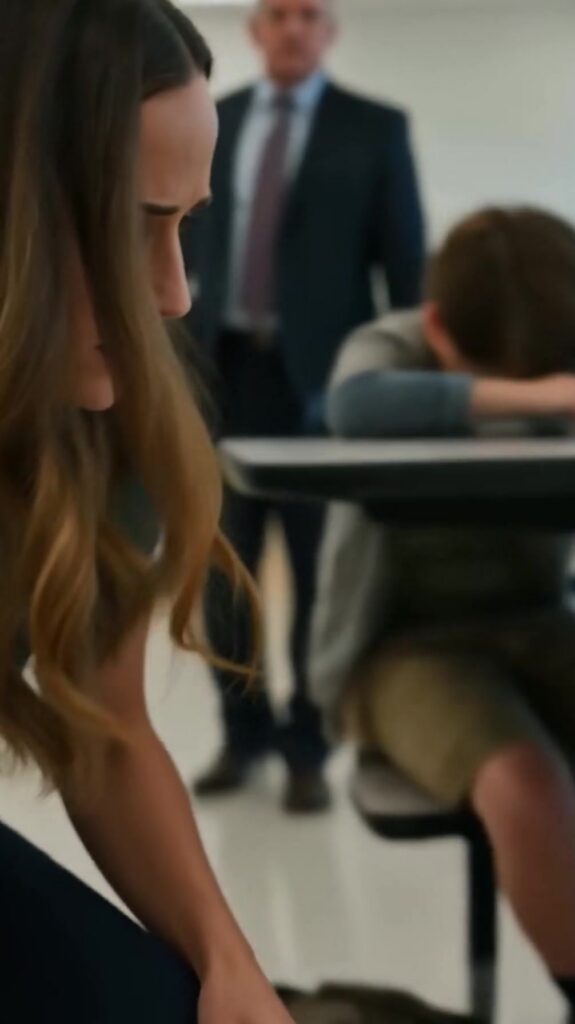
At the far end of the last table, tucked into the corner near the vending machines that never worked right, he sat with nothing. No tray. No carton. Not even one of those sad apples they handed out when you forgot your lunch money. His sleeves were pulled past his wrists like he was trying to hide his hands from the world, and he stared at the empty space in front of him like it might eventually fill itself out of sheer embarrassment.
His name was Miles Carter, though most people only knew him as “that quiet kid” or “the one who always reads” or, on days like this, “the kid with no lunch.”
A pack of seventh graders cut through the aisle in a wave of loud laughter. One of them, a kid with a haircut that looked like it had been sculpted out of gel, angled his chin toward Miles and stage-whispered, “Yo, he has no lunch.” The others laughed the way kids laugh when they want to be seen laughing.
Miles didn’t look up. He just curled his fingers around the edge of the bench, knuckles pale, and tried to shrink without moving.
Then the backpack thing happened.
It wasn’t even a big dramatic shove, more like a casual flick of a foot—like the kid was nudging a rock off a sidewalk. Miles’s old backpack, patched in three places and held together by a zipper that had long given up, slid off the bench and hit the tile with a heavy thud. The sound cut straight through the cafeteria noise. A few papers exploded out like startled birds: loose worksheets, a math notebook with bent corners, a library book with a torn dust jacket.
“Please stop,” Miles said, but it came out so quiet it was more breath than sound.
Normally that would’ve been the end of it—the pack would’ve kept moving, the moment would’ve dissolved into the cafeteria chaos, and Miles would’ve picked up the pieces later. But something shifted in the room, like the volume dial got turned down for just a second. Maybe because the thud was too heavy. Maybe because one of the papers floated right into someone’s spilled chocolate milk. Maybe because a teacher happened to be looking.
Ms. Carver, who taught social studies and wore her hair in a messy bun that somehow made her look more awake than everyone else, was walking past with a stack of hall passes. She stopped dead, eyes sharpening.
“Hey,” she said—not loud, but with that teacher tone that made even loud kids remember they had bones. “What’s going on?”
The seventh graders kept walking like they hadn’t heard. The one with the gel-hair shrugged with his whole body, like innocence was a jacket he could put on. “Nothing.”
Ms. Carver didn’t chase them. She didn’t have to. She just crouched next to Miles, already reaching for the papers.
“You okay?” she asked, voice softer now, like she was speaking through a doorway.
Miles nodded too fast. “I’m fine.”
But the way his ears were red said he was not fine at all.
Ms. Carver gathered the scattered sheets carefully, smoothing them with her palm. She handed him his notebook, then the library book. Then her fingers paused on something thicker, something that hadn’t looked like schoolwork at all.
It was an envelope. Old, not old like “last year,” but old like it had lived in a drawer for a long time. The paper was cream-colored and worn at the edges, and it had been sealed with a stamp—faded gold, pressed into wax that had cracked slightly with age.
Miles lunged for it too quickly. “It’s nothing,” he said, snatching it with both hands and trying to shove it back into his bag.
Ms. Carver didn’t grab it. She just froze mid-crouch, like someone had pressed a pause button on her. Her eyes stayed on the stamp, and whatever she recognized there made her face go strangely pale.
“Miles,” she said carefully. “Where did you get that?”
His shoulders rose. “It’s… it’s just something. It’s not important.”
Ms. Carver’s mouth opened, then closed again. She looked like she was trying to remember how to breathe. Then she stood, envelope still in Miles’s hands, but her gaze locked on it as if it were holding the room together.
“Wait here,” she said, and turned so fast her hall passes fluttered like cards.
Miles sat frozen. The cafeteria noise rushed back in around him, but it felt distant, like he was underwater. He held the envelope against his chest. He could feel the brittle wax under his thumb. He’d told himself a dozen times not to bring it to school. It was the kind of thing you kept hidden—proof of a life you didn’t really know how to explain.
Ms. Carver wove through tables toward the front, straight to where the principal stood near the lunch line, doing his usual “I am present and responsible” routine. Principal Hargrove was a tall man with a permanent worried crease between his eyebrows, like the building itself had given him that wrinkle.
Ms. Carver leaned in close and whispered something. Hargrove’s expression shifted from routine concern to something like shock. His eyes cut across the cafeteria and landed on Miles. Then back to Ms. Carver. Then, weirdly, to the walls—like he was suddenly seeing the room as more than paint and fluorescent lights.
Hargrove walked toward Miles with Ms. Carver a step behind, and the path they took felt like it made a quiet tunnel through the noise. Kids watched, forks paused midair.
“Miles,” Principal Hargrove said, voice low. “Can we speak with you for a moment?”
Miles’s throat tightened. Getting called out in the cafeteria was basically every kid’s nightmare. “Did I do something?”
“No,” Ms. Carver said quickly. “No. Not at all.”
Miles stood because standing felt safer than sitting. His backpack strap hung limply, one buckle snapped, and he held the envelope like it might bite someone if he let go.
Hargrove nodded toward the doorway. “My office. Just a minute.”
Kids leaned in as they passed, hungry for drama that wasn’t theirs. Miles kept his eyes on the floor, feeling the heat crawl up his neck. Halfway out, he heard someone mutter, “What’s so special about him?” and it landed like a pebble in his shoe.
In the office, the air smelled like printer paper and stale coffee. A framed photo of the school’s opening day hung behind the desk, all shiny smiles and ribbon-cutting scissors.
Principal Hargrove held out his hand, not demanding, just asking. Miles hesitated. Ms. Carver’s eyes were wet already, like she was trying not to cry in a room where no one else seemed to understand why.
“May I?” Hargrove asked gently.
Miles swallowed and handed over the envelope.
The principal didn’t open it right away. He just turned it over, tracing the stamp with his thumb like he could read it in braille. The gold seal was worn but still clear enough to make out the design: a small crest, a single star above a book, and the letters C.H.F. curved underneath.
Ms. Carver whispered, almost to herself, “Carter-Hollis Foundation.”
Miles’s eyes flicked up. “You know it?”
Hargrove’s voice softened in a way Miles had never heard from him. “This school was built with their money,” he said. “A century ago. We still have plaques. Grants. Scholarships.”
Miles’s hands curled into his sleeves again. “I don’t have any money,” he said quickly, as if the accusation was already coming. “We… we live with my aunt now. My mom—”
“Miles,” Ms. Carver said, and reached out, stopping just short of touching his shoulder. “No one is saying you do.”
Hargrove carefully broke the cracked wax. The sound was tiny, but in the quiet office it felt huge. He unfolded the letter inside, paper thin and covered in neat, looping handwriting.
He read the first line, and his face changed like someone had turned on a light behind it.
Ms. Carver leaned in, reading along over his shoulder. Her eyes filled fast, tears collecting like she’d been holding them back for years and this was finally the excuse they needed.
Miles watched them, confused and scared and suddenly angry. “What does it say?”
Hargrove cleared his throat, but it didn’t help. His voice trembled anyway. “It’s addressed to… the future caretaker of Carter-Hollis Academy,” he said. “That’s what this school was called before the district renamed it.”
Miles blinked. “It’s just Jefferson Middle.”
Ms. Carver let out a shaky breath. “Not originally.”
Hargrove kept reading, eyes scanning the page like he couldn’t believe the words were real. Then he looked up at Miles, and there was something in his expression that wasn’t pity, wasn’t suspicion—something closer to awe mixed with heartbreak.
“Miles,” he said, “this letter… it says the founder set aside a trust. Not for fancy upgrades. For lunches. For supplies. For kids who come to school with nothing and pretend they’re fine.”
Miles stared at him. “That can’t be real.”
Ms. Carver laughed once, a small wet sound. “It’s real,” she whispered. “I’ve seen that stamp on old documents in the district archives. I used it in a lesson once.” She wiped her cheek with the back of her hand, embarrassed and emotional at the same time. “But I never thought I’d see it like this.”
Miles’s chest tightened. “Why would it come to me?”
Principal Hargrove flipped to the last page. “Because,” he said slowly, “the letter says it should be given to the last living Carter descendant enrolled at the school, if one is found.”
Miles’s lips parted. “My dad’s last name was Carter,” he said. “I barely knew him. He died when I was little.”
Ms. Carver sat down suddenly, as if her legs forgot their job. “Oh, sweetheart,” she murmured.
Hargrove looked toward the window, out at the cafeteria where kids were still eating, still laughing, still forgetting what it was like to be the only one without a tray. Then he looked back at Miles and lowered his voice like the words were fragile.
“This school,” he said, “was his family’s. It exists because of them. And it looks like somewhere along the line, we forgot what it was built for.”
Miles didn’t know what to do with that. The idea sat in his stomach like a stone: heavy, unreal. He thought of the empty space on the table. The laughter. The backpack on the floor. His own voice saying please stop, like it was a question.
“I don’t want people to treat me weird,” he said quietly. “I just… I just wanted lunch.”
Principal Hargrove nodded. “Then that’s where we’ll start,” he said. “Lunch. And then we fix the rest.”
Ms. Carver reached into her desk drawer—because teachers always had snacks like magic—and pulled out a granola bar, offering it like it was something sacred. Miles took it slowly, as if he was afraid it would vanish.
Through the glass, the cafeteria buzzed on. No one out there knew that an old letter had just reminded the adults what the building was supposed to be. No one knew that the kid with no lunch had been carrying a key in his backpack the whole time, sealed in faded gold.
Miles peeled the wrapper back and took a bite, small and careful. It wasn’t pizza day, and it wasn’t warm, and it wasn’t enough to erase everything.
But it was something.