The gala hall glittered with crystal chandeliers, polished glass, and people who had never gone hungry a day in their lives. It was the kind of room that smelled like citrus polish and expensive perfume, where laughter didn’t bounce so much as glide, careful not to scuff the marble. Waiters floated past with trays of food so pretty it seemed like a crime to chew it. The silent auction tables were dressed in velvet and optimism.
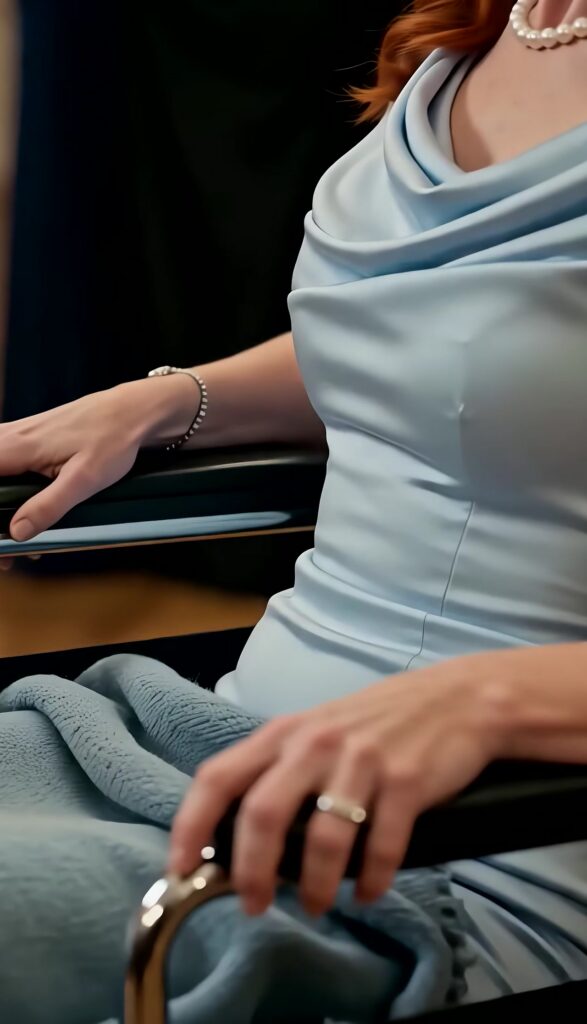
Mara Ashford sat near the center like a piece of art the donors had paid to admire. Pale blue gown, red hair pinned back in a way that made her look untouchable, pearls laying obediently on her collarbone. She kept her hands folded over a soft blanket covering her legs, because it was easier than watching people glance down and then look away too quickly, like her wheelchair was contagious. Someone had positioned her with a perfect view of the stage and a worse view of the exit.
She’d learned the rules of these nights: smile when they praised your bravery, tilt your head when they asked if you’d “ever tried new treatments,” accept the pity without letting it show on your face. The gala was for the Ashford Foundation—her family’s name in sleek letters on the programs. Healing, access, opportunity. Big words. A lot of hors d’oeuvres.
Then the crowd shifted.
It wasn’t the usual ripple caused by a celebrity arrival or a donor with a louder laugh than everyone else. This movement had an edge, like people were trying to make themselves smaller without knowing why.
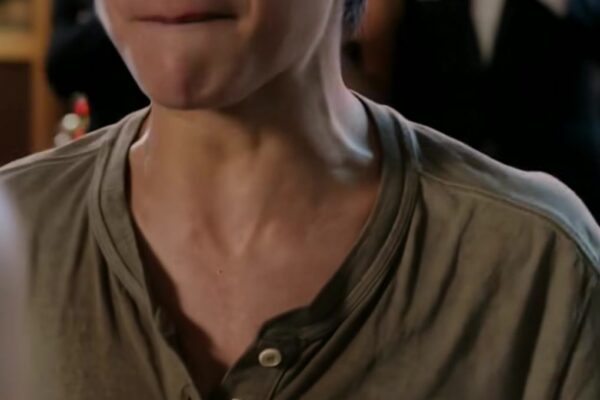
A little boy walked in from the direction of the service corridor, like he’d taken a wrong turn from the back-of-house world and refused to apologize for it. Dirt smudged his cheek. His Yankees t-shirt looked like it had survived three owners and a dog. His jeans were ripped in a way that didn’t come from fashion. He was thin enough that the fabric hung from his knees like it was tired too. His hair stuck up in stubborn spikes, and his eyes were the kind you saw in tired adults at bus stops—steady, far away, holding too much.
He moved straight through the glittering wealth like he didn’t belong there and didn’t care. Guests watched him like he was a spilled drink: an inconvenience, a mystery, something somebody should handle.
Mara’s first thought was practical. Someone’s child. A staffer’s nephew. A charity case brought in for a staged photo op. She’d seen those too—cute, curated hardship, always with a foundation representative nearby to control the narrative.
But there was no handler. No frantic event coordinator trailing him with a headset and panic. The boy walked as if he’d decided the room was his, and everyone else was just renting it for the evening.
He stopped beside Mara’s chair.
Before anyone could intercept him, he dropped to one knee. The action wasn’t dramatic; it was careful, like he’d practiced not to startle animals. He placed his small hand on top of the blanket, directly over where her fingers rested beneath it.
The touch wasn’t hard, but it cracked something in the air. Mara stiffened. Her first instinct was to pull away—touch at these events always came with a price. Sympathy touch. Donor touch. Photo touch.
She turned sharply, startled by the contact and by the boy himself. “Who are you?”
He didn’t flinch. His breath shook, tiny and uneven, like he’d been running or crying or both. “I can help.”
Mara blinked, because the words didn’t fit the boy. Help was what adults promised in press releases. Help was what doctors charged for. Help was what the foundation pretended it could buy for other people while she sat and watched.
“Sweetheart,” she said automatically, voice smooth with years of training, “you shouldn’t be—”
“Please,” he whispered, and his voice wasn’t cute or pleading in a childish way. It was raw. “Trust me.”
Nearby conversations thinned. Someone paused mid-sip. A glass clinked once against a ring and then went quiet. The band kept playing, but the music suddenly sounded too cheerful for the moment forming like a bruise.
Mara felt her fingers tighten under the blanket. She was aware of security across the room, two men in dark suits who hadn’t moved yet because they were waiting for a cue. She was aware of the eyes on her, the subtle excitement of people who sensed potential spectacle. She hated that. She hated being the centerpiece of anything that wasn’t her choice.
“What are you doing?” she asked, trying to keep her voice firm.
The boy leaned closer, so only she could hear him clearly. His eyelashes were clumped slightly, like he’d wiped his eyes with the back of his hand too many times. “One… two… three.”
Mara’s body did what it always did: nothing. The space below her waist stayed quiet, numb, an old absence she’d learned to live around. For one second, she felt foolish for even allowing this. For one second, she wanted to call security herself and end the humiliation before it bloomed.
Then her breath caught.
A tiny tremor moved through her leg—so small it could’ve been imagination. But it wasn’t. It came with heat, with pressure, with a strange prickling like waking up after sleeping in a bad position. Her mouth opened without sound. Her hands gripped the chair’s armrests hard enough to make the leather creak.
The boy’s face stayed focused, like he was holding a fragile thing in his mind and refusing to drop it.
Mara felt again—another ripple, stronger this time. Her calf twitched, her knee responding like it remembered its job. Her eyes widened. A sob tried to climb her throat and she swallowed it down, terrified of scaring the moment away.
“Please,” the boy said again, softer now, almost tearful. Not begging for her money. Not asking for anything. Just anchoring her to whatever was happening.
And then she rose.
It wasn’t graceful. Her hands shot forward, grabbing the edge of a nearby table for balance. The blanket slid off her lap and fell to the marble with a whisper. Her knees shook as if they were surprised to be included. The room inhaled as one body.
The band stopped mid-note. A cymbal rang out and then died. Forks paused above plates. Conversations broke like glass.
Mara stood in total shock, staring down at her own legs as if they belonged to someone else. Tears filled her eyes so fast the chandeliers turned into blurs. “How…?” she breathed.
The boy looked up at her, his mouth trembling, his eyes shining as if he’d been holding back a flood. “My mom said your heart would remember first.”
The line hit her harder than the sensation in her legs. Heart. Remember. Not science. Not luck. Not donation-driven miracles. Something older. Something personal.
Mara bent toward him, hands shaking, and that was when the pendant at his neck caught the light. A small piece of metal on a frayed cord. Not costume jewelry. Not something you’d find in a souvenir shop. It was an heirloom style—simple but unmistakable, etched with an emblem she’d seen stamped into wax seals and engraved into her family’s silver: a crest of interlocking branches and a tiny star.
Her stomach dropped like an elevator snapping its cable.
“Where did you get that?” Her voice came out thin, not the polished gala voice. The real one.
The boy lifted trembling fingers to the pendant as if it burned and comforted him at the same time. “It was hers,” he said. “She told me not to lose it. She said if I found you, you’d know I wasn’t making things up.”
“Who is ‘she’?” Mara asked, though she already had names piling up in her mind—women who’d worked for the family, nurses, assistants, people her parents had dismissed as easily as they dismissed an empty wine glass.
He swallowed hard. “My mom.”
Mara’s knees nearly buckled, not from weakness now but from the sudden weight of memories she’d packed away and labeled too painful to open. A summer at sixteen. A secret. A phone taken away. A trip abroad that had been called “a reset.” Her father’s cold voice: This is for the best.
Her eyes searched the boy’s face and found fragments that didn’t make sense until they did—the curve of his cheekbone, the way his eyebrows angled when he was trying not to cry, the stubborn set of his jaw that mirrored the Ashford portraits lining their estate hallway.
“What’s your name?” she managed.
He hesitated, as if saying it out loud might make the room swallow him. “Eli.”
Mara’s throat tightened. She reached for him, slow, giving him a chance to pull away. He didn’t. When her fingers brushed his hair, it was warm and real and nothing like a staged charity moment.
“Eli,” she whispered, tasting the syllables like they were a truth she’d been denied. “Why are you here?”
His voice turned fragile and certain all at once. “She got sick,” he said. “She kept saying you’d help, but not with money. She said you’d help because you’d remember.” His eyes darted to the staring guests and back to Mara. “She told me you’d be surrounded by people who clap at the right times, but you’d still be lonely. She said if I touched you, you’d wake up.”
Mara’s heart hammered. Around them, security finally started to move, and she snapped her head up. “Stop,” she said sharply, and the closest guard actually did, startled by her tone. It was the first command she’d given in years that didn’t come wrapped in politeness.
She looked down at Eli again. “Your mother,” she said, voice breaking. “Where is she now?”
Eli’s lower lip quivered. “In a hospital. Not like this place,” he added, glancing around at the velvet and light. “She said I had to come before it was too late.”
Mara felt the room watching, hungry for a story, but she suddenly didn’t care. She had spent so long being elegant, composed, distant. Standing on legs that had just remembered how to hold her, she realized distance was a choice. Or maybe it had always been something that had been chosen for her.
She crouched down awkwardly, knees wobbling, so her face was level with his. “Eli,” she said, “tell me everything.”
He lifted the pendant again, letting it swing between them like a tiny, defiant star. He took a breath that shook his whole chest, and whispered, “She said… you’re my—”
His voice cracked on the last word, swallowed by the stunned silence of the gala, by the weight of a family crest against a child’s heartbeat, by the sudden possibility that the foundation bearing her name had been built to fix everyone except the one person she’d left behind.
And for the first time all night, Mara didn’t feel like an exhibit. She felt like a beginning.