The cobblestone street glowed under warm string lights and old yellow street lamps, like somebody had sprinkled honey across the ground and dared the night to taste it. It was one of those little old-town blocks where the buildings leaned in close, the windows were always foggy from kitchens, and you could hear laughter bounce off brick like it had nowhere else to go.
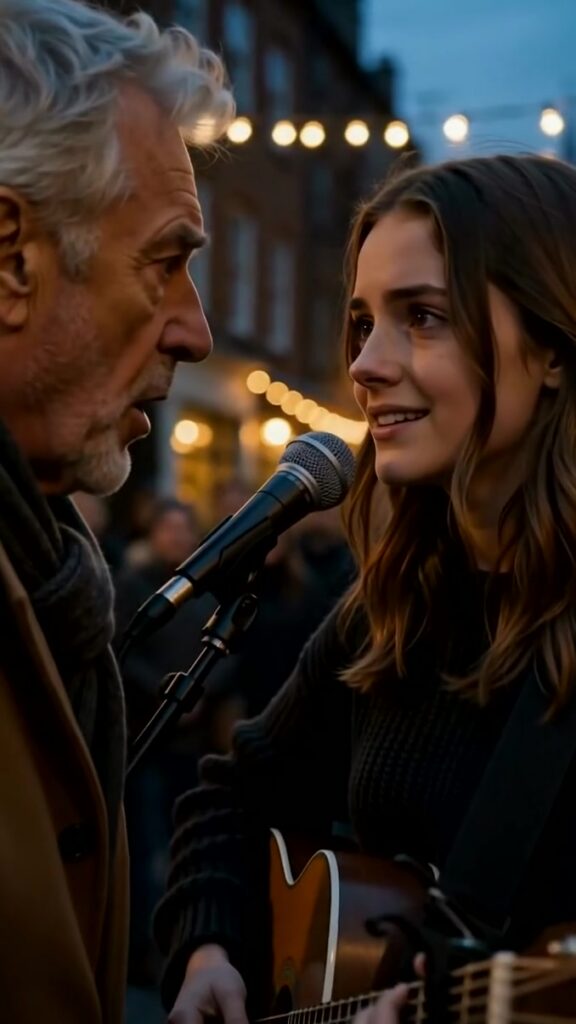
Mara stood under the awning of a closed bakery with a mic stand that wobbled if you looked at it wrong. Her guitar was scratched and familiar, the strap softened from years of use. She’d set her tip jar on a milk crate and taped a hand-written sign to it that said, “rent + ramen = thanks.” The crowd that night wasn’t huge—maybe twenty people—but they made a decent half-circle, as if they were protecting the space around her from the rest of the world.
She’d been playing upbeat stuff for most of the evening. Easy songs. Covers you could hum to. But now her fingers found the first gentle shape of a melody she didn’t play often. It always made her feel like she was opening a drawer she wasn’t supposed to touch. She closed her eyes anyway, because that was how the song demanded to be treated: like a secret.
Her voice was steady at first. Then the lyrics pulled at her ribs, and the final line came out with a little wobble, as if it didn’t want to leave her mouth. The last chord faded, hanging in the air long enough for someone to decide whether to clap. People did—softly, respectfully, almost like they were afraid to startle the memory that song carried.
Mara opened her eyes, smiled into the microphone, and leaned close enough that her breath brushed the metal grill. “Thanks,” she said, because she always said that. The word had become a habit, like checking her pocket for her keys.
That’s when she saw him.
Near the back of the crowd stood an older man in a brown coat and a scarf wrapped too tightly, like he was holding himself together with wool. He wasn’t clapping. His hands were just hanging there, useless. The street lamps painted the lines on his face a tired gold, and his eyes shone with water that didn’t look fresh, like it had been waiting a long time for permission to spill.
He stepped forward. Not urgently. Not dramatically. Slowly, as if each footfall had to negotiate with whatever was inside his chest. The crowd shifted to let him pass. Conversations stopped mid-breath. Even the guy with a bike leaned on his handlebars and went still.
He stopped right in front of Mara’s milk crate and looked up at her with the expression of somebody who has just heard their own name called in a place they didn’t expect to exist anymore.
For a moment, neither of them spoke. Mara’s fingers tightened on the guitar neck. She had dealt with drunk hecklers and overenthusiastic tourists and one lady who tried to give her a live parakeet once. This was different. This was… heavy.
His voice came out low and rough, like it had been scraped raw on the way up. “I’m sorry,” he said. “That song you just played… where did you learn it?”
Mara forced a small breath. “My mom,” she answered, and immediately felt twelve years old again, sitting cross-legged on a threadbare rug while her mother hummed and braided her hair. “She used to sing it when I couldn’t sleep.”
The man flinched, not away—toward. His jaw trembled like he was trying to keep it from falling apart. “What was her name?”
Mara’s stomach did something unpleasant, like it had missed a step. She didn’t know this man. She was sure she didn’t. But there was something in his face that felt familiar in a way she couldn’t place, like a scent from a house you don’t remember living in.
The crowd was fully silent now. A passing car slowed down, then moved on, as if it sensed the air had thickened into something you shouldn’t drive through.
Mara swallowed. Her throat clicked loudly in the microphone. “Her name was Eliana,” she said, and the name fell between them like a coin dropped into a well. “Everyone called her Ellie.”
The man’s eyes squeezed shut for a second. When he opened them, there was a kind of wreckage there—relief tangled with regret, hope braided with fear. He lifted one hand, not to touch her, just to show it wasn’t empty. His fingers were stained with ink, and his nails were short like he’d spent a lifetime chewing away nerves.
“She… she used to sing that,” he whispered. “In a kitchen with green tiles. She’d tap the spoon against the pot like it was a drum.” He gave a broken laugh that didn’t have any humor in it. “She’d change the last line on purpose because she thought it made it funnier.”
Mara’s heart started pounding so hard she could hear it. Her mother had talked about green tiles exactly once, in a half-story she didn’t finish. Mara had assumed it was from an apartment before she was born. A hundred people have green tiles. That meant nothing. Except… it meant something.
“Who are you?” Mara asked. She tried to make it sound firm, but it came out thin.
He looked down at the cobblestones as if he needed them to keep him upright. “My name’s Tomas,” he said. Then, like he couldn’t help himself, “I’m your mother’s brother.”
Mara blinked. The words didn’t land at first; they skidded off her brain like rain on glass. “She didn’t have a brother,” she said automatically. “She told me she didn’t have any family. She said it was just us.”
Tomas nodded, too quickly, like he’d practiced agreeing with that version of reality. “Yeah,” he breathed. “That’s what she had to say to survive it.”
Mara held tighter to her guitar, the instrument suddenly feeling less like a friend and more like something to hide behind. “I don’t understand,” she said, and hated how small her voice sounded.
Tomas reached into his coat pocket slowly, with the caution of someone who knows sudden movements can ruin everything. A few people in the crowd tensed, protective instincts waking up. He pulled out a worn photograph instead of a weapon. The edges were frayed. The picture showed a young woman with dark hair and bright eyes, sitting on a porch step with an acoustic guitar in her lap. Her smile was lopsided, like she was mid-joke. Next to her stood a lanky teenage boy holding a pot like a drum and a spoon like a baton.
Mara’s lungs forgot their job.
Her mother in that photo was so young it hurt. And yet unmistakable. The same chin. The same way her eyebrows angled when she was about to laugh. The boy next to her had the same eyes Tomas had now—eyes that looked like they carried storms.
“That’s Ellie,” Tomas said softly. “And that’s me, back when I still thought I was indestructible.” He swallowed hard. “I’ve been looking for her for fifteen years.”
Mara’s hands started to shake. She set the guitar carefully on its side like it was made of glass. “She’s… she’s not here,” she managed. “She died three years ago.”
Tomas’s face collapsed, not dramatically, but like a building quietly giving up. He pressed his fingers to his mouth and stared at the photo as if it might change. A sound came out of him—small, involuntary, the noise of somebody realizing they’re too late.
“I didn’t know,” he said. “I swear I didn’t know.”
Mara felt anger rise, hot and sudden, because grief always came with companions. “Where were you?” she asked, and her voice finally grew teeth. “If you were family, where were you when she was working doubles and coming home smelling like fry oil? Where were you when she cried in the bathroom because the rent went up again?”
Tomas flinched like she’d slapped him, but he didn’t argue. He looked at her with an awful honesty. “I was scared,” he admitted. “And I was stupid. And I was running from the same thing she was. We grew up in a house where love came with conditions and apologies didn’t mean anything. Ellie left first. I thought I’d follow. Then life happened the way it does, and every year I told myself I’d find her when I was better. When I had something to offer besides problems.” His voice cracked. “Turns out you can’t wait until you’re ready to be family.”
The silence that followed wasn’t empty. It was crowded with everything Mara had never asked her mother because she was afraid of the answers. She remembered her mom waking from nightmares, blinking like she’d just surfaced from dark water. Remembered the way she never talked about grandparents, never let Mara see her birth certificate, always changed the subject when Mara asked where they were from.
Mara wiped her cheeks with the heel of her hand, annoyed to find they were wet. “How did you find me?” she asked.
Tomas breathed out, shaky. “I didn’t,” he said. “Not on purpose. I was walking through here because I… I come to this block sometimes. It sounds dumb, but Ellie used to talk about wanting to play under string lights one day. Like it was a postcard version of freedom.” He glanced up at the lights above them, and his face twisted. “Then I heard your voice. And that song. And it felt like someone reached inside my chest and turned a key.”
Mara looked at him for a long moment. The crowd was still there, but it had become background, like the world had narrowed to this patch of cobblestones and the two of them standing on it. Someone cleared their throat softly, then decided against speaking.
“I don’t know you,” Mara said at last. “And I’m not promising anything.”
Tomas nodded quickly. “You don’t owe me anything,” he said. “I know that.” He hesitated, then added, “But if you want… I can tell you about her. About before. About who she was when she wasn’t just trying to make it to the next day.”
Mara’s chest tightened. She’d spent so long thinking her mother’s life started the day Mara was born, like the past had been erased on purpose. The idea that there were stories—real ones, with details and jokes and green-tiled kitchens—felt like someone opening a door she’d been leaning against her whole life.
She picked up her guitar again and hugged it close, not to play, but because it was the one thing that made her feel anchored. “Okay,” she said, surprising herself with how calm it sounded. “Not here. Not in front of everyone.” She gestured weakly at the little crowd, who all suddenly remembered they existed and looked away politely.
Tomas’s eyes filled again, but this time he managed a fragile smile. “Of course,” he said. “There’s a café on the corner. We can sit where it’s warm.”
Mara nodded. Then, before she could overthink it, she leaned into the microphone one more time. “Hey,” she told the crowd, voice shaky but steady enough. “Thanks for listening tonight. I’m gonna pack up early.”
A few people murmured encouragement and dropped bills into the jar with extra care, like they were contributing to something more than rent and ramen.
As Mara slid her guitar into its case, Tomas stayed still, hands visible, giving her space like he’d learned too late how important that was. When she finally stood, case in hand, he didn’t reach for her. He just walked beside her as they stepped out from under the string lights and into the softer glow of the old yellow lamps, two strangers connected by a song that had survived long enough to find its way home.