The winter air in New York cut like glass, but Julianne barely noticed. Cold was just another ingredient in the recipe: heat the grill, keep your fingers moving, don’t think too hard about the way your eyelashes turned damp from steam and then froze into tiny needles when the wind shifted.
Her cart sat on the corner like it had grown there—small, wooden, a little lopsided, painted the color of mustard that had seen too many summers. The sign above the awning read JULES’ HOT PLATES in hand-lettered paint that was starting to flake. The city pretended not to see her most days. People floated past in wool coats and earphones, eyes skimming over the steam like it was fog on glass.
Julianne didn’t mind the invisibility. Invisibility meant no one asked questions she couldn’t answer without getting that look. Invisibility meant she could sell food, save cash in a jar under her bed, and keep her life contained in a few manageable squares of sidewalk.
She flipped a strip of marinated meat and listened to it crackle. The smell—garlic, citrus, a little smoke—made a guy in a beanie pause. She handed him a paper tray, he handed her a couple bills, and they both pretended the exchange was only about lunch.
Then everything stopped.
Julianne felt it before she saw it—like the air had been vacuumed clean. The foot traffic slowed in a ripple. People turned their heads. A couple tourists drifted closer, phones already up like antennas.
A man stepped out of the crowd, and for a second Julianne’s mind didn’t slot him into the street scene. He looked like he belonged in a lobby with polished marble, not on a windy corner that smelled like exhaust and onions. Perfect suit. Hair neat in that expensive way that never frizzes. Hands bare in the cold, like he hadn’t even registered the temperature.
Leo.
She hadn’t seen him in weeks. Not since that late night where he’d stood by her cart after closing, hands stuffed in his pockets, pretending he didn’t know what to say and failing at it in a way that felt honest.
He walked straight to her, eyes locked on hers like the rest of the world was scenery. He didn’t hesitate. He dropped down on one knee right there on the wet sidewalk.
Gasps moved through the crowd like a gust.
“Julianne,” he said, and his voice shook even though his gaze didn’t. “Will you make me the happiest man alive?”
A box appeared in his palm—red velvet so bright it looked ridiculous against the gray day. He opened it and the diamond inside caught the weak winter light, throwing a spark that made it seem like the whole corner had briefly turned into a movie set.
Phones lifted. Someone whispered, “Oh my God.” Someone else said, “Is that real?” like the ring might be an ad.
Julianne’s mouth went dry. Her hands, still holding tongs, hovered above the grill. Her first thought wasn’t romance, or even shock. It was practical: the meat was going to burn.
Then a voice cut through the moment, sharp as a snapped icicle.
“Right here? Right now?”
Leo stiffened. Julianne didn’t have to turn to know who it was; she’d heard that tone once before, at a distance, and it had lived in the back of her mind like a siren.
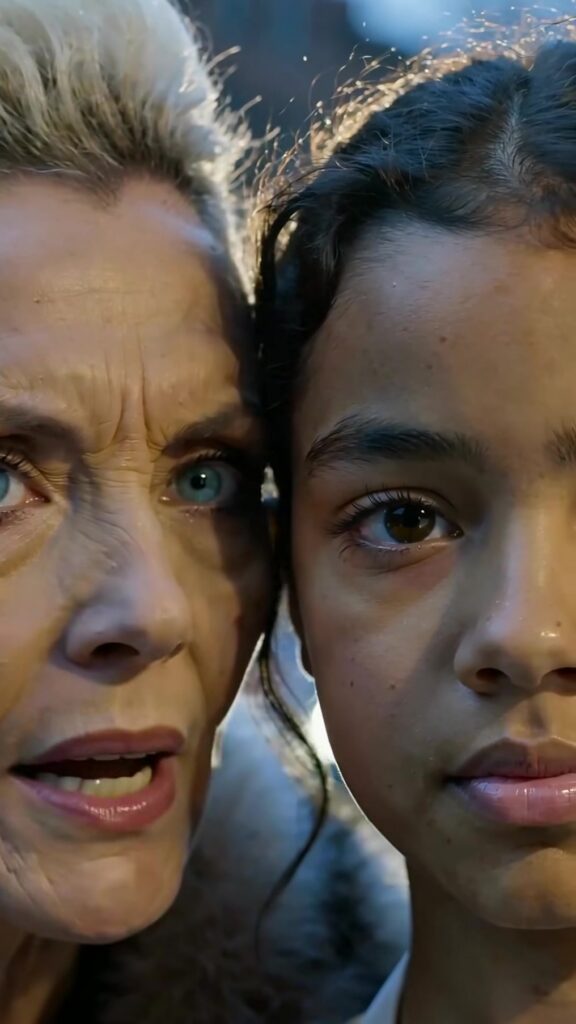
Leo’s mother approached with the calm of something expensive that didn’t believe it could be touched by weather. A fur coat hugged her shoulders like a threat. A driver in a black cap hovered behind her like punctuation.
Her eyes landed on Julianne—not on her face, exactly, but on the cart, the grease stains on her apron, the little cuts on her knuckles, the steam that clung to her hair.
“She’s nothing,” she said, loud enough for everyone to hear. “A street girl. Look at her. Smell her. You would throw away everything… for this?”
The word this hit Julianne like a slap. Not you. Not her name. This.
The crowd shifted, hungry for either a breakdown or a miracle. Julianne could almost feel the collective lean: go on, do something.
Leo’s jaw worked. “Mother, stop—”
“No.” His mother’s smile was thin and practiced. “You stop. This ends now.”
Silence fell so suddenly Julianne could hear the hiss of fat dripping onto coals.
All eyes turned to her.
Julianne didn’t cry. Not because she was brave, exactly. Mostly because she’d learned years ago that tears were a currency other people spent for you. She wasn’t interested in buying anyone’s pity.
Instead, she reached into her apron.
A few people sucked in breath like she might be pulling out a knife. Julianne’s fingers closed around something familiar and flat. She took it out slowly and held it up between two grease-marked fingers.
It wasn’t a weapon. It was an old, scuffed MetroCard wrapped in clear tape.
“This,” Julianne said softly, and the word sounded different coming from her—less like trash, more like an item with weight. She looked at Leo’s mother without flinching. “This is the card I used the first time your son found me.”
Leo blinked, a flicker of memory crossing his face. Julianne had never told him the full story, not in one neat speech. She’d let it spill out in small pieces over nights when the city felt too loud.
She turned the MetroCard so everyone could see the handwritten note taped to the back. The ink had faded, but the words were still there. A phone number. A name. A date.
“He was lost,” Julianne said. “Not in a cute way. In a real way. He got off the subway at the wrong stop and his phone was dead and he didn’t even have cash because everything he owns is… invisible.” She glanced at the suit, the ring, the driver. “Like it just appears when he needs it.”
A few people laughed nervously. Leo’s mother didn’t.
Julianne kept going. “He walked up to my cart like it was a lighthouse. He bought food he didn’t even like, because he didn’t know what else to do. Then he asked if he could stand there for a minute to warm up.”
Leo’s throat bobbed. He didn’t move from his knee, but his eyes never left her.
“He tried to tip me a hundred,” Julianne added, a little smile tugging at her mouth despite everything. “I told him no, because I’m stubborn and because my pride is one of the few things I’ve managed to keep.”
She looked at Leo’s mother again. “So I gave him this card. The one I’d been stretching for a week. I wrote my number on it and told him to text me when his phone woke up. I didn’t do it because I wanted anything from him. I did it because I know what it looks like when someone is freezing and pretending they aren’t.”
The crowd’s energy shifted—less predatory, more attentive. A woman near the curb lowered her phone a fraction, like she’d remembered she was watching real people.
Leo’s mother’s nostrils flared. “A charming story,” she said. “But it doesn’t change—”
“It changes everything,” Julianne interrupted, still calm, still quiet. Her own surprise at her steadiness buzzed through her chest. “You think I’m beneath notice because I sell food on a sidewalk. You think ‘street’ means I’m desperate, that I’ll grab for anything shiny.” She nodded at the ring box, not dismissive—just factual. “I’m not. I’m careful. I’ve had to be.”
She slid the MetroCard back into her apron like it was a talisman. “I’m not asking you to like me. I’m not asking you to approve of me. I’m telling you that I’m here because I built a life out of what I had. And your son saw me when most people didn’t.”
Leo’s mother opened her mouth, then shut it. She looked around at the crowd, at the phones, at the fact that this corner was no longer hers to control. Her expression tightened, the way a perfect seam strains when the fabric pulls the wrong direction.
Leo finally spoke again, voice steadier now. “Mom,” he said, and there was something in it that sounded like an ending. “You don’t get to decide what’s worthy. Not for me.”
He stood up, slowly, like he didn’t want to startle the moment. He held the open box out to Julianne again, but his eyes asked a different question than the words had.
Julianne glanced at her grill. The meat had charred at the edges. Smoke curled up, stubbornly normal. Her whole life was right there in the smell of it—work, heat, survival.
She took off one glove, the cheap kind from a dollar store, and flexed her fingers. Then she reached for Leo’s hand—not the ring. Just his hand. She squeezed once, grounding both of them.
“You proposed in front of my cart,” she said, voice dry with disbelief. “Do you know how much pressure that puts on a woman with a spatula?”
A laugh rolled through the crowd, relieved and warm.
Leo’s mouth broke into a grin that looked like he’d been holding it back for months. “I panicked,” he admitted. “It felt like the only place that made sense.”
Julianne exhaled, watching her breath turn to fog. “I’m not saying no,” she said, and the crowd’s reaction hit like a wave—gasps, cheers, the sound of people being delighted on purpose. “But I’m also not saying yes like it’s a fairytale you can buy.” She leaned in a little, close enough that only he could really hear the next part. “If we do this, we do it like grown-ups. With real conversations. And boundaries. Especially about your mother.”
Leo’s eyes softened. “Deal,” he said immediately, like it was the easiest promise he’d ever made.
Julianne looked past him at his mother, who stood stiff as a statue carved from money. “And for the record,” Julianne added, loud enough this time, “I’m not invisible. I’m just busy.”
Then, with hands that still smelled faintly of garlic and smoke, she finally let Leo slide the ring onto her finger. The diamond flashed again, but it wasn’t the brightest thing on the sidewalk. The brightest thing was the look on Leo’s face—like he’d found the one place in New York that didn’t make him feel cold.
Julianne picked up her tongs again, because life didn’t stop just because the internet was watching. She flipped the next batch like she always did.
Somewhere behind her, the crowd kept buzzing. Somewhere in front of her, Leo stayed close, shoulder to shoulder, like he’d decided that this corner—steam, survival, and all—was exactly where he belonged.