The courtroom had already decided she was guilty. Not officially, not on paper, not in the clean little language the judge liked to use—yet. But you could feel it anyway, like the room had leaned its whole weight toward one outcome and was just waiting for the final shove.
Elena stood at the center table in a stiff borrowed blazer that didn’t quite hide the edges of her maid uniform underneath. The black-and-white fabric made her look like a misplaced chess piece in a game she didn’t understand. Her hands wouldn’t stop shaking, so she clasped them together hard enough to leave half-moons in her palms.
Across the aisle, the gallery was packed with people who had never spoken to her but had no trouble deciding who she was: a thief, a liar, a girl who probably “had a temper.” They looked at her the way you look at a stain on a carpet—annoyed that it existed and eager to watch someone scrub it out.
Noah Hale sat in the first row because the prosecutor said it would be “helpful for the jury to see the family.” That sentence alone made Noah’s stomach hurt. He didn’t feel helpful. He felt like a small animal held up as proof.
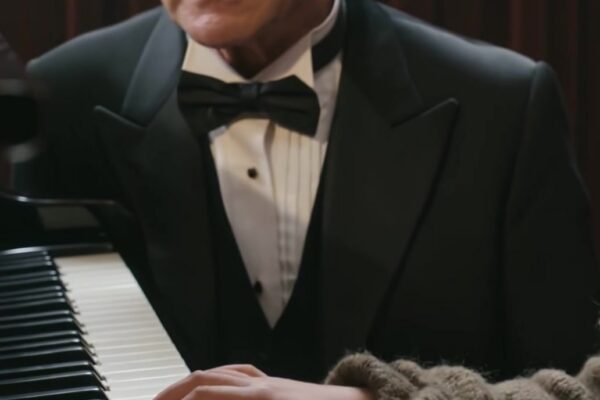
Beside him sat his grandfather, Richard Hale, in a dark suit that looked like it had been ironed by someone who feared him. Richard’s posture was calm in that practiced way that made people assume he was reasonable. His hand rested lightly on Noah’s shoulder—light, but heavy enough to remind Noah who controlled the room.
“Remember,” Richard had murmured in the car, voice smooth like old leather. “You were upset. You saw nothing clearly. It’s normal to be confused. So you say nothing. That’s how we get through this.”
Noah had nodded because that’s what you do when the person you live with tells you what the world is. Besides, Richard wasn’t just his grandfather. He was the kind of man servers called “sir” twice in one sentence.
But Noah wasn’t confused. Not really.
Two nights earlier, his grandmother’s bedroom door had been half open. He’d been wandering the hall in socks, unable to sleep because the house felt too big and too quiet after the funeral visitors finally left. He’d heard a voice—sharp, angry—then another voice, lower, more controlled. He’d crept to the staircase and crouched behind the carved banister, his heart banging like someone was knocking from the inside.
Elena had found him there. She’d been carrying a laundry basket and nearly dropped it when she saw his face.
“Hey,” she’d whispered, soft as a blanket. “Noah, what are you doing up?”
Then the bedroom door had swung wider. Footsteps. Quick. Elena’s whole body changed. She set the basket down and moved in front of him like it was automatic, like she’d been built to shield kids from bad weather.
“Stay back,” she’d whispered. “Don’t make a sound.”
He’d seen a sleeve flicker in the hallway light. A flash at a wrist—silver, expensive. Something snagged, then popped loose. It made a tiny metallic click when it hit the floor, a sound nobody else seemed to hear over the arguing.
Later, after the shouting stopped and the hallway went strangely still, Noah had crawled forward and picked it up. A cufflink. Smooth, heavy, with a small engraving shaped like a hawk in flight.
He’d hidden it in the toe of a sneaker under his bed. Because he didn’t know what else to do with evidence when you’re nine years old and the adult in charge tells you the truth will “ruin everything.”
Now Elena was being asked to ruin her own life on command.
The prosecutor, a woman with a sharp bun and sharper smile, paced like she owned the floorboards. “Elena Marquez had access,” she said, tapping a stack of photos. “She knew the house. She knew the schedule. She was in financial trouble. The widow was found dead in bed. No sign of forced entry. No sign of an intruder.”
Elena’s public defender tried to object, but his words landed like pebbles thrown at a castle wall. Even the jury looked bored, like they were watching a rerun.
When Elena finally spoke, it wasn’t dramatic. That was the worst part. “I didn’t do it,” she said, voice cracking around the edges. “I loved her. She was… she was kind to me.”
Noah’s throat tightened so hard he felt it behind his eyes. Kind. That word reminded him of Elena bringing him hot chocolate when his parents didn’t come to visit on weekends like they promised. Kind was Elena fixing the ripped knee on his school pants so Richard wouldn’t yell about “wasting money.” Kind was Elena saying, “It’s okay,” like she meant it.
Richard’s hand pressed slightly harder on Noah’s shoulder, a silent warning. Noah stared at the judge’s gavel, the shiny wood that looked too polite to do something as ugly as bury an innocent person.
The judge leaned forward, ready to summarize, ready to close. The air in the room held its breath.
Noah couldn’t.
He shoved himself up from the bench so fast his knee banged the wood. The sound snapped through the courtroom like a ruler on a desk. Heads turned. The bailiff shifted. Elena blinked like she’d been slapped by daylight.
Richard reached for Noah’s arm. “Sit down,” he hissed, still smiling with his mouth while his eyes turned cold. “Now.”
Noah stepped back instead. His heart was trying to escape through his ribs. “It wasn’t her,” he said, louder than he meant to. His voice came out thin but it carried.
A murmur rolled through the gallery. Elena’s hands flew to her face.
Richard’s fingers tightened on Noah’s sleeve. “Noah,” he warned, and there was panic under it now, a flicker of something raw.
Noah yanked free. For the first time in his life, he pulled away.
“She protected me,” he said, and the words surprised even him because they sounded like a sentence from a brave kid, not the scared one he’d been practicing.
The judge raised a hand. “Young man—”
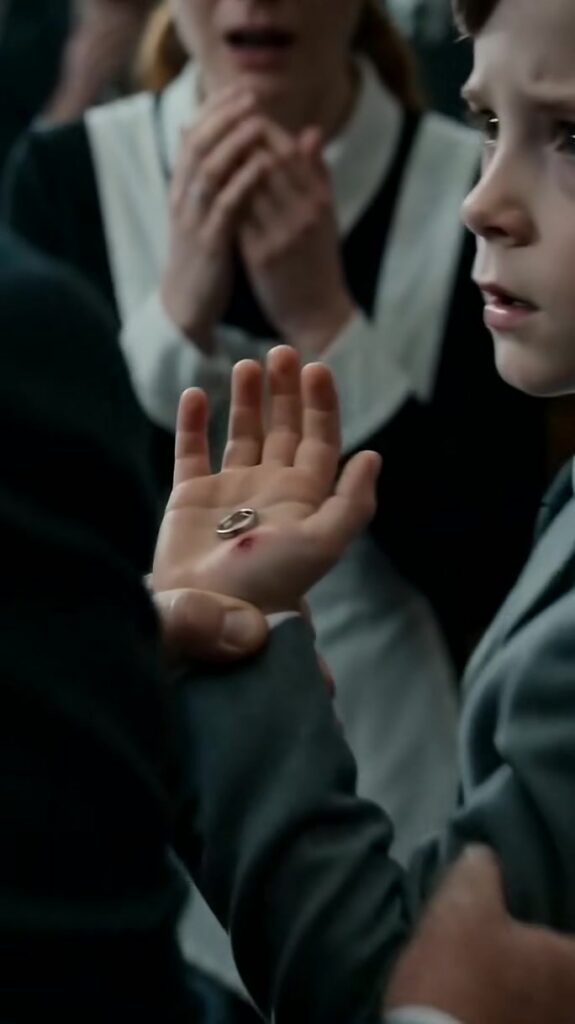
Noah reached into his pocket. He’d put the cufflink there this morning, telling himself he might not use it, that maybe he just needed to feel it close, like a lucky charm. His fingers closed around the cold metal and he held it up in the air like a tiny flashlight.
It caught the courtroom lights and winked.
The prosecutor frowned. The jury leaned forward. Elena went perfectly still.
Richard’s face drained. Not a theatrical reaction, not a villain in a movie. Just a subtle loss of color, like somebody turned down the saturation.
“Where did you get that?” Richard asked too quickly. Too sharp. Like a man who’d practiced every expression except surprise.
Noah swallowed. His hand shook, but he kept it raised. “It was on the floor,” he said. “That night. By the stairs.”
Richard laughed once, a little sound that didn’t reach his eyes. “That could be anyone’s. This is nonsense.”
Noah looked at the hawk engraving. He knew that symbol. He’d seen it on Richard’s study letter opener. On a ring Richard wore to business dinners. On the thick paper used for invitations that said HAWKSTONE CLUB in fancy print.
Noah lifted his other hand and pointed, not at Elena, not at the prosecutor, not at the jury.
At his grandfather.
“It was him,” Noah said. “He was there. Elena tried to stop him. She told me to be quiet.”
The courtroom didn’t just get silent. It emptied of sound, like someone unplugged the world.
Richard’s smile snapped off his face. “You don’t understand what you’re saying,” he said, voice low. “You’re confused.”
Noah’s eyes burned, but he shook his head. “I’m not.” He held the cufflink out toward the bailiff because he didn’t know who else to give it to. “It has stuff on it. From that night.”
The bailiff hesitated, glancing at the judge. The judge’s eyebrows had climbed so high they nearly disappeared. “Approach,” the judge said, and the single word felt like the first crack in a wall.
Richard stood abruptly. “Your Honor, this is highly inappropriate. The child is being manipulated—”
“Sit,” the judge said, suddenly not gentle. “Now.”
For the first time, someone in this building told Richard Hale what to do.
Richard didn’t sit. Not immediately. His eyes flicked to the door like he was calculating distances. That tiny movement did more damage than any confession.
The prosecutor, smelling blood in the water, stepped forward. “Mr. Hale,” she said slowly, “do you own cufflinks bearing that insignia?”
Richard’s jaw worked once. “Many men do.”
Elena let out a sob that sounded like air returning to her lungs after being held underwater. “Noah,” she whispered, and it wasn’t gratitude so much as disbelief that the boy had chosen truth over fear.
The judge called a recess. The bailiff took the cufflink in an evidence bag like it was suddenly radioactive. Two officers moved, casually at first, then less casually when Richard tried to step back.
“This is outrageous,” Richard snapped, and now the whole room could hear the steel under the polish. “You can’t do this based on a child’s fantasy.”
Noah’s knees felt like jelly, but he stayed standing. “It’s not a fantasy,” he said. “It’s why she told me to be quiet. Because you were scary.”
Richard stared at him, and for one awful second Noah thought he might lunge. Instead, Richard’s expression shifted into something smaller: calculation, trapped.
When the officers took Richard by the arms, the courtroom finally exhaled. It didn’t mean everything was fixed. It didn’t undo two nights of terror or the way people had looked at Elena like she was disposable. But it changed the direction of the story, and sometimes that’s the first miracle.
As Richard was led away, he leaned close enough for Noah to hear him over the commotion. “You’ve just made an enemy,” he whispered.
Noah’s whole body shook, but he looked up anyway. “Maybe,” he said, surprising himself again. “But she’s not going to jail for you.”
Elena sank into her chair, crying openly now, the kind of crying that comes when your body realizes it might get to keep living. Noah walked to her, ignoring the stares, and she took his hand like it was the only solid thing in the room.
The courtroom hadn’t decided she was innocent. Not yet. But for the first time all day, it looked like it might actually listen.