The garden looked too peaceful for a lie. That was the first thing I thought when I found myself standing at the edge of the Hawthorne estate, pretending my shoes didn’t feel like they were made of borrowed guilt.
Late sun slid through the branches in warm squares, turning the stone path into a checkerboard. The roses behaved like they’d been trained. Even the fountain sounded rich. Behind all that, the house sat big and quiet, like it had mastered the art of keeping its mouth shut.
I wasn’t supposed to be there. Not really. I was the new temp gardener—“temp” meaning I got paid cash and asked zero questions. The head groundskeeper, a man named Rudy with hands like bark, had handed me gloves and a list of chores and told me to stay away from the back terrace.
“That’s where the family sits,” he’d said, like the terrace was holy and I was contagious.
So naturally, I ended up near the back terrace.
There was a bench under a maple tree, and on it sat Mr. Hawthorne himself. I’d seen him in photos—old business magazine covers that were somehow still framed in the hallway like this was a museum to his jawline. In person, he looked smaller. Not weak, exactly, but contained. He wore a navy suit in a way that made it feel like a uniform, and dark sunglasses that turned his face into a closed door.
Everyone in the estate talked about his blindness the way they talked about the weather: unavoidable, a little sad, not anyone’s fault. “Since the accident,” they’d whisper. “Poor man.”
Beside him on the bench was a tea tray. Silver. Polished. The kind of thing you could see your reflection in if you leaned close enough.
And then the little girl showed up like she’d been dropped into the scene by a different director.
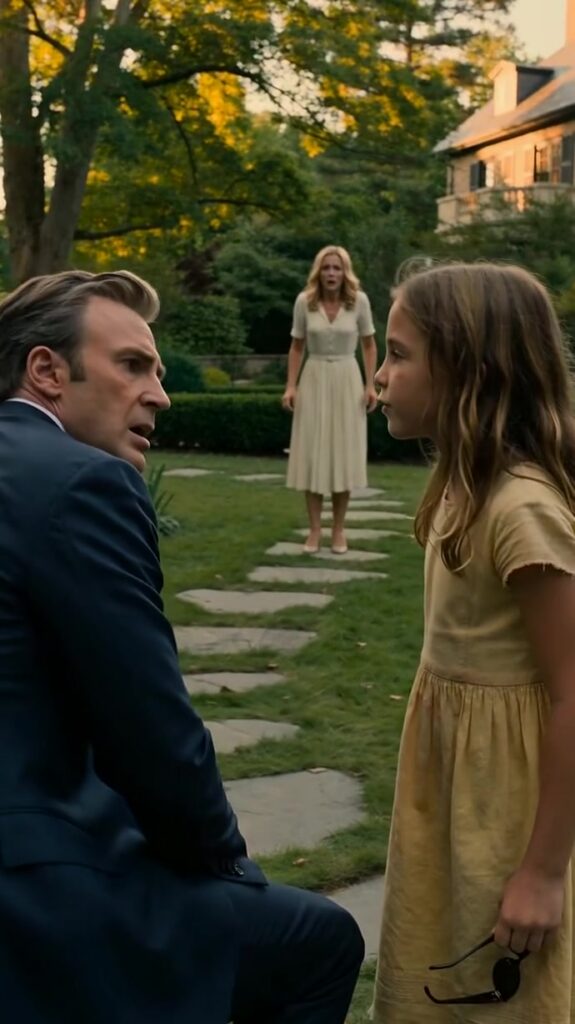
She couldn’t have been more than eight. Yellow dress that had seen better birthdays. Knees scuffed. One sock a little lower than the other. She walked straight up the path, ignoring the way the gardeners and staff naturally curved around the family like water around rock.
She stopped in front of Mr. Hawthorne and didn’t do the cute kid thing where they wait to be noticed. She slapped her palm right on his forehead, like she was checking if he was real.
He flinched so hard he nearly tipped forward. His hand shot to the bench, knuckles whitening against the wood.
“You’re not blind,” she said.
The sentence cut through the garden so clean it made the birds sound like they were lying too. Leaves still moved gently overhead, like they hadn’t heard.
Mr. Hawthorne’s jaw tightened. “What did you say?” His voice didn’t have the soft, sad quality everyone used when they spoke about him. It was sharp. Annoyed. Alive.
The girl’s eyes were glossy with tears, but the rest of her looked bolted into place. She reached up with both hands and yanked the sunglasses off his face.
His eyes opened wide instantly—focused, clear, not searching. Not drifting. Watching.
I felt my stomach drop, like I’d stepped off a curb that wasn’t there.
At the same moment, I noticed movement near the terrace doors. A blonde woman—Mrs. Hawthorne—had come out with a linen napkin in her hands and then stopped mid-step. She froze too fast. Like she’d been practicing freezing.
The little girl held the sunglasses in one fist like a trophy and pointed at Mrs. Hawthorne with the other. “It’s your wife.”
Mr. Hawthorne turned his head in the exact direction she pointed, no hesitation, no guessing. His eyes landed on his wife like a spotlight.
Mrs. Hawthorne took a step backward.
It was a small step. Elegant, even. But it was still a retreat.
The girl leaned closer to the bench, voice lower now, like she was telling a secret she’d already decided to share. “She puts it in your food.”
Mrs. Hawthorne’s mouth opened. Nothing came out.
Mr. Hawthorne’s throat bobbed. “What is ‘it’?”
“Something that makes you sleepy,” the girl said, and then corrected herself with a tiny shake of her head. “No. Something that makes you act sleepy. So everyone believes you.”
I should’ve walked away. I should’ve remembered my place, remembered my gloves, my list, my paycheck. But my feet stuck to the stones.
Mrs. Hawthorne finally moved forward, like she was going to laugh it off, scoop the child up, turn it into a cute misunderstanding. She made it one step and stopped again. Fear won in the space between her and the bench.
Mr. Hawthorne stood halfway, bracing himself as if standing required effort he couldn’t admit he didn’t have. His eyes flicked to the tea tray, then back to his wife. “My tea,” he said quietly, like the word had teeth. “Is that what this is about?”
The girl nodded once. Not dramatic. Just certain.
She opened her other hand and I saw what she’d been holding the whole time: a tiny silver medicine spoon. The family crest was engraved on the handle—two hawthorns crossed like swords. It looked expensive enough to have its own insurance policy.
She held it up. “This. She uses this.”
Mrs. Hawthorne’s face changed. Not into panic—into calculation. Like she was already figuring out which version of the story would survive.
“Sweetheart,” she said, voice syrupy, “where did you get that?”
“From the kitchen,” the girl replied. “From the drawer behind the flour. The one you told Marta never to open.”
A name dropped like a pebble into a still pond. Somewhere behind the terrace doors, I heard a sharp inhale—someone else listening.
Mr. Hawthorne’s gaze didn’t leave his wife. “Behind the flour,” he repeated. “Is that true?”
“Of course not,” Mrs. Hawthorne said too quickly. Then she tried a softer tone, like kindness could erase timing. “This is ridiculous. She’s a child. She doesn’t understand—”
“I understand,” the girl cut in. Her voice wobbled for the first time, like her courage had finally met the weight of what she was doing. “I saw you. You did it when you thought nobody was watching.”
Mr. Hawthorne’s hands curled. “When?”
The girl blinked hard, tears spilling over now, but she kept her chin up. “At night. Sometimes you don’t drink it all, so she pours the rest out and makes a new cup in the morning. She says it keeps you calm.”
Mrs. Hawthorne’s eyes flicked toward me for the first time, like she’d just realized there were witnesses that didn’t live on her payroll. I pretended to be fascinated by a patch of grass.
Mr. Hawthorne exhaled through his nose, slow. “And the blindness,” he said, almost to himself. “That was… convenient.”
Mrs. Hawthorne lifted her hands. “You were injured. You had headaches, vertigo, sensitivity to light—”
“So you gave me sunglasses,” he said, holding them up. “And something to make me sluggish. And I played along because it was easier than admitting I was scared.”
The garden kept shining, shamelessly peaceful, like it didn’t care about any of us.
The little girl reached into the pocket of her yellow dress and pulled out something else: a folded napkin with a dark stain. She offered it like evidence in a courtroom. “I saved it,” she whispered. “From yesterday. When you spilled.”
Mrs. Hawthorne’s composure finally cracked. Not with tears—she laughed once, short and startled, like a sound escaping. “You have no idea what it’s like,” she said, voice sharpening. “To live with a man who sees everything. Who controls everything. Even when he pretends he can’t.”
Mr. Hawthorne’s face stayed still. “So you decided to make it true.”
Mrs. Hawthorne’s eyes flashed. “I decided to survive.”
For a second, nobody spoke. The fountain burbled. The roses stood there in their perfect rows. The sun painted gold on the path like it was blessing the scene.
Then the terrace door swung open wider and Marta—the cook, small and furious—stepped out, wiping her hands on her apron like she was ready to fight God. Behind her was Rudy, the head groundskeeper, looking like a man who’d just realized the estate’s secrets were going to get dirt under his nails.
Marta’s gaze landed on the spoon. Her face drained. “Madre de Dios,” she muttered.
Mr. Hawthorne straightened fully, no wobble at all. “Call my lawyer,” he said to no one in particular. Then, to Marta, softer: “And call the police.”
The little girl’s shoulders sagged like her whole body had been holding its breath. She stared at Mr. Hawthorne’s eyes—open, clear, undeniable—and for the first time she looked like a kid again. Small. Tired. Like she’d carried a truth too big for her dress pockets.
He crouched in front of her, careful, like he was afraid sudden movement might break something. “What’s your name?” he asked.
She hesitated, then whispered it.
He nodded once, absorbing it the way people absorb the first crack in a life they thought was solid. “Thank you,” he said, and his voice did go softer then—not weak, just human. “You shouldn’t have had to do that.”
She hugged the spoon to her chest. “I didn’t want the garden to keep lying,” she said, wiping her face with the back of her hand. “It looks too nice. Like it’s trying to trick people.”
And standing there in that perfect sunlight, with the fountain singing and the roses pretending they hadn’t heard a thing, I understood exactly what she meant.
The garden really did look too peaceful for a lie.