Rain didn’t fall so much as it attacked. It slapped the sidewalk in silver sheets, turned passing cars into smeared headlights, and made the whole block look like it was being watched through wet glass. The jewelry shop sat in the middle of it all like a lantern someone forgot to blow out—small, stubbornly bright, and warm enough to make you believe storms were an outdoor problem.
Inside, the air smelled faintly of metal polish and old velvet. Amber lamps cast a honeyed glow over display cases where rings sat in neat rows like tiny, obedient moons. The place was quiet in that particular way expensive things make a room feel—soft, respectful, almost afraid of scuffing itself.
Bernard Hale stood behind the counter with a cloth in his hand, doing the same circular motion he’d done a thousand times. He had a gentle, deliberate sort of face, the kind that made people talk slower without meaning to. Routine was his strongest defense. Routine kept the world from bursting through the door.
Then the door burst through the world.
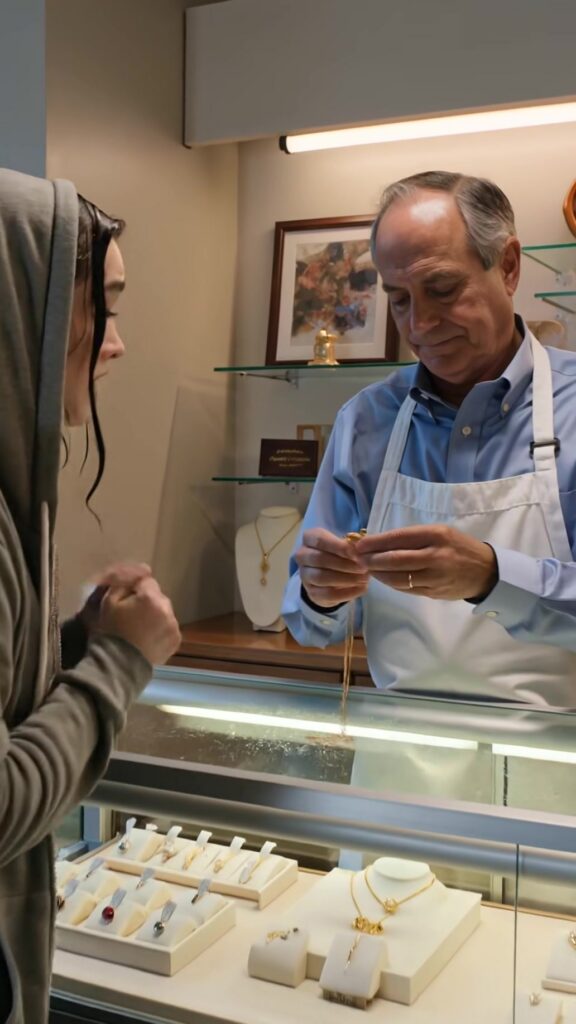
A gust of cold air crashed in first, followed by the sound of the rain like a crowd pressing up against the glass. A young woman stumbled inside, soaked through. Her dark hair was plastered to her cheeks and neck. A gray hoodie clung to her shoulders, and her jeans were ripped at one knee like she’d met the pavement personally. She stood there for half a second like she’d forgotten how to exist indoors, breathing hard, staring at the warmth as if it were suspicious.
In her hands was a gold chain. She held it tight, close to her chest, like it was the only thing keeping her from sliding back out into the storm.
Bernard’s first thought wasn’t “danger.” It was “trouble.” The kind of trouble that involved complicated feelings and police reports and the sort of conversations you can’t wrap up with a receipt. Still, his voice came out even.
“Can I help you?”
She crossed the shop in three quick steps, water dripping onto the rug. She didn’t glance at the cases, didn’t pretend to browse. She just thrust the necklace forward.
“How much for this?”
Bernard took it carefully, as if it might burn him. It was real gold—worn but decent quality. The chain links had that soft, rounded shine from years of skin contact. Not new. Not fashionable. Not something a kid would pick out for themselves on a random Tuesday.
He weighed it in his palm. Checked the clasp. Ran his thumb along the edge of the locket.
“Fifty dollars,” he said. “That’s what I can do.”
The woman didn’t blink. “Okay. Deal.”
That response hit him harder than a threat would’ve. People always argued. People always lied a little. People always acted like they weren’t desperate even when they were. This girl didn’t have the energy for pride.
Bernard looked up. Her eyes were wide and fixed, like she was listening for something outside. She kept her body angled toward the door, already leaving in her mind.
He should’ve just done the exchange. Fifty dollars, paperwork, goodbye. He should’ve let the routine protect him.
Instead, his fingers found the tiny notch on the locket. He flipped it open.
The picture inside wasn’t glossy. It was old, black-and-white, slightly curled at the corners. A man with a younger face held a little girl on his hip. The man’s grin was too big, the kind you only have before life teaches you to conserve happiness. The girl had a serious expression like she didn’t trust the photographer.
Bernard recognized the man immediately. He’d spent years avoiding mirrors because he couldn’t stand seeing what time had done, but the shape of that smile was unmistakable.
Under the photo, there was an engraving in tiny letters.
For my little Clara.
The cloth in Bernard’s hand slipped and fell behind the counter. His chest tightened the way it used to when he ran too fast, except he hadn’t moved. The room didn’t feel warm anymore. It felt airless.
Clara.
His daughter. The name he’d stopped saying out loud because it made his throat close up. The name that lived in a drawer at home with old birthday cards and a single sock he couldn’t throw away because it felt like admitting something.
Eighteen years ago, there had been a storm like this one. The river had been swollen and brown. The news had said “tragic accident,” the kind of phrase that sounds like it should come with a blanket and a cup of tea. No body. Just a shoe found downstream, and a neighborhood full of people trying to be helpful in the way people are helpful when they don’t know what to do with your grief.
Bernard had never really believed the word “drowned.” He’d tried to. He’d sat through the counseling sessions. He’d listened when people told him it was time to move forward. But belief is not something you can force onto a heart like a hat.
The young woman saw the change in his face immediately. Her spine went rigid. Her eyes flicked to the locket, then to Bernard, then to the door. Instinct took over. She backed away, hand reaching for the handle.
“Wait,” Bernard said, and it came out rougher than he intended. He moved from behind the counter too fast, nearly catching his knee on the corner. He wasn’t trying to trap her; he was trying to hold onto the only solid thing in the world for one second longer.
He stopped between her and the exit, palms up, empty.
“That was my daughter’s,” he said. Then, because the sentence sounded like a lie even to him, he added, “I… I gave it to her.”
The girl froze with her fingers on the handle. The rain threw itself against the windows like it was impatient with them.
For a moment she didn’t turn around. Bernard could see the way her shoulders rose and fell too fast, the way she swallowed like she was trying to get courage down her throat.
When she finally looked back, her eyes were shining—not just from the rain. Her face was young, but exhaustion sat on it like an old roommate who never paid rent. There was a thin scar near her eyebrow Bernard hadn’t noticed at first, and something about her jawline made his stomach drop, like déjà vu with teeth.
“She said you wouldn’t recognize me,” the young woman whispered.
The words didn’t land gently. They hit like a thrown stone, and Bernard felt them crack open all the years he’d sealed shut. His mouth opened, but nothing came out. He stared at her as if the right angle would make her transform into the child in the photo.
“What,” he finally managed, “did you just say?”
Her hand left the door. Slowly, like she was surrendering something. She looked down at the locket in Bernard’s hands, and the corners of her mouth trembled with a humor that had no joy in it.
“Clara,” she said, and there was no dramatic pause, no big reveal music. Just a name tossed into the air like it belonged there. “That’s… that’s me. Or it was. She used to call herself that before it got complicated.”
Bernard shook his head once, hard, as if he could fling the statement away. “No. No, Clara was—” He couldn’t finish. Drowned. Gone. Dead. The words were too heavy to lift.
“They told you that,” she said quickly, like she’d had this argument in her head for years. “I know what they told you. I was there when they decided what the story would be.”
Bernard’s knees went weak. He grabbed the counter edge with one hand, the locket still open in the other. “Where have you been?”
She let out a shaky breath and rubbed her wet hands together like she was trying to start a fire. “Everywhere. Nowhere. Mostly places that don’t ask for your last name. I didn’t come here for… this. I came here because I needed cash. Tonight.”
Bernard’s mind struggled to keep up. “Why? What’s happening?”
The girl’s eyes darted to the window. Outside, a dark sedan slid by too slowly, its wipers moving like metronomes. She flinched.
“Someone’s looking for me,” she said. “And not in a ‘missing persons’ way.”
Bernard’s hands tightened around the locket. His thumb pressed the tiny engraved letters like he could read the truth through them. “Who?”
She hesitated. The shop felt suddenly too bright, too open, like the glass cases were exposing them. “I don’t think we should talk here.”
“You walk back out there and you’ll disappear again,” Bernard said, his voice cracking on the last word. “And I can’t—” He stopped, because the thought was unbearable.
The girl swallowed, and something in her expression softened. Not trust, exactly. More like resignation, like she’d been carrying a bag too heavy for too long and was considering setting it down.
“You still have that look,” she murmured, almost to herself. “The one you had in the picture. Like you think smiling can fix stuff.”
Bernard laughed once, a harsh, disbelieving sound. “I haven’t smiled like that in eighteen years.”
She reached up and wiped rain from her cheek, but it just smeared. “Yeah,” she said quietly. “I noticed.”
A clap of thunder rolled overhead. The lights flickered, and for half a second the shop looked like it was underwater. Bernard made a decision so fast it scared him.
He snapped the locket closed and wrapped the chain around his fist like a promise. “Come with me,” he said. “Back room. There’s a door to the alley. We can leave without—”
“Without them seeing,” she finished, and her gaze went sharp. “So you do understand.”
Bernard didn’t understand. Not really. He understood only one thing with absolute clarity: the storm had finally delivered something it had stolen from him, and he wasn’t letting it get swept away again.
He held the locket out to her, not as a purchase, not as a relic, but as proof he was real.
She stared at it for a heartbeat. Then she reached for the chain, fingers trembling, and for the first time since she’d come in, she stepped away from the door on purpose.
“Okay,” she said, voice small under the rain. “But you need to know—my name isn’t Clara anymore.”
Bernard nodded, blinking hard. “Tell me what it is,” he said. “Tell me everything.”
She took a breath like she was about to jump off something high. “It’s Mara,” she said. “And the reason I’m here is because the people who took me as a kid… they finally made a mistake.”
Outside, the rain kept hammering the glass, trying to drown out the past. Inside, Bernard opened the door to the back room and let the stormy truth in anyway.