The breakfast room at the Driftwood Motel had that special kind of sadness you only find on highways—stale syrup in the air, a jukebox that didn’t work, and wallpaper the color of old peas trying its best to hang on. Outside, rain stitched the parking lot into a blurry gray quilt. Every so often thunder grumbled like an engine refusing to start.
Casey “Graves” Granger didn’t belong in a place like this, which was exactly why he liked it. He was big enough that the vinyl booth groaned under him, and his black leather vest was so worn it looked like it had been born that way. He had a mug of coffee he wasn’t drinking, because his hands weren’t steady this morning. They hadn’t been steady in years. Not since the tiny coffin. Not since the name that still showed up in his head like a road sign he couldn’t ignore: Lila.
He’d stopped here for fuel and something warm, telling himself it was just a pit stop. Except the moment he walked in, he saw her.
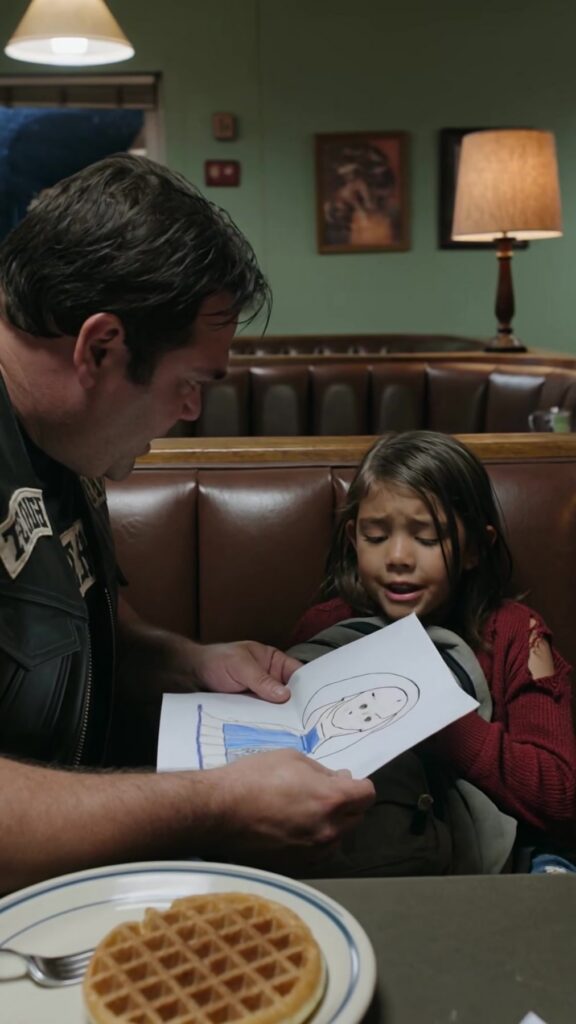
A little girl, maybe seven, folded into herself at the far booth near the window. Hair tangled. A red sweater ripped at the shoulder. Knees peeking through jeans that had clearly lost a fight with asphalt. She hugged a frayed backpack so hard it looked like she was keeping it from floating away.
In front of her sat a waffle slowly turning into a sponge.
The motel clerk—an older guy with a mustache that looked painted on—kept glancing over like the kid might bolt and take the silverware with her. Nobody else in the room said a thing. People have a way of not seeing what scares them.
Casey slid out of his booth and walked toward her, moving like he was crossing thin ice. When he got close, he didn’t tower. He lowered himself to one knee beside her booth, careful not to crowd her.
“Hey,” he said, keeping his voice soft. It came out rough anyway. “You okay, kid?”
Her eyes snapped up, wide and wary, then back down to the backpack. She didn’t answer. She just squeezed tighter.
“I’m not a cop,” he added. “And I’m not… whatever you’re thinking I am.”
That got the tiniest flicker—like she’d already thought of plenty.
Casey nodded toward the waffle. “You don’t have to eat that. Waffles are overrated.”
Still nothing. But she didn’t run, and in Casey’s experience that counted as progress.
He saw the backpack was half-open, a zipper tooth missing, the fabric stained with travel. He held his hands up, palms out. “What’s in there? Something important?”
Her chin dipped the smallest amount. A yes, but afraid of saying it.
“Can I look?” Casey asked. “Only if you say it’s okay.”
The room felt quieter than it should. Even the rain seemed to pause to listen.
After a long moment, the girl pushed the bag toward him like it weighed a hundred pounds. Her fingers didn’t let go. Not fully.
Casey slowly tugged the zipper open the rest of the way. Inside was a jumble of kid survival gear: a broken plastic comb, a single sock, a juice box that had been crushed and resealed with tape. Then his fingertips hit folded paper.
He eased it out like it might bite.
It was a drawing in bright crayon—two stick-figure girls holding hands under a square house with a crooked red roof. A sun in the corner smiling too hard. The kind of picture adults pin to fridges and then forget to take down until the edges curl.
“Did you make this?” Casey asked.
The girl shook her head quickly. Her voice was small but clear, as if she’d practiced it. “My sister did.”
Casey’s stomach tightened. “Where’s your sister?”
The girl looked toward the window, at the wet parking lot and the veils of rain. “Not here.”
Casey turned the paper over, expecting maybe a name, maybe a phone number. Something hopeful.
Four words were scrawled across the back in uneven block letters, the kind a kid does when they want to look grown: HE TOOK THE WRONG ONE.
Casey went still. Not biker-still. Not tough-guy-still. The kind of still that happens when your body understands danger a second before your brain catches up.
“Sweetheart,” he said carefully, “who took who?”
Her lower lip trembled. She stared at the table like it might open and swallow her. “The man. He thought… he thought I was her.”
Casey tasted iron like he’d bitten his tongue, but he hadn’t. He flipped the drawing back to the front and saw, in the bottom corner, a name written in sloppy crayon cursive.
Lila.
He felt the air leave his chest. It was like someone had reached in and grabbed the old scar tissue and yanked. Lila. His Lila had been gone for five years. Highway accident, they told him. Wrong lane. Wrong night. He’d believed it because believing was easier than digging.
The rain outside brightened—lightning splitting the sky—and in that flash he saw movement in the parking lot. Headlights sweeping. A pair, then another. Bikes rolling in fast, tires hissing on wet pavement.
Not travelers. Not tourists. They came in a line like they’d rehearsed it.
Casey’s instincts, honed in a past he didn’t brag about, snapped into place. He slid the drawing into his jacket like it was a map to buried treasure. Then he ducked lower and motioned the girl down.
“Hey,” he whispered, urgent now. “Come here. Under the table. Right now.”
Her eyes went huge again. She clutched his vest like he was the only solid thing in the room.
“Stay with me,” he said. “No matter what you hear.”
Outside, engines growled. Doors of helmets clacked. The motel’s glass entrance reflected shapes moving through rain, black and shining.
Casey pulled the girl behind the booth, pressing her gently into the shadowed corner. His mind ran fast, clicking through options. One: get her out the back. Two: distract them. Three: call someone. But calling someone meant time, and time was a luxury the world rarely offered kids like her.
He peeked over the booth edge. Three men approached the entrance. Leather. Patches. Not Casey’s club, not anyone he recognized, and that worried him more than a familiar enemy would’ve. The center guy carried himself like he owned gravity.
The bell over the door chimed when they came in, bright and wrong. They shook rain from their jackets like they weren’t standing in a room with a child’s untouched breakfast.
“Morning,” the leader said to the clerk, smiling without warmth. “We’re looking for someone.”
The clerk swallowed. His eyes darted—almost toward the girl’s booth, then away. Fear makes you betray people without meaning to.
Casey felt the girl’s hand clutching his vest tremble harder. He covered it with his own, big and steady. “You’re doing good,” he murmured, more to himself than her.
Through the gap between booth backs, he watched the leader’s gaze sweep the room. It paused a heartbeat too long near their table.
Casey’s pulse turned into a drum. He reached inside his jacket, not for a weapon—he hadn’t carried one since the funeral—but for the folded drawing. The words on the back burned like a warning label.
HE TOOK THE WRONG ONE.
He looked down at the kid beside him, rainlight catching in her eyes. “What’s your name?” he whispered.
She hesitated, like names were dangerous. Then, barely audible: “Mara.”
“Okay, Mara.” Casey swallowed hard. “Listen to me. I don’t know why that drawing has my daughter’s name on it. But I’m gonna find out. And I’m not letting them take you.”
The leader took a step deeper into the room, boots squeaking faintly on the tile. “Little girl,” he called, voice syrupy. “We just want to help. Your family’s worried.”
Behind the booth, Mara shook her head so violently her hair whipped. “Liar,” she breathed.
Casey’s jaw tightened until it hurt. He leaned toward her ear. “When I say run, you run to the kitchen. There’s a back door. Don’t look back. Understand?”
She stared at him like she was trying to decide if he was another lie. Thunder rolled again, closer this time.
Then the leader’s shadow slid over the end of their booth, darkening the floor like a stain.
Casey rose in one smooth motion, turning to block the view. He forced a lazy, bored expression onto his face—the kind of face he used to wear in bars when trouble was sniffing around looking for a reason.
“Can I help you?” Casey asked, loud enough for the room to hear, casual like it wasn’t life-or-death. “Because you’re dripping all over their floor and I don’t think they’re paying you to mop.”
The leader’s eyes narrowed, assessing. He took in Casey’s size, his vest, the old scars on his knuckles, and something shifted—recognition or calculation. “We’re looking for a child,” he said, voice tightening. “Not interested in you.”
Casey smiled without showing teeth. “Yeah,” he said. “Funny thing. I’m suddenly very interested in the child.”
Behind him, he felt Mara press against the booth, readying herself like a sprinter in the dark. Casey kept his body between her and the men, one hand subtly pointing toward the kitchen.
Lightning flashed again, and in that white instant Casey decided something he hadn’t decided in a long time: he was going back into the fight. Not for revenge. Not for pride. For a kid with shaking hands and a drawing that had the wrong name written in crayon, like fate had slipped and left fingerprints.
“Mara,” he said under his breath, “run.”
The booth rustled. Tiny feet hit the floor. And Casey stepped forward, taking up space, taking up all the attention, as the men’s heads snapped toward him and the storm outside kept on roaring like it approved.