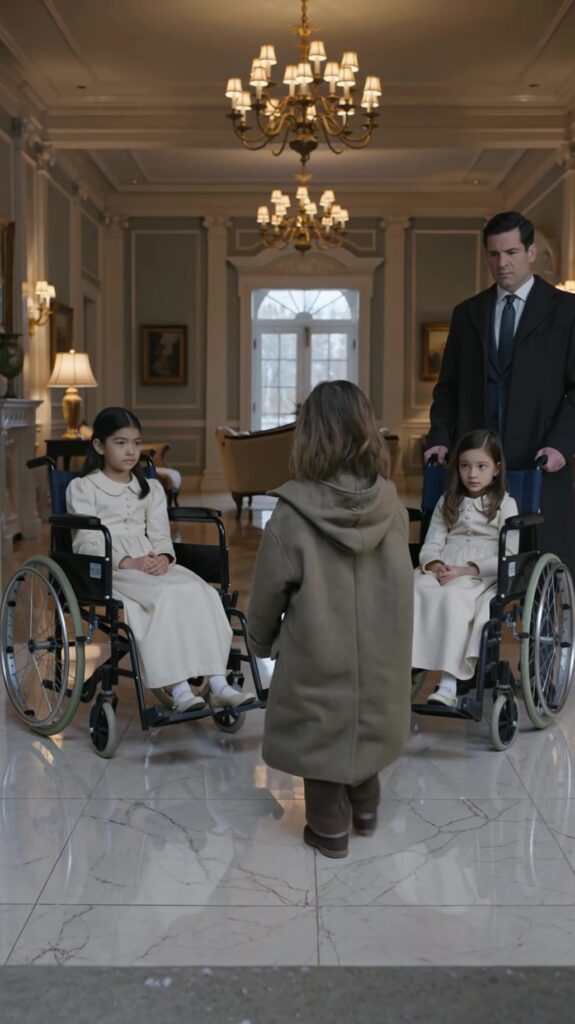
Everyone in Graycastle knew the Hawthorne mansion the way you know a cliff edge: you didn’t have to go near it to feel it looming. It perched above the town with its wrought-iron gates and glossy black cars, like money had grown into a house and learned to glare.
People also knew Elias Hawthorne. They knew the crisp suits, the quiet donations with loud strings attached, the way he could buy silence as easily as bread. They told each other he’d once been different, before his wife died and the house filled with wheelchairs and specialists and the smell of antiseptic pretending to be hope.
For two years, his daughters—Mara and Lottie—hadn’t walked. It wasn’t a simple break or an illness with a neat name. It was an accident that didn’t have the decency to end cleanly: a winter crash on a bridge, a spin of metal and glass, and then an afterlife of physical therapy charts, gentle voices, and the kind of optimism that costs per hour.
Doctors came. Doctors went. Some promised new treatments in foreign cities. Others sighed like the problem was the family’s attitude. Elias paid them all. He paid for the best food, the best equipment, the best lighting so the girls would look healthier in photographs. What he couldn’t pay for was laughter. That went missing the same night his wife did.
The only thing that stayed steady was Old Nessa in the kitchen. She was the kind of elderly woman who could cut an onion and a man’s ego with equal efficiency. Elias didn’t know when she’d started working for them; she felt more like a fixture than staff. Two weeks before she died, she caught him standing in the hallway outside his daughters’ room, listening to the silence like it might confess something.
“If you ever get desperate enough,” Nessa said without looking up from rolling dough, “you’ll start believing in impossible things.”
Elias gave her a humorless smile. “I’m already there.”
Nessa wiped flour from her hands and leaned close, her eyes sharp in a face that should’ve been too tired for sharpness. “Then listen. If a lost child ever touches your broken child and calls her by name… don’t ask how. Just open the door.”
He almost asked what on earth she meant. But she was already humming under her breath, like she’d said something ordinary, like she’d warned him not to overbake the rolls.
After Nessa was gone, the kitchen felt too clean. Elias found himself remembering her words at odd moments—when a new specialist asked for another scan, when Mara forced a smile and said she was “fine,” when Lottie stared out the window as if she could see her old legs still running somewhere outside the glass.
On the first real snow of December, Elias drove himself. The driver had called in sick, and Elias didn’t want a stranger’s sympathy in the car. He took the long route past the church, past the closed toy store, past the corner where the streetlights flickered like they were nervous.
That’s where he saw her.
A little girl sat on a stone step outside a shuttered bakery, wrapped in an oversized coat that swallowed her like a tent. Snow was gathering in her hair, softening the tangles into something almost pretty. Her boots were too big, her cheeks too pale. She wasn’t crying. That was the unsettling part. She looked like someone who’d already used up tears on earlier days.
Elias slowed without meaning to. There were shelters in town, charities, people who pretended not to see children like this because it hurt less. Elias wasn’t pretending. He was staring because something in him—something ugly and frantic—heard Nessa’s warning click into place like a lock.
He pulled over, stepped out into the cold, and walked toward the girl. Up close, she smelled faintly of smoke and wet wool. When she looked at him, her eyes were calm in a way that made him feel like he was the one being evaluated.
He said the sentence that would’ve made any reasonable person call the police. “If you can help my daughters walk again, I’ll adopt you.”
The girl blinked once, slow. “Okay.”
No bargaining. No questions. Not even a flinch at the word adopt, like she’d heard it before and decided it didn’t matter which mouth it came from.
Inside the car, she held her hands in her lap and watched the mansion rise ahead of them. She didn’t gape at the gates or the guards. She didn’t look impressed. It was almost worse than awe—it was familiarity, like she’d been here in a dream she didn’t fully remember.
At the front door, the staff stared. Elias didn’t explain. He didn’t have the energy for explanations. He took her straight to the sunroom where Mara and Lottie sat in their wheelchairs, blankets over their legs, a half-finished puzzle abandoned on the table. The winter light made their faces look like old paintings—beautiful, distant, not quite alive.
Mara, fourteen, had her mother’s dark hair and her father’s suspicious gaze. Lottie, twelve, looked softer until you saw her jaw set in stubborn defiance. When they saw the little girl, both of them straightened, like surprise was the closest thing to excitement they had left.
“Dad?” Mara asked. “Who’s that?”
“Her name is…” Elias hesitated. He hadn’t asked. The oversight struck him as insane now. He turned to the child. “What’s your name?”
She tilted her head. “Rue.”
“Rue,” Elias repeated, tasting the word like it might be a trick. He forced himself onward. “Rue is going to… try something.”
Lottie snorted. “Try what? Magic?”
Elias heard the brittle edge in her voice and hated himself for feeding it. “Just… let her.”
Rue stepped forward. She was so small against the polished floors and the windows that stretched up like frozen waterfalls. She stopped between the two wheelchairs and held out her hand toward Mara first.
“Can I?” Rue asked.
Mara glanced at Elias like she wanted to see him squirm. Then, almost lazily, she placed her fingers in Rue’s.
Nothing happened right away. Elias hated that he’d expected lightning, a sudden glow, a choir of angels. Instead, what changed was Rue’s face. Her calm expression softened, not into kindness, but into focus. Like she was listening to a song only she could hear.
Mara went very still. Her eyes widened, not in wonder, but in shock that made her lips part. She stared at Rue’s face as if it was a mirror reflecting something she wasn’t ready to recognize.
“Dad?” Mara whispered.
Elias’s heart jerked. “Mara, I’m—”
But Mara wasn’t looking at him. She was staring up at Rue.
Rue leaned closer, voice low enough that it felt like a secret the room didn’t deserve. “You still hide the music box under your bed.”
Mara’s breath caught. Elias’s stomach dropped. He didn’t know about any music box. He knew the therapists’ schedules, the medication dosages, the price of imported braces. He did not know his daughter’s hidden treasures.
Mara’s fingers tightened around Rue’s hand as if Rue was the only solid thing in the world. “How do you know that?” she whispered.
Rue’s eyes flicked to Mara’s legs, to the blanket, to the footrests. “Because you promised her you’d keep it safe,” Rue said. “And you did. Even when you were mad.”
Elias couldn’t breathe. The word her landed like a stone.
Then Mara’s toes moved.
It was tiny. Barely a shift beneath the blanket. Elias would’ve dismissed it as a twitch if he hadn’t been watching like a starving man watches bread. Mara’s face twisted with confusion, then fear—fear of hope itself.
“I… I felt that,” Mara said, voice cracking.
Lottie’s eyes filled, angry tears. “Stop messing with her,” she snapped at Rue, but her hands were trembling on her own armrests. “Stop it. Don’t—don’t do that.”
Rue didn’t recoil. She simply turned, held out her other hand to Lottie, patient as snowfall. “May I?”
Lottie hesitated longer. She looked at Elias, her expression sharp enough to cut him open. “If this is another trick,” she said, “I’m never forgiving you.”
“I know,” Elias managed.
Lottie placed her hand in Rue’s.
The air didn’t sparkle. The chandelier didn’t sway. But Rue’s posture shifted again, like someone stepped into her skin and stood a little taller. Her gaze went distant, then painfully present.
Rue’s voice came out softer, older around the edges. “You hate the sound of the rain on the hospital roof,” she murmured to Lottie. “Because it sounds like clapping, and you think it’s making fun of you.”
Lottie’s eyes went wide. “I never told anyone that.”
Rue swallowed, and for the first time her calm cracked into something like sadness. “You told her,” Rue said. “In your head. Over and over.”
Both girls were crying now, silently, like they didn’t trust noise with something this fragile. Elias stood behind them, hands clenched, feeling like a stranger in his own life.
“Who are you?” he asked Rue, the question scraping out of him.
Rue didn’t look at him. She watched Lottie’s feet, watched the way the girl’s ankles trembled as if deciding whether to remember their job. “You’re the one who made a deal,” Rue said. “Open the door.”
Lottie’s right foot lifted off the footrest. An inch. Then another. Her knee shook like a sapling in a storm. She gasped, a sound that was half-laugh, half-sob.
“Dad,” Lottie said, finally looking at Elias now, and there was terror there, but also something he hadn’t seen in years. “Dad, I can feel my legs.”
Elias sank to his knees behind her chair because his body couldn’t hold him up anymore. It wasn’t gratitude. It wasn’t kindness. It was desperation finally paying out in a currency he didn’t understand.
Rue’s fingers stayed wrapped around Lottie’s, steady as an anchor. Her eyes lifted and met Elias’s for the first time since they’d walked into the mansion.
There was no triumph in her face. No innocence, either. Just a quiet, chilling certainty—like she’d come here for a reason that had nothing to do with being rescued.
“You said you’d adopt me,” Rue reminded him.
Elias tasted ash behind his teeth. “Yes,” he whispered. “Yes. Of course.”
Rue nodded once, satisfied, and for a moment Elias saw what he’d missed on the bakery steps: she wasn’t a child waiting to be saved.
She was a key.
And whatever lock she fit, it was already turning.
Outside, the snow kept falling, quiet and relentless, covering the town in clean white lies. Inside the mansion, Mara’s feet began to move beneath her blanket, and Lottie’s legs trembled with the first hint of standing. And Elias Hawthorne—rich, powerful, not kind—realized too late that bargains made in desperation don’t come with a refund policy.