The little red pedal car was worth almost nothing, which was exactly why Ethan Cross didn’t understand the way the two boys were staring at it like it was a pet they were about to give away. The thing was dented in three places, the paint had faded to a kind of tired cherry, and one of the pedals squeaked like a mouse getting stepped on. If it showed up at a garage sale, someone would offer five dollars and feel generous.
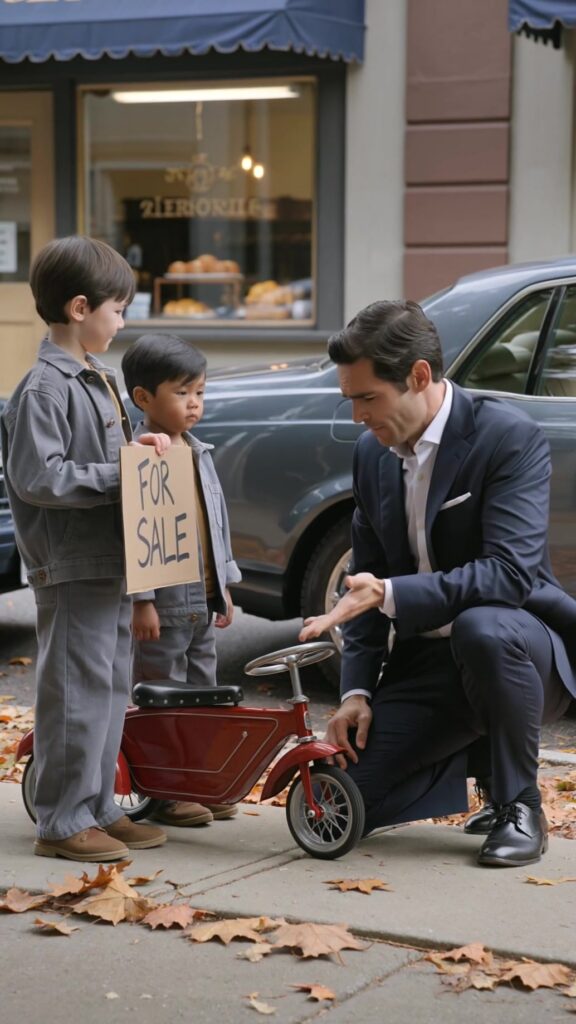
And yet the older boy held a cardboard sign like it weighed a hundred pounds. FOR SALE. Thick marker, slightly crooked letters. The younger kid stood so close to his brother that their sleeves touched, eyes fixed on the sidewalk as if the cracks might offer an escape hatch.
Ethan had come out of his car with a coffee in one hand and his phone in the other, half-distracted by the day’s schedule. He wore a blue suit because it was easier to look like someone who had it together than to actually have it together. He was on his way to a meeting he didn’t want, in a life that looked tidy from the outside.
Then he saw the car. Then the boys. Then that look—no hustle, no playful scam. Just a quiet panic that made his stomach go tight.
The sidewalk was dressed up for fall: orange leaves pinned to the concrete by last night’s drizzle, wind flicking the corners like impatient fingers. Behind the boys, the bakery window glowed buttery and warm, fogged a little at the edges. Someone inside was arranging croissants like they mattered more than the world.
Ethan slowed, then stopped. It was the kind of stop you make before your brain catches up—your body already choosing kindness before your schedule can veto it.
He crouched near the little pedal car. A blue ribbon was tied around the steering wheel in a careful bow, like a tiny party decoration someone didn’t want to admit was a goodbye.
“You’re selling this?” Ethan asked. He tried to keep his voice light, the way adults do when they don’t want to scare kids with their adult sadness.
The older boy swallowed. He had a smudge of something—chocolate? dirt?—on his cheek. “Yes, sir,” he said, and he was trying so hard to sound grown-up that it made Ethan’s throat burn. “It’s my car.”
“How much?” Ethan asked, mostly out of habit.
The boy glanced sideways at his brother, as if checking whether saying a number would break something. “We… we don’t know,” he admitted. “Whatever’s fair.”
Ethan stared at the car again. Fair was complicated. Fair was a word people used when they were hoping the world would notice them.
“Why would you sell your favorite toy?” he asked, because he couldn’t stop himself.
The older boy’s brave face trembled. He lowered his eyes to the ribbon. “Because our mom needs medicine.”
The younger kid turned his head sharply, pretending to look at the bakery, but his shoulders rose and fell like he was holding his breath to keep from crying.
That answer landed like a punch. Ethan had heard a thousand pitches for donations and causes, but this wasn’t a pitch. This was two boys standing in public with their heart sitting on the pavement.
“What’s your name?” Ethan asked softly.
“Mason,” the older boy said. “He’s Ben.”
Ben didn’t look up. He hugged his elbows, like he was cold even though the day wasn’t that bad.
Ethan nodded, buying time. His eyes slid from their worn sneakers to the sign to the ribbon again. The bow wasn’t random. Something about the shade—soft blue, almost periwinkle—hit a memory so clean it made his vision tilt.
Years ago, Ethan had stood in a tiny apartment, hands shaking as he tied a ribbon around a gift box. It was a silly, hopeful thing—he’d bought a pair of baby socks and wrapped them like a joke he couldn’t wait to share. The woman he loved had laughed, then cried, then said she was pregnant. They had danced in the kitchen in socks on hardwood, almost slipping. They had talked about names. They had believed in a future like people do when they don’t know what can happen in three weeks.
Three weeks later, she was gone.
No note that made sense. A disconnected phone. A quiet apartment with her shampoo still in the shower and one mug in the sink. Ethan had tried everything—calls, friends, old coworkers, a private investigator he couldn’t afford but paid anyway. The trail turned into fog.
He’d told himself she left because she didn’t want him. Because that story hurt less than the other possibility.
Now, on a leaf-strewn sidewalk, he saw that same ribbon tied to a child’s steering wheel with the same neat, stubborn loops.
Ethan’s voice dropped without permission. “Who is your mother?”
Mason stiffened. For a second, Ethan thought he’d pushed too far, become another stranger asking questions like it was entertainment. But Mason’s hand slipped into his jacket pocket, fingers working something folded and soft.
“We have this,” Mason said, and his words wobbled. “So people believe us.”
He held out a crumpled pharmacy receipt, folded into quarters and opened and refolded so many times the paper had gone thin at the creases. Ethan took it carefully, like it might tear and with it the boys’ last thread of hope.
The print was faded but readable. A woman’s name sat at the top.
Leah Hart.
Ethan’s heart did something strange—stopped, restarted, then slammed against his ribs like it wanted out. Leah. Same last name she’d used when they met, before she’d changed it back to her mother’s maiden name after a messy family history she didn’t like to talk about. Ethan hadn’t seen those letters in years, but his brain recognized them like a song you can’t forget.
His eyes darted lower. There were medication names he didn’t know, a price circled in pen, and beneath that an emergency contact field. Ethan’s fingers began to shake so hard the receipt fluttered.
Father: unknown.
Air seemed to vanish. Ethan heard the bakery door chime, someone laughing inside, the squeak of the pedal car as Ben shifted his weight against it. All of it sounded far away.
“Where is she?” Ethan managed. His voice came out hoarse, like he’d swallowed sand.
Mason’s chin lifted the tiniest bit, defiant in a way that didn’t belong on a kid. “Home,” he said. “She’s sleeping a lot. She told us not to worry. But she—” He stopped, jaw clenching. “She doesn’t know we’re doing this. She’d be mad.”
Ben finally looked up. His eyes were wet but determined. “We just want her to stop hurting,” he whispered, like admitting it might make it worse.
Ethan stared at them—at Mason’s too-serious face, at Ben’s small hands gripping the steering wheel, at the ribbon. He saw a flash of Leah’s smile in Mason’s mouth, the curve of Ben’s eyebrows like a familiar photograph. It wasn’t proof. It didn’t need to be.
His phone buzzed in his hand with a calendar reminder. Meeting in fifteen minutes. He felt the absurdity of it like a joke the universe had told badly.
Ethan folded the receipt gently, more gently than he’d folded anything in years, and handed it back. “How much is the medicine?” he asked, forcing his voice into something steady.
Mason glanced down at the paper, then at the bakery window like he could read the number off the glass. “A lot,” he said. “The lady at the pharmacy said maybe… maybe two hundred? More?”
Two hundred. For Ethan, it was dinner for two at a place with cloth napkins. For these boys, it was the difference between holding onto childhood and selling it piece by piece.
Ethan reached into his wallet, then stopped. Money was easy. Too easy. It was the bandaid, not the wound. His gaze moved from Mason to Ben. “Do you have a way to get home?”
“We walked,” Mason said quickly. “It’s not far.”
Ethan swallowed. “I’m going to help,” he said, and felt the words settle like a promise he couldn’t take back. “Not just with the medicine. I need to see your mom.”
Mason’s eyes narrowed. “Why?”
Ethan hesitated, because what do you say to two kids on a sidewalk? Hello, I might be the person your life has been missing? Hello, your mother was my whole world before she vanished? Hello, I’ve been carrying a ghost and it looks like it has your face?
He took a breath. “Because I knew Leah,” he said carefully, testing the name out loud like it might cut him. “A long time ago.”
Ben’s grip tightened on the steering wheel. “Mom doesn’t like talking about before,” he murmured.
“I won’t make her,” Ethan said. “I just… I need to know she’s okay.” He glanced at the sign again. “And you don’t have to sell the car.”
Mason’s lip trembled, and he turned it into a stubborn line. “We don’t want charity,” he said, voice cracking on the last word.
“Then don’t call it that,” Ethan replied. “Call it… a trade.”
He reached out, not to take the car, but to touch the ribbon lightly. “This ribbon,” he said, voice barely audible, “I used to tie bows like this.”
Mason stared at him, confusion and suspicion wrestling in his face. “Mom ties ribbons all the time,” he said. “She says it makes ugly things look less scary.”
Ethan’s eyes stung. He nodded once, hard. “Yeah,” he said. “That sounds like her.”
He stood, suddenly aware of how tall adults must look to kids. He adjusted his suit jacket like it mattered. “Show me the way,” he said. “And the car? Bring it. We’ll put it in my trunk. Not because you’re selling it—because you’re keeping it.”
Mason hesitated, then slowly nodded. Ben wiped his face with his sleeve and sniffed like he was angry at his own tears. Together, they gripped the sides of the little red pedal car and started rolling it toward Ethan’s dark sedan.
The squeaky pedal turned once as it bumped over a crack in the sidewalk, and the sound felt like a countdown. Somewhere ahead was an apartment Ethan hadn’t seen. Somewhere inside was a woman who had disappeared with a secret big enough to reshape his life. And on the steering wheel, a faded blue ribbon fluttered in the autumn breeze, stubbornly pretty against a world that had been anything but.