When the rehab center called it “nonresponsive,” it sounded like a polite way to say her legs had stopped listening. When the neurologist said “we don’t see structural damage,” it sounded like a polite way to say he couldn’t explain why she still couldn’t wiggle her toes. Everybody had a phrase. Everybody had a clipboard. Nobody had an answer that felt like hers.
So Ivy got used to the rhythm of being managed. Her dad managed appointments, medications, and the tone in the house—soft, careful, like grief in socks. Neighbors managed casseroles. Friends managed their guilt by texting once a month: thinking of you!!! She managed her face, which was the hardest part. She learned how to look “brave” even when she felt like a locked door.
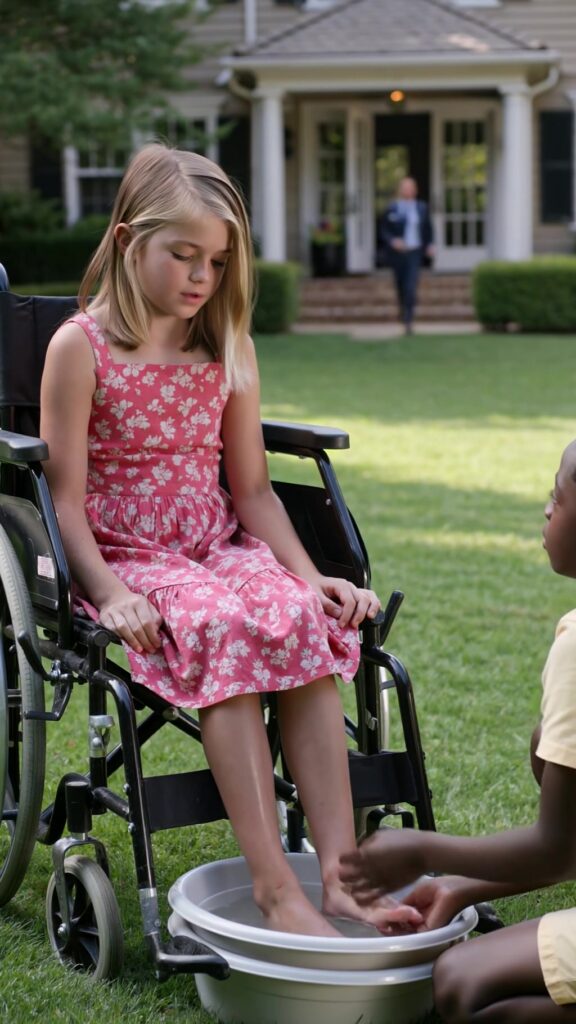
That afternoon, her dad rolled her out into the backyard because the weather was so perfect it almost felt rude not to use it. The lawn looked freshly combed. The big house behind them blurred in her vision like it didn’t belong to her life anymore. She hated how pretty everything was. It made the sadness feel louder, like someone playing a sad song at full volume in a room full of flowers.
She was staring down at her bare feet—her dad had taken her shoes off so her skin could “breathe”—when a voice drifted over from the side gate.
“Hey,” the voice said, casual and unafraid. “Is this a bad time?”
Her dad turned. A kid stood there, maybe fourteen, maybe younger, with a yellow T-shirt and grass stains on his knees like he belonged outdoors. He held a plastic basin in both hands, sloshing water like he’d been carrying it a while. He didn’t look rich. He didn’t look impressed by the house. He looked… focused, like he had a list in his head.
“Can I help you?” her dad asked, polite but tense.
The boy lifted the basin a little. “I’m Mateo. I live two streets over. Ms. Larkin—your neighbor—said you might let me do something I’m good at.” He said “good at” like he meant it the way someone says they’re good at folding fitted sheets: weird, specific, and true.
Ivy raised an eyebrow. “Are you here to sell lemonade?”
Mateo glanced at her feet, then back to her face. “No. I’m here to wash your feet.”
Her dad actually blinked. “Excuse me?”
“Not like—” Mateo held up one hand. “Not like a prank. My grandma showed me some stuff. It’s not a doctor thing. It’s a… nerves and circulation and calm thing.” He shifted his weight. “If you say no, I leave. Promise.”
There was a beat where Ivy expected her dad to say absolutely not, thank you, goodbye, gate closed. But the boy’s voice didn’t have that slippery, salesy sound adults used when they were trying to manufacture hope. It was steady. Almost boring. Like he was offering to water a plant.
Ivy surprised herself by speaking first. “Whatever. My feet are already disappointing. Go ahead.”
Her dad shot her a look. “Ivy—”
“Dad,” she said, keeping her eyes on Mateo. “We’ve tried literally everything except… random backyard foot washing.”
Mateo set the basin down on the grass like it was delicate. The water caught sunlight in bright shards. He knelt, careful not to jostle her wheelchair, and dipped a cloth into the basin. There was something in the water—an herbal smell, sharp and clean, like crushed mint and lemon peel.
“It’s warm,” he said, like he was reassuring himself as much as her. “If it’s too hot, tell me.”
He lifted her left foot and rested it in his palm for a second before lowering it into the basin. He didn’t touch her like she was fragile glass. He touched her like she was a person who deserved to be handled normally. The cloth moved in slow circles over her heel, the arch, the ball of her foot, like he was tracing a map he’d memorized.
“This is weird,” Ivy muttered.
“Yeah,” Mateo agreed, not offended. “But weird isn’t illegal.”
Her dad hovered a few steps back, arms half-crossed, unsure if he was supposed to stop it or witness it. Ivy kept watching the water. The ripples looked unreal, like the world could still be moved by small things.
Mateo spoke softly as he worked. “Your feet are kind of like the last people in line for blood and attention. When the brain gets scared, it forgets them first.” He wrung out the cloth and dipped it again. “Sometimes you have to remind them they still matter.”
Ivy swallowed. She didn’t want to admit how much that sentence landed. Not her feet. Her. Like she was the last person in line for her own life.
“Don’t freak out,” Mateo said, eyes still on his hands. “Just trust me a tiny bit, okay?”
No one had asked her for trust like that. Gently. Like a favor, not a demand. Doctors asked for compliance. Her dad asked for effort. The world asked her to stay inspirational. Mateo asked like it was okay if she couldn’t give him much.
He pressed his thumb along the tendon behind her ankle, then held her toes between his fingers and gave them a slow stretch. Ivy’s stomach tightened for no reason. Her breath caught.
Because something moved.
It wasn’t dramatic. No miracle montage. It was the smallest twitch in her big toe, like a light flickering on in a room that had been dark for months.
Ivy stared at it, then at her other toes like they might be lying. “Wait,” she whispered. “Did… did you see that?”
Mateo nodded once, like this was information, not fireworks. “Yep.”
Her throat burned. “I felt it. Like—like electricity, but warm.”
Her dad made a strangled sound somewhere between a gasp and a laugh. He stepped forward too fast, then stopped himself, afraid of scaring the moment away.
Mateo didn’t grin. He didn’t clap. He just reached into the basin and felt around at the bottom like he’d dropped something there on purpose. His fingers closed on a thin piece of metal. He lifted it, water streaming off it in silver threads, and held it out on his wet palm.
It was an ankle clasp—delicate, curved, the kind of jewelry Ivy used to wear when she wanted to feel like her old self. The clasp had a tiny star charm, scratched on one edge.
Ivy’s heart tripped. “That’s…” Her voice went small. “That’s mine.”
Her dad’s face went pale in a way she recognized from hospital hallways. “Where did you get that?” he demanded, but the question came out softer than the words.
Mateo looked up at them both, calm as ever. “I didn’t get it,” he said. “You lost it.” He tilted the clasp so the star caught sunlight. “In the accident, right? You were wearing it.”
Ivy’s mind flashed: the night rain, the sound of bending metal, her ankle twisting against the car floor. She remembered the clasp snapping, the sting, the panic. After that, everything was sirens and white ceilings and adults talking over her like she was already a story.
“They never found it,” Ivy said, barely audible. “We looked.”
Mateo glanced toward the side gate, toward the sidewalk beyond it. “Ms. Larkin’s dog found it months ago. Buried in her yard. She cleaned it and kept it.” He swallowed, like he was deciding whether to say the next part. “She told my grandma about you. My grandma said… sometimes the body holds on to the exact moment it got scared. And sometimes it lets go when you give it the missing piece.”
Ivy stared at the clasp. It looked ridiculously small for something that had haunted her so much. A bit of silver, a scratched star, the stupid symbol of a before-life.
Mateo set the clasp gently on the edge of the basin. “I think your feet stopped because your brain kept replaying ‘danger, danger’ every time you tried to move. Today we’re telling it something else.”
Her dad’s eyes shone, and he didn’t even try to hide it. “How do you know all this?”
Mateo shrugged, like the answer was both simple and complicated. “My grandma used to do this for people who didn’t have insurance. She called it ‘listening with your hands.’” He lifted Ivy’s foot again, slow and respectful. “We’re not curing anything in five minutes. But we can start a conversation.”
Ivy laughed once, harsh and surprised. “A conversation with my toes.”
“Exactly,” Mateo said, and for the first time his mouth twitched like he might be amused. “They’ve been ghosting you.”
Ivy took a breath and tried again. She focused on the warmth, on the pressure of Mateo’s fingers, on the ridiculous smell of mint in the air. She pictured the clasp snapping back together, pictured the moment unhooking from her bones.
Her big toe moved. Then the next one, a tiny ripple. Not much. But it was hers. It was an answer.
Her dad made a noise that was definitely a laugh now, and he dropped to his knees in the grass like he needed to be closer to the ground. “Ivy,” he said, like her name was a prayer.
She looked at Mateo, tears threatening but not winning yet. “You’re not a doctor,” she said, half accusation, half disbelief.
Mateo squeezed her heel once, gentle. “Nope,” he said. “I’m just the first person today who isn’t scared of your legs.”
And in the middle of that too-beautiful backyard, with sunlight on the water and a scratched silver star glinting like a dare, Ivy felt something she hadn’t felt since the accident: not the promise of a miracle, but the return of possibility. It wasn’t loud. It wasn’t cinematic. It was small, warm, and moving—starting at her feet and climbing upward, one honest twitch at a time.