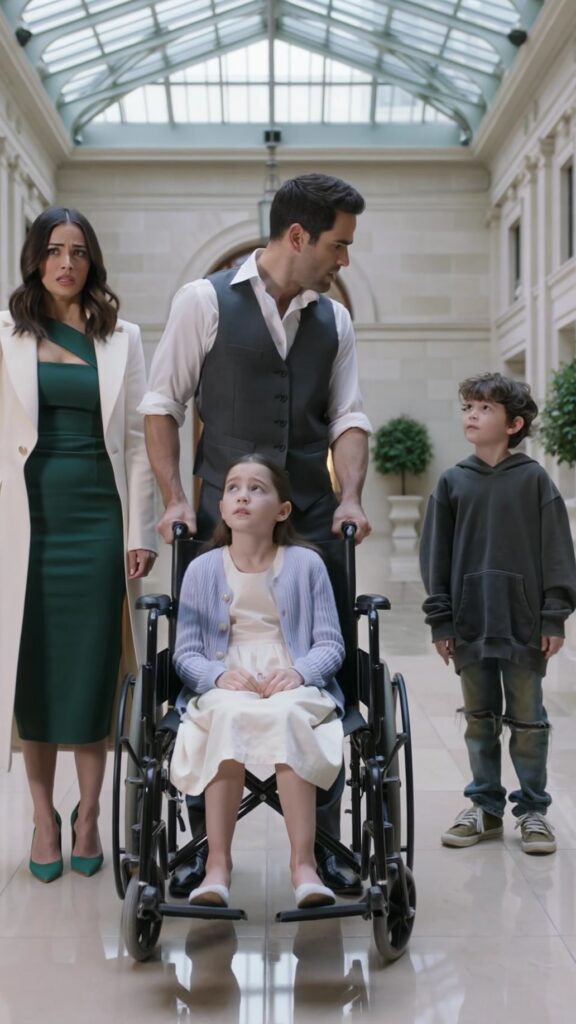
The atrium was the kind of place that tried to convince you nothing bad could happen inside it. Glass roof, sun pouring down in thick, generous sheets, floor so polished you could spot your own stress lines if you looked hard enough. Even the plants looked curated—tall palms in white stone planters, leaves glossy like they’d been wiped down that morning.
Jasper Vale had paid for the atrium twice over without meaning to. Once in taxes—his name sat on a plaque near the elevator, one of those tasteful “donor” acknowledgments people pretended not to read. And once in time, because it was the only part of the rehabilitation hospital that didn’t smell like antiseptic and worry.
He stood behind the wheelchair with both hands braced on the push handles, like he could keep the whole world steady by anchoring himself to it. In the chair, Mia’s legs were tucked under a pale blanket printed with little whales, a pattern that made her seem younger than nine. She tilted her face up to the ceiling, squinting at the brightness like it was a puzzle.
“It’s like a greenhouse,” she said, then gave him her sideways smile. “But for people.”
“A peoplehouse,” Jasper said, and she giggled. The sound was small but clean, a noise that belonged in this light.
Celeste Arden hovered at Jasper’s right shoulder, close enough to look like she belonged there permanently. She wore cream-colored wool, soft lines, and an engagement ring that caught the sun whenever she moved her hands. People in the hospital recognized her—not because she was famous, exactly, but because she had the kind of face that made you assume she’d never had to ask for anything twice.
“I brought your book,” Celeste told Mia, holding up a paperback with a dragon on the cover. “The next one in the series. The dragon finally learns to fly.”
“Maybe my legs will do that too,” Mia said, matter-of-fact, and the sentence landed like a pebble dropped into water: small splash, ripples that went on too long.
Jasper’s hands tightened on the chair. Celeste’s smile stayed put with practiced gentleness. “We’ll keep trying,” she said. “That’s what heroes do.”
Jasper wanted to believe in heroes. He had built a whole life on the idea that if you threw enough resources at a problem—money, lawyers, doctors, private wings—you could turn chaos into a spreadsheet and beat it with persistence.
They were halfway across the atrium when a voice cut through the bright air like a crack in glass.
“She’s not really paralyzed.”
It didn’t come from a doctor. It came from a boy standing near the left row of planters, skinny arms folded tight against his chest. He was maybe thirteen. Dark hair that looked self-cut. A backpack slung over one shoulder like he’d come straight from a place that didn’t do glass ceilings.
Jasper’s feet stopped. The wheelchair stopped with him. Celeste froze so completely her shadow didn’t seem to move.
The boy lifted his chin, eyes locked on Jasper with the kind of steadiness adults hated because it didn’t ask permission.
“Your fiancée is the reason she’s still like this,” he said, and then, as if he’d held the words in his mouth until they burned, he pointed directly at Celeste.
For a beat, the atrium kept pretending. Sunlight stayed cheerful. The leaves stayed glossy. The fountain in the corner kept doing its gentle trickle.
Then Jasper felt the sentence land somewhere old and sore. Not confusion—impact. Like finding a bruise you didn’t know you had.
“What is he talking about?” Jasper heard his own voice come out thin, too loud in a place built for quiet. He turned to Celeste so sharply the edge of his coat brushed Mia’s shoulder. “Is it true?”
Mia looked up at him first, then at Celeste, eyebrows knitting. She didn’t understand the accusation, not really. But she understood fear. Kids always did. She could read it in the way Celeste’s smile didn’t belong on her face anymore.
Celeste’s expression emptied like someone had pulled a plug. Color drained. Her lips parted, but the denial didn’t arrive. Her body decided distance before her mind decided a story.
She took a slow step back.
Jasper stayed anchored to the wheelchair, one hand still clamped to the handle like it was a vow. He took only half a step toward Celeste, caught between instincts: protect the child, confront the adult.
“Who are you?” Jasper demanded of the boy, because it was easier than asking the question that frightened him. “Why would you—”
“Because you won’t listen to anyone who can’t buy a suit,” the boy snapped. His voice trembled on the edges, not from uncertainty but from holding too much back. “Because she’s been doing it for months and everybody thinks it’s just… bad luck.”
Celeste’s eyes darted around the atrium, searching for an exit, a nurse, a distraction, anything. The bright space offered none. Everything was visible. Too visible.
“This is insane,” she said finally, but the words came out wrong, clipped, like she was reading them off a card she hadn’t rehearsed. “Jasper, you can’t seriously—”
“Celeste,” Jasper said, and his voice was low now, dangerous in its calm. “Don’t move. Tell me what he means.”
The boy didn’t say another word. That was the part that made him hard to dismiss. If he’d kept ranting, Jasper could have filed him under “disturbed” and rolled Mia away. But the boy just stared, jaw set, as if he’d already paid whatever price came with speaking once.
And then Jasper saw it.
Near Celeste’s sleeve, where the cuff of her coat shifted as she backed away, something flashed in the sunlight—a tiny, wicked glint. A small glass vial, half-hidden, like an afterthought. It bumped lightly against the inside of her wrist when she moved, catching the light again.
Jasper’s throat went dry. His brain offered him a ridiculous explanation first—perfume sample, vitamin drops, something harmless. But the hospital’s security briefing played in his mind, the warnings about medication theft, the locked cabinets, the controlled substances.
“What is that?” Jasper asked, and even Mia’s fingers curled around her blanket at the tone.
Celeste’s hand snapped to her sleeve like a reflex. Too fast. Too guilty. Her eyes flicked to Mia, then away, like she couldn’t stand the idea of being seen by a child.
The boy finally spoke again, voice hoarse. “It’s not the medicine that makes her better. It’s the one that keeps her from getting better.”
The atrium didn’t darken, not really. The sun was still there, bright and rude. But Jasper felt as if a shadow had been dropped inside his chest.
Mia’s gaze ping-ponged between them. “Jas?” she whispered, using his private nickname, the one reserved for when she was scared. “What’s happening?”
Jasper couldn’t answer her. Because the answer was too ugly to fit in this clean, gleaming place.
Celeste’s breath went shallow. Her pupils looked huge. She licked her lips like someone about to sprint. “You’re letting some random kid ruin our lives,” she said, and the word “our” sounded suddenly like a trap. “He’s lying. He wants money. He—”
“Stop,” Jasper said, and his voice cracked. His eyes stayed on the vial. “Open your hand.”
Celeste’s fingers tightened around her sleeve, and for the first time, her perfect composure slipped into something raw. “You don’t understand,” she hissed, not even denying it now. “I did it because—because you were slipping away from me.”
The confession was quiet, but in the atrium it felt like shouting. A couple on a bench looked up. A nurse at the far end paused mid-step, her attention caught by the tension in Jasper’s posture.
Jasper’s mind started to connect dots he’d refused to see: the plateau in Mia’s progress, the “unexpected” setbacks, the way Celeste always insisted on being present for medication times, the private conversations with staff that Jasper had assumed were just her being helpful.
He thought of Celeste’s ring catching sunlight, how proud she’d looked when he’d proposed. He thought of Mia’s small joke about flying. He thought of every night he’d blamed himself for not doing enough, every time he’d sat in meetings and moved money around like pieces on a board, believing love could be engineered.
Celeste shifted, body turning toward the exit. The vial glinted again.
Jasper moved before he could think. He didn’t leave Mia—he couldn’t—but he swung the wheelchair sideways, blocking Celeste’s path the way a door might block a storm. His hands went out, not to grab her, but to stop her from getting past him and the child.
“Security,” he called, voice carrying, and the word tasted like metal.
Celeste’s face twisted. For an instant, rage and panic and something like grief crossed it in rapid succession. “Jasper, please,” she said, and now the light made her tears look like tiny knives. “I didn’t mean—”
“You did,” the boy said, almost gently. “You kept doing it.”
Two orderlies appeared from the corridor, responding to the sudden change in atmosphere like dogs hearing a whistle. A nurse followed, eyes narrowing at the sight of the vial and Celeste’s rigid posture.
Celeste made her move—one desperate lunge toward open space.
But in the bright, honest atrium, there was nowhere to hide, and the lie was too ugly to survive under all that daylight.
Jasper kept one hand on Mia’s chair, feeling her trembling through the metal, and watched as the staff closed in. He realized, with a sick clarity, that this wasn’t the end of something.
It was the beginning of knowing exactly how far a person could go to keep being loved.
And in the sunlight that made everything look clean, Jasper finally saw the mess he’d been standing in all along.