At first, the guests thought the boy was begging. It was the kind of charity gala where people pretended not to notice anything messy—wrinkled shirts, chipped nail polish, emotions. Even the ocean down below the terrace seemed filtered, like someone had turned down the volume on real life.
The Mirador Hotel’s rooftop was all creamy stone and soft lantern light. Waiters glided around with trays that held food too pretty to eat. Someone’s jazz trio tried hard not to sound like a jazz trio. A charity banner fluttered near the bar: SIGHT FOR TOMORROW. It made the wealthy guests feel like their wallets were holy.
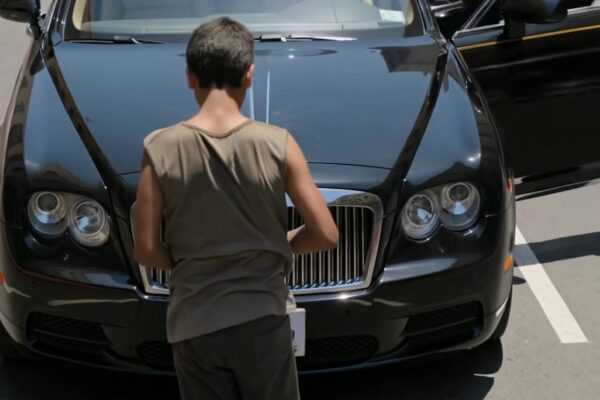
So when a barefoot kid climbed the steps from the service alley, thin as a broom handle, nobody jumped. A few heads turned the way you glance at a street performer you don’t plan to tip. He wore an oversized hoodie with one sleeve torn and carried a bulging sack that made a faint, tinny clatter. Probably cans. Probably harmless. Probably security’s problem in thirty seconds.
Except security didn’t pounce. Maybe the guards had stepped away for a smoke. Maybe they were watching the mayor’s wife try to look casual while holding a glass of champagne. Or maybe, for once, the kid walked like he belonged somewhere and that confused everybody.
He stopped near the center tables—the ones closest to the railing, with the best view and the thickest financial donors. His eyes locked on a table with a small cluster of people that seemed to glow with its own importance.
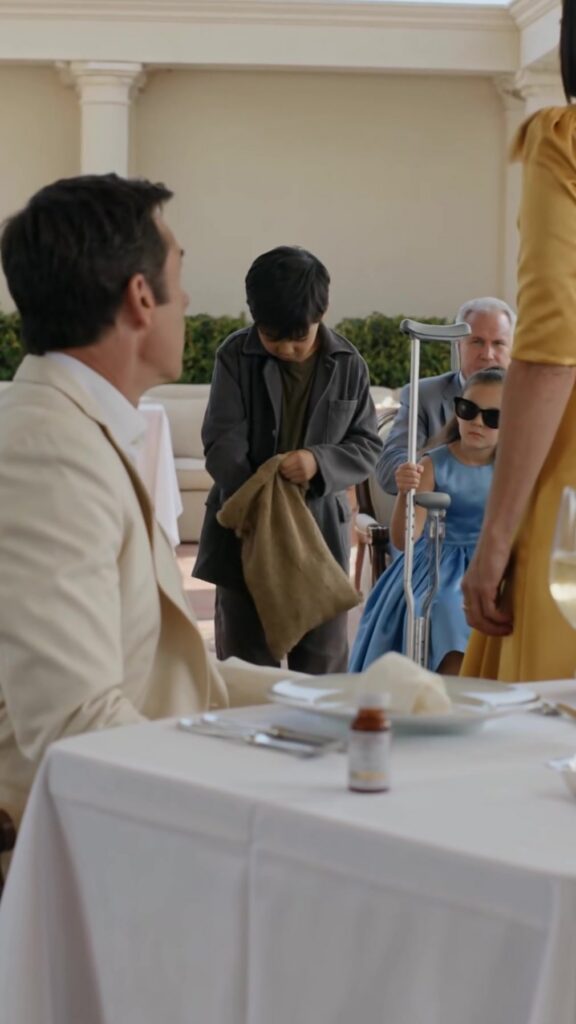
Augusto Rivas sat there, billionaire in a slate suit that looked like it had been ironed by physics. His wife, Paloma, wore a yellow dress that screamed “sunshine” even though the night air was cool. And between them sat their daughter, Lucía, in a neat blue dress, dark sunglasses covering her face. A crutch rested across her lap like a prop everyone had agreed not to discuss.
The kid pointed straight at them like he’d been practicing it in a mirror and shouted, loud enough to slice through the jazz: “Your daughter can see!”
The terrace changed shape. It wasn’t dramatic, not at first—just a sudden reorganization of attention. Forks paused midair. A waiter froze with a wine bottle tilted like a question mark. Someone near the railing turned so fast their chair screeched against the stone. Then the whole crowd went quiet in that way people do when they want to be part of a story but not involved in it.
Augusto didn’t leap up like the hero in a movie. He simply stopped moving. His hand hovered near his plate, fingers slightly curled, as if time had snagged him by the sleeve. He stared at the boy with a face that tried to process the impossible and, worse, the familiar.
Paloma’s smile—her gala smile, the one built for photographers—held for half a second too long, then cracked.
The boy took a step closer. He lifted his sack as if it were evidence and said, this time without shouting but somehow louder, “She poisoned her food.”
A small sound escaped someone in the crowd, like a surprised laugh that didn’t have the courage to become one. The jazz trio stopped playing. No one told them to; they just sensed the vibe had turned into an emergency.
Augusto stood. Slowly. Too slowly for a man who prided himself on being decisive. His eyes flicked from the boy to his wife, and something ugly crossed his face. Not anger exactly. More like a private fear finally being forced into public lighting.
Lucía, who had been sitting still the whole night the way adults expect “fragile” children to sit, tilted her head. Not vaguely. Not the hesitant tilt of someone guessing where a voice came from. She turned with precision until her face—those dark lenses—aimed right at the boy.
Paloma went pale so fast it looked like the terrace lights had changed.
The boy dropped the sack on the stone. It hit with a dull thud and a clink of metal. He dug through it with quick fingers, pushing aside crushed cans and a few random bits of trash like he’d hidden something inside on purpose. Then he pulled out a tiny medicine bottle. No label. The plastic cap was scratched, the way it gets when it’s opened too many times by someone in a hurry.
Augusto snatched it. His grip was hard enough to hurt the bottle. His hand shook the moment he recognized it—not because he knew what it was, but because he knew what it wasn’t. It wasn’t any of the legitimate prescriptions that came with Lucía’s “condition.” It wasn’t any brand the family doctors had listed. It was a secret.
Lucía’s voice slipped into the silence, soft and dry: “Mommy gives it to me…”
Somewhere behind them, a glass fell and shattered. The sound should’ve made everyone jump. Nobody did. The terrace had become a single nerve ending.
The boy swallowed, like he’d run out of oxygen but kept going anyway. “She told the nanny it works better in sweet juice.” He nodded toward the table as if the memory was physically sitting there. “Like mango. Or apple.”
Paloma’s mouth opened. Nothing came out. Then she found her voice and it came out sharp and bright, a knife disguised as a laugh. “This is insane. Who are you? Security!”
Her shout finally snapped the guards into motion. Two of them started toward the boy, hands already reaching.
“Stop,” Augusto said. It wasn’t loud, but it had the kind of weight money gives a man’s voice. The guards hesitated, frozen in the awkward space between orders.
Augusto looked down at the bottle. He turned it over, thumb brushing the scuffed plastic. “Where did you get this?”
The boy’s gaze darted to Lucía, then back to Augusto. “From your trash.”
The crowd made a collective, disgusted inhale, like the kid had admitted to something worse than accusing a socialite of poisoning her child. Paloma recoiled as if the words had left a stain.
“You went through our—” she started.
“You throw it out like it’s nothing,” the boy cut in. His voice wobbled, but he didn’t drop his stare. “But it’s always in the same bag. The one with the gold tie. The one your driver leaves behind the kitchen door, so staff doesn’t see it.”
Augusto’s eyes narrowed. That wasn’t a guess. That was someone who’d watched the routine.
Lucía shifted. Her fingers found the edge of her sunglasses. For the first time all night, she moved like a kid instead of a display. “Can I take them off?” she asked quietly, not looking at her mother.
Paloma’s head snapped toward her. “Lucía, no.” Too fast. Too automatic.
“Let her,” Augusto said, and the way he said it made Paloma flinch.
Lucía pulled the sunglasses away. Her eyes blinked at the light, glossy and uncertain like they’d been kept in the dark on purpose. The pupils tightened. She looked around, slow at first, like someone reacquainting themselves with a room they’d been told was imaginary.
Then her gaze landed on the boy. Not just in his direction. On him. On his face. She smiled, small and stunned, as if she’d been handed a secret she didn’t know she was missing. “You’re real,” she whispered.
The boy exhaled like he’d been holding his breath for days.
Augusto’s jaw worked. He stared at Paloma, the bottle still in his hand. “What is this?”
Paloma’s eyes flicked to the crowd—the donors, the cameras that had quietly lifted phones, the waiters who suddenly forgot they had jobs. You could almost see her calculating how many headlines her life could survive.
“It’s nothing,” she said, too quickly. “It’s a supplement. The doctors—”
“Which doctors?” Augusto asked. “Because I’ve met all of them.”
Lucía spoke again, and the innocence of it made the air feel colder. “Mommy said it helps me stay… quiet.”
That did it. The terrace didn’t just listen anymore; it judged.
The boy lifted his chin, like he finally trusted himself to say the rest. “She didn’t want you to fix her,” he said to Augusto. “If Lucía gets better, she’s not your miracle project anymore. People stop clapping for you. They stop donating because they’re sad for you.” He gestured at the banner, at the polished crowd. “She keeps her like this, you keep them like this.”
Augusto’s face went blank in a way that was somehow more terrifying than rage. He set the bottle down on the table with careful precision, as if any sudden movement might break the last piece of his life that still made sense.
“Call my head of security,” he said to a waiter without looking away from Paloma. “And call the police. And call Dr. Serrano. Now.”
Paloma took a step back, her heels scraping stone. For the first time, the yellow dress looked less like sunshine and more like a warning.
“Augusto, don’t be ridiculous,” she tried, softer now. “You’re going to let some street kid—”
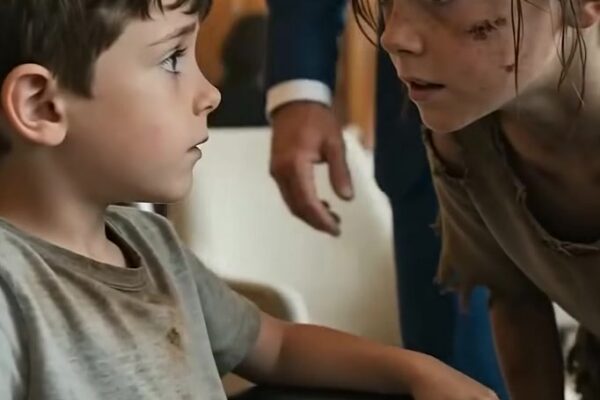
“His name is Nico,” Lucía said suddenly, proud, like she’d solved a puzzle. Everyone stared at her. She blinked, surprised at herself. “I… I remember him.”
The boy’s eyes widened. “You do?”
Lucía nodded. “From the garden. When I was little. You used to whistle.” She attempted a weak little whistle and giggled when it came out wrong. The sound was so normal it almost hurt.
Augusto’s gaze snapped to the boy. “You were here before.”
Nico’s shoulders lifted and fell. “My mom cleaned rooms. A long time ago. Before she got sick.” He hesitated, then added, “Your daughter used to chase sunlight spots on the floor. Like a cat.”
Paloma’s expression tightened, like she was watching her carefully built story unravel thread by thread. “Enough,” she hissed. “This is a performance.”
But the performance had already changed leads. Lucía stood, awkward with the crutch, and looked out at the crowd with naked eyes. She squinted at the lights, then focused on her father. “Dad,” she said, voice steadier, “I can see you.”
Augusto’s face crumpled for one second—grief and relief wrestling in the same space—then he caught himself, because men like him didn’t cry in public unless it was strategic.
He reached for Lucía’s hand. She took it without hesitation.
Security arrived in a wave of black suits, but not for Nico. Augusto lifted his free hand and pointed at Paloma like he was signing a contract. “Detain her,” he said.
Paloma laughed, high and brittle. “You can’t be serious.”
Augusto’s voice dropped. “I’m serious enough to lose everything if I’m wrong.” He looked at Lucía. “But I’m not wrong.”
Nico stood there, still barefoot, still ragged, still holding his sack like a shield. The guests stared at him differently now—not with pity, not with annoyance, but with that strange mix of awe and discomfort people get when someone low on the ladder touches a truth they were hoping would stay out of reach.
As Paloma was led away, she twisted her head toward Nico, eyes sharp again. “What do you want?” she spat. “Money? Attention?”
Nico shook his head. “I wanted her to have her eyes back,” he said, nodding at Lucía. “That’s it.”
Lucía squeezed her father’s hand, then looked at Nico like she was trying to memorize him with the brand-new privilege of sight. “Thank you,” she said, simple as that.
And for the first time that night, the ocean below the terrace sounded real again—loud, messy, alive—like the world had been waiting for someone to stop pretending not to see.