The luxury fashion boutique looked flawless, the kind of place that made you straighten your posture the second you stepped inside. The light was the expensive kind—soft but bright, flattering in a way that felt suspicious. It slid over the polished floor like water and made every glass case look like it had its own halo. Handbags sat on velvet shelves with the confidence of museum artifacts. Even the air smelled curated, like someone had bottled “wealth” and sprayed it into the vents.
Mara kept telling herself it was just a job. Fold scarves. Run sizes. Smile. Don’t flinch when someone said “just” and snapped their fingers. She’d learned to move quiet, to keep her hands visible, to never look too long at the jewelry. The jewelry always looked back. Diamonds and gold in neat little beds, as if they’d been tucked in by someone with gloves and a grudge.
It was mid-afternoon when the boutique’s calm cracked open like a dropped mirror.
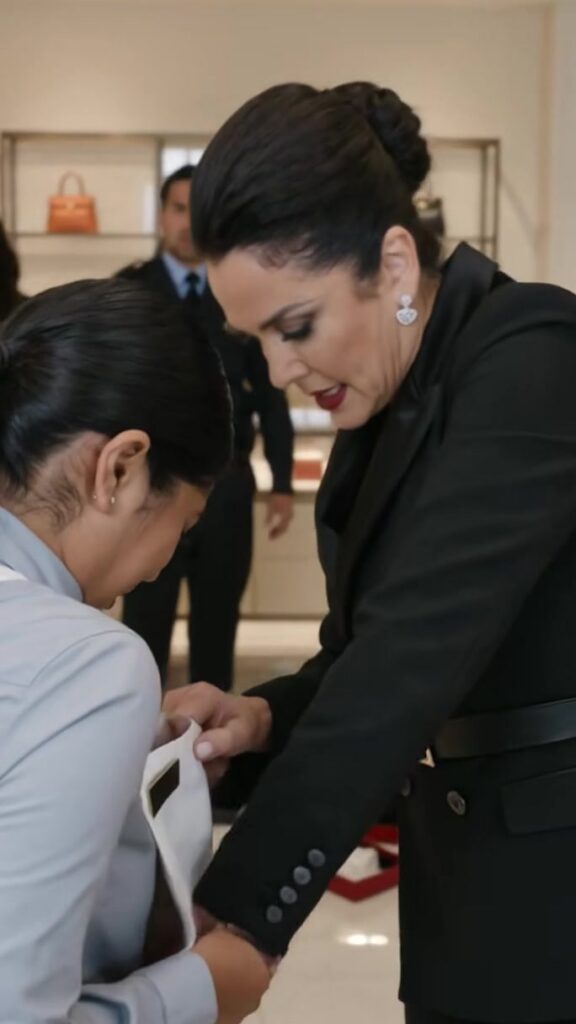
One second, a woman in a cream trench coat was laughing with a friend near the handbag counter. The next, she lunged—fast, furious, practiced—snatching Mara by the hair and yanking her close like she was reeling in a fish.
“Thief!” the woman screamed, loud enough to make the soft music sound like it was apologizing. “I saw you hide my bracelet!”
Before Mara could even shape a word, the woman’s hand cut across her face. The smack echoed off the glass cases. A stack of display boxes toppled and hit the floor with a hollow clatter. People spun around. Someone near the fitting mirror brought both hands to her mouth. A man in a tailored jacket froze mid-step like a mannequin that suddenly remembered it was alive.
Mara stumbled backward, cheek burning, eyes full. She grabbed the edge of the counter to keep from falling.
The woman pointed at her like she was pointing at a stain. “Search her now!”
Security hesitated just long enough for everyone to notice he was hesitating. Then he stepped in, awkwardly official, and reached toward Mara’s apron pocket. Mara’s breath hitched. She hadn’t even known that pocket could feel like a trapdoor.
His fingers closed around something. He pulled it out.
A diamond bracelet caught the light and threw it back in shards.
Gasps popped around the boutique like fireworks. The woman’s expression changed instantly—triumph sliding in, smug and glossy. “I knew it,” she said, like she’d won a game no one else had agreed to play.
Mara stared at the bracelet, throat tight. It was stunning in a way that almost hurt. Too heavy-looking. Too complicated. Like it belonged in a vault, not in a pocket next to a lint roller. “That isn’t yours,” she managed, voice cracked and small.
For a beat, people didn’t understand. They just stared, waiting for a simple story: assistant steals bracelet, rich woman catches her, consequences follow, everyone goes back to shopping.
Then the owner came rushing from the back, tie crooked, face already tense as if he’d been sprinting toward bad news his whole life. He took one look at the bracelet and turned pale, as if the diamonds had drained the color out of him.
His lips parted. “No,” he whispered first, like he was trying to reject reality on principle. Then louder, to the room: “That piece was locked in our private vault.”
The boutique went quiet, a hard silence that seemed to press on everyone’s ears. “Only family has access,” the owner added, eyes fixed on the bracelet like it had crawled out of the floor.
Slowly, every gaze slid toward the woman in the cream trench coat. Her smirk evaporated. She took half a step back, then stopped, realizing there was nowhere in a boutique made of mirrors to hide.
Mara pressed a shaking hand to her cheek. Tears made the lights smear into stars. “I told you,” she whispered, not even aiming it at the woman anymore. “It wasn’t hers.”
The owner’s jaw worked like he was chewing through old memories. “This,” he said, voice lower now, dangerous in the way a door is dangerous when it’s locking. “This bracelet disappeared the same night my brother’s wife was found dead.”
The cold that hit the room wasn’t from the air conditioning. It was the sudden feeling of being inside someone else’s nightmare.
The woman’s eyes flicked to the exit. Then to the security guard. Then to the staff. Her hands curled and uncurled, as if she was practicing being innocent.
From the back of the boutique, near the alteration room, an older seamstress dropped a garment bag. It hit the floor with a soft thud, but the sound still landed like a gunshot.
“No…” the seamstress breathed. Her name tag read NINA, but everyone called her Nonna Nina because she’d been there forever and told you exactly what you didn’t want to hear. Her eyes were wide and wet. She stared—not at the rich woman, but at Mara. “No, no,” she said again, voice trembling. “She’s wearing Elena’s face.”
Every head turned. The boutique lights suddenly felt too bright, exposing the tiny details: the purple bloom rising under Mara’s cheekbone, the shaky set of her mouth, the way her eyes were more startled than guilty.
Mara’s stomach dropped. “I don’t know who Elena is,” she said. The words sounded wrong in her own ears. Like she was lying and didn’t know it.
The owner blinked hard. His gaze sharpened, traveling across Mara’s features like he was comparing her to a photograph in his head. “Elena was my sister-in-law,” he said carefully, each word heavy. “And her daughter disappeared that night too.”
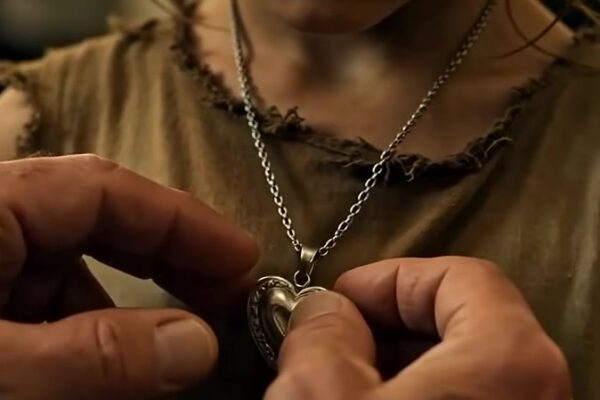
Nina took a step closer, hands hovering as if she might touch Mara’s face but was afraid it would crumble. “I held that baby,” she whispered. “I hemmed her first little party dress. Same eyes. Same scar—here.” Nina pointed to a faint pale line near Mara’s hairline, half-hidden by her bangs.
Mara lifted her fingers and touched the spot. She’d always had that scar. She couldn’t remember getting it. She’d told herself it was from falling off a bike as a kid. A story you could buy cheap and carry around forever.
The woman in the trench coat made a sharp sound, like a laugh that had been strangled. “This is insane,” she snapped. “You’re all—”
“What’s insane,” the owner interrupted, “is that you accused my employee of stealing a bracelet that should not exist outside my vault.” He looked at the guard. “Lock the doors.”
The guard hesitated again, but this time it wasn’t uncertainty. It was fear. Still, he nodded and moved toward the entrance. The boutique’s sleek glass doors clicked shut, the sound final.
Mara’s mind raced, slipping on itself. She tried to remember anything before last year, before the shelter, before the name Mara felt like a borrowed coat. She remembered fog. A lullaby. A woman’s perfume—something floral and desperate. A bright flash of a hallway with red carpeting and a man’s voice saying, “Don’t look back.”
Her knees wobbled. She grabbed the counter again.
Nina’s eyes filled. “Little star,” she whispered, the nickname landing like a key in a lock. “That’s what Elena called her. Stellanina. Little star.”
Mara flinched at the word, a sharp ache behind her ribs. “Stop,” she said, but it came out as a plea, not a command.
The owner held the bracelet carefully now, like it was both evidence and curse. He turned it over and pointed to the underside. Tiny letters were etched into the metal—too small for most to see, but he knew where to look. “E.M.,” he murmured. “Elena Marconi.” His eyes lifted to Mara. “Mara,” he repeated slowly, tasting it. “Marconi.”
The rich woman’s face went tight. Her gaze darted to Mara, then to Nina, then back to the bracelet. “You’re all making up ghost stories to cover your staff’s theft,” she said, but her voice was thinner now, fraying at the edges.
The owner didn’t look away from Mara. “What is your real name?” he asked gently, like he was afraid of breaking her with the question.
Mara tried to answer. Nothing came. Her tongue felt useless. She swallowed hard and whispered, “I don’t know.”
Nina let out a sob she’d been holding for years. “Oh, baby,” she said.
The boutique, flawless and shining, suddenly felt like a stage set built over a pit. Mara realized, with a sick twist, that the bracelet hadn’t been placed in her pocket by accident. Someone wanted her accused. Someone wanted her in this room, under these lights, with this family name hovering like a knife.
She looked at the rich woman in the trench coat. The woman’s makeup was perfect, but her eyes had the bright, alert cruelty of someone who’d rehearsed this scene.
“You,” Mara said, voice steadier than she felt. “You put it on me.”
The woman’s nostrils flared. “Prove it.”
The owner exhaled through his nose, slow. “We will,” he said. “Because if that bracelet left my vault, someone in my family helped.” His gaze slid, for the first time, to the woman. “And if my brother’s wife died the same night their child vanished…” He didn’t finish the sentence. He didn’t need to.
Nina reached into her pocket with shaking fingers and pulled out an old phone, screen cracked, case faded. “I kept pictures,” she said, voice raw. “I never deleted them. I couldn’t.” She tapped, hands trembling, and then held the phone out toward Mara.
On the screen was a little girl with dark hair and a gap-toothed grin, holding a tiny purse too big for her. Her eyes were Mara’s eyes. Her scar was there, faint but visible, like a signature.
Mara stared until her vision blurred. The room tilted. Somewhere deep inside her, a door she didn’t know existed creaked open, letting in a gust of old fear.
And in that gust, she finally remembered one more thing: a woman’s voice saying, close to her ear, “If anyone asks, your name is Mara now. You’re safe. Don’t ever go back.”
Mara looked up, tears sliding down her face, and met the owner’s gaze. “I don’t know what happened,” she whispered. “But I think someone has been lying to me my whole life.”
The boutique remained flawless around them—lights still glowing, music still playing softly as if nothing had changed. But everyone in the room understood the truth now.
The explosion hadn’t been the slap. It had been the bracelet, and the way it had dragged the past out into the open, glittering and sharp enough to cut.
And whoever had planted it on Mara had made one mistake.
They’d counted on her being powerless.
They hadn’t counted on her being the missing girl.
They hadn’t counted on family.
Or on Nina, who wiped her cheeks with the back of her hand and said, voice suddenly steady, “Call the police. And lock that woman in until they get here.”
The rich woman’s face twitched, calculating. For the first time since she’d stormed in, she looked genuinely scared.
Mara straightened, fingers still curled around the counter edge, and took a shaky breath. In the reflection of the glass case, she didn’t look like a sales assistant anymore.
She looked like a secret that was done being kept.
And somewhere in the boutique’s perfect lighting, the diamonds in the bracelet flashed—cold, bright, and unforgiving—as if they’d been waiting all along for the truth to finally catch up.