The boutique on Hawthorne Street always smelled like money and citrus cleaner. Even the air felt curated, like it had been filtered through velvet ropes before it was allowed inside. The glass cases gleamed with neat rows of diamonds, and the mirrors were so flawless they made everyone look like they’d slept eight hours and made good choices.
Maribel only came in because her manager said it was “good for the brand” to show up at least once a week—be seen, be polished, be the kind of woman who belonged near a seven-thousand-dollar bracelet. She wasn’t buying anything today. She was just killing time while her phone charged and telling herself she was being brave by walking into places that used to make her feel small.
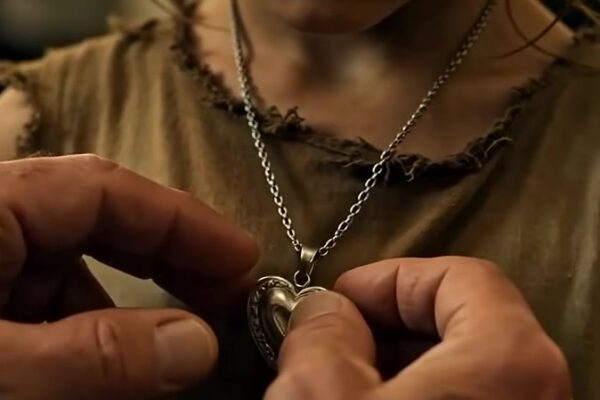
She wore a plain black dress and an old ring on a thin gold chain around her neck. She’d stopped wearing the ring on her finger months ago. Too many questions. Too many looks. Around her throat, it was just another piece of jewelry—if you didn’t know what it meant.
The bell over the door chimed again, and the whole room shifted. People didn’t even have to look up; they felt it. A bride-to-be entered like she had a spotlight following her. She was tall, glossy, and flanked by two friends who held shopping bags and giggled like they were auditioning for a reality show.
“We have an appointment,” the bride announced, before anyone could ask. She didn’t say her name at first, as if names were optional when you were used to being accommodated.
A sales assistant in a beige suit hurried over. “Of course. Congratulations! We’ll bring out the settings you selected.”
The bride’s eyes tracked across the boutique, not really seeing merchandise so much as scanning for threats. That’s when they landed on Maribel.
It was instant—like watching a cat spot movement in tall grass. The bride’s smile snapped into a different shape, sharp and satisfied.
“Oh,” she said, loud enough to turn heads. “That’s funny.”
Maribel looked up from the display card she’d been pretending to read. She felt her stomach do the weird sinking thing it did before a migraine, a body remembering pain before the mind could place it.
The bride walked over, heels clicking a confident rhythm. “You,” she said, pointing. “Take that off.”
Maribel blinked. “Sorry?”
“The ring,” the bride said, nodding at Maribel’s neck. “The one you’re wearing. Take it off.”
Maribel’s fingers went to the chain instinctively, protective. “This is mine.”
One of the friends laughed, a little too eagerly. “Everybody’s got a story.”
The bride leaned in, eyes glittering. “That ring belongs to my fiancé. I’ve seen it. I’ve held it. He had it resized last year.”
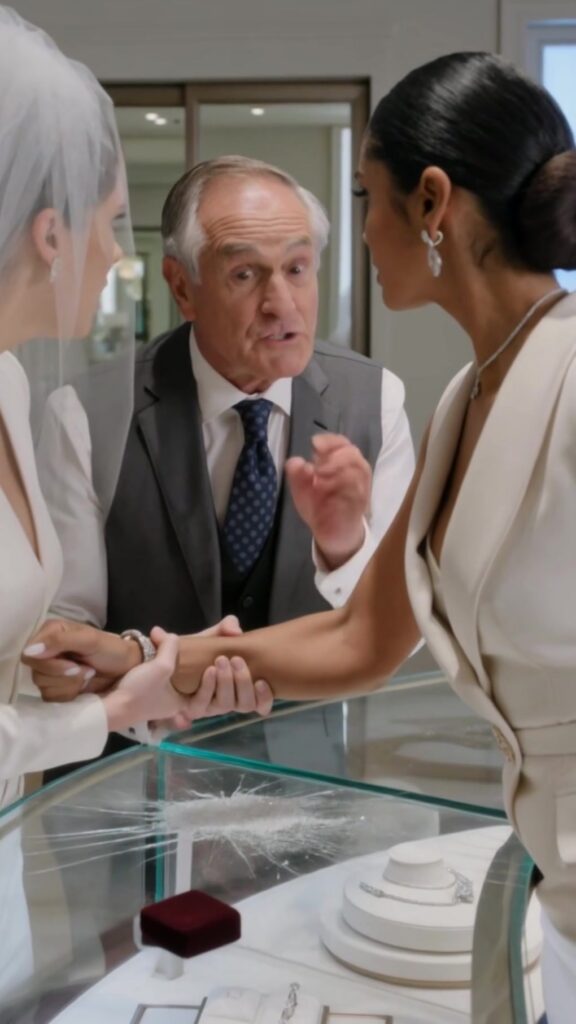
Maribel’s throat tightened around a breath. She tried to step back, but the bride was already reaching. Her hand snapped out and grabbed Maribel’s wrist—hard, possessive—like Maribel was an item someone might shoplift.
“Say it,” the bride hissed. “Say who sent you here. Or are you just… like this all the time?”
All around them, the boutique became a circle of interested silence. People leaned in like their bodies were magnetized by drama. Someone lifted a phone. The sales assistant hovered, frozen between helping and not wanting to touch a woman in couture.
Maribel’s cheeks burned. Her wrist hurt. She could hear her pulse in her ears. “Please let go,” she said, voice unsteady. “You’re hurting me.”
The bride tightened her grip anyway and, with her other hand, slammed a velvet ring box down onto the glass counter. The sound cracked through the boutique like a gunshot. A thin line spidered from the edge of the impact point across the glass.
Everyone flinched.
“I’m not embarrassed,” the bride announced, addressing the crowd as if she’d been given a microphone. “I have nothing to hide. But I will not be humiliated in public by some—” She glanced at Maribel’s cheap flats, the plain dress, the tired eyes. “—by some person who thinks she can play pretend.”
Maribel’s mouth opened, but no words came out. The truth was in there, heavy as wet sand. She didn’t know how to pour it out in a way that wouldn’t ruin everyone’s day.
A door behind the counter opened and an elderly jeweler stepped out. He had a neat white mustache and hands that looked carved from time—steady, careful, used to holding delicate things. His name tag read LEON, though most people called him Mr. Leon like he owned the building even when he didn’t.
“Ladies,” Leon said, voice calm but strained, “we can’t have—”
Then he noticed the ring.
It wasn’t obvious at first. The ring was small, plain gold, the kind of piece you’d overlook in a case full of diamonds. But Leon’s eyes locked on it the way a musician recognizes a melody from a single note.
Maribel’s chain had slipped slightly during the struggle, and the ring had swung forward, catching the light. The inside of the band flashed an engraving for a moment.
Leon’s face drained. His brows lifted, then pulled together. His hands started to tremble, just barely, but enough that the sales assistant noticed and stiffened.
“Madam,” Leon said to the bride, voice suddenly small. “That ring… may I see it?”
The bride scoffed. “Finally, someone with sense. Yes, look at it. Tell her it’s stolen.”
Maribel’s fingers, shaking now too, slid the chain over her head. She held the ring out without meeting anyone’s eyes. When Leon took it, his thumb rubbed the inside of the band like he was checking for a scar he remembered from long ago.
He swallowed hard. “This… this is not an engagement ring,” he said quietly.
The bride’s laughter hit a wall. “Excuse me?”
Leon turned the ring so the bride could see the inside. “We made this in this boutique,” he said. “Custom order. Twelve years ago. I remember because the man insisted on a specific script. He said it was for his wife.”
The word wife landed on the glass counter like a dropped tool.
The bride’s mouth fell open, then snapped shut. “No,” she said, like she could veto reality. “That’s impossible. He’s never been married.”
Maribel finally lifted her eyes. They were glossy, exhausted, and steady in a way that made the room feel suddenly less like a boutique and more like a courtroom.
“He has,” Maribel said. Her voice didn’t rise; it didn’t need to. “To me.”
The friends exchanged panicked looks. The sales assistant’s hand went to her own mouth. Someone’s phone camera kept recording, unwavering, hungry.
The bride stepped back as if the air around Maribel had turned poisonous. “Who are you?” she demanded, but there was a crack in her certainty now, a hairline fracture like the counter glass.
Maribel inhaled through her nose, slow. “My name is Maribel Rojas,” she said. “I was married to Jordan Kline. That ring was the one he ordered after we signed our papers at City Hall because he said we’d do a ‘real wedding’ later. We never did.”
Leon’s eyes closed for a moment, like he was praying for everyone to be kinder than they were about to be.
The bride’s face cycled through colors—pink, white, then an angry red that looked more like fear than rage. “You’re lying,” she said, but it came out thin.
Maribel shook her head. “He moved out three years ago. He said he needed space. Then he disappeared. I thought… I thought maybe he filed something without telling me.” She gave a short, humorless breath. “Turns out that’s not how it works.”
Leon cleared his throat. “We keep records,” he said, voice gentle but firm. “I can pull the order. The date. The name. The inscription.”
The bride stared at the ring in Leon’s hand as if it had grown teeth. “He told me his last relationship was ‘complicated,’” she whispered. “He told me she was… she was unstable. That she wouldn’t let go.”
Maribel’s expression didn’t change much, but something in her shoulders loosened—as if the truth, once spoken, had finally stopped biting her from the inside. “I let go,” she said. “I just didn’t know I was still legally attached.”
A long silence stretched, filled with tiny sounds: the hum of the lights, the faint traffic outside, the soft buzz of a phone trying to focus.
The bride swallowed. “Why are you here?” she asked, and for the first time, it didn’t sound like an accusation. It sounded like she truly didn’t understand how this collision had happened.
Maribel looked down at her empty chain. “Because I got a message last week,” she said. “An email from a lawyer. About ‘an upcoming marriage’ and ‘potential complications.’ No name. No context. Just… a warning.” She lifted her eyes again. “I came here because this is where he bought the ring. I thought maybe the jeweler would tell me if he’d ever returned it. If he’d ever tried to erase me.”
Leon’s jaw tightened with quiet anger. “He did come back once,” he said. “Not to return it. To ask if we could remove the engraving.”
The bride’s breath hitched.
“We said no,” Leon continued. “That’s not something we do. He left in a hurry.”
The bride’s friends shifted closer to her, suddenly protective, their earlier giddiness evaporated. One of them whispered, “Call him. Right now.”
The bride fumbled for her phone with hands that weren’t so steady anymore. She stared at the screen, then up at Maribel. “If you’re telling the truth,” she said, voice low, “then my entire life for the last year has been…” She couldn’t finish.
Maribel nodded once. “I’m not here to ruin you,” she said. “I’m here because I’m tired of being the secret he keeps burying.”
Leon held the ring out toward Maribel again, but she didn’t take it. She looked at it like it was a key to a door she wasn’t sure she wanted to open.
Outside, a siren wailed in the distance and faded. Inside, the boutique’s luxury felt suddenly flimsy, like it was just set dressing over something much messier.
The bride’s call rang once, twice. It went to voicemail.
She stared at her phone, then at the ring, then at Maribel. All the sharpness drained out of her face, replaced by a kind of stunned clarity.
“So he was going to marry me,” she said slowly, “while still married to you.”
Maribel’s voice was quiet, but it didn’t shake this time. “Yeah,” she said. “That’s what the ring has been trying to tell you.”
Leon set the ring gently on the counter, right beside the cracked glass line, like placing evidence at the center of the room. No one touched it. No one seemed to want to be the next person who got burned.
The bride inhaled, long and controlled, then straightened her shoulders. Her eyes still looked wet, but her spine looked steel.
“Okay,” she said. “Then we fix this.”
Maribel didn’t know what “fix” meant yet. Divorce papers. Police reports. A thousand ugly conversations. But for the first time in years, the truth was out in the open where it could be dealt with, instead of living like a bruise under the skin.
And in the boutique that had been glowing with untouchable luxury minutes before, the ugliest thing on display was no longer a woman being shamed.
It was the groom who thought he could buy two futures with one lie.