The first thing Mina noticed about the supermarket in Brookhaven was how bright it was. The lights didn’t just illuminate; they interrogated. Every aisle looked like it had been polished for a commercial, and Mina, in her thrifted cardigan and scuffed sneakers, felt like she’d wandered onto the wrong set.
She adjusted Lio on her hip and nudged the cart forward with her knee. He was three, all elbows and curiosity, and he’d been chanting “cereal, cereal, cereal” since they walked in. Mina smiled despite the knot in her stomach. She’d promised herself she wouldn’t look at the prices too much. She’d stick to her list. She’d breathe. She’d keep her dignity.
It was the kind of day where everything felt like it might slip if she held it too loosely.
She’d gotten the text that morning: Come by. Pick up what you need. Use the tag. It was from a number she didn’t have saved. No name, just a short message like a note slipped under a door. She stared at it for a long time before replying with a single question mark. The response came quick: Trust me. It’s time.
Mina didn’t “trust” easily. Not after the last couple of years, not after learning how fast kindness could come with strings. Still, the grocery cupboard at home had turned into a museum of empty jars and stale crackers. And there was Lio, growing like a weed, asking for apples like they were a luxury item.
So she came. She tucked the tiny tag into the pocket of her jeans. It felt like a toy—thin plastic with a barcode and a pale blue strip—but the message made it feel heavier than her keys.
She kept her head down as she moved through the aisles, choosing basics. Pasta. Rice. Eggs. A bag of oranges because Lio reached for them and kissed one like it was a soccer ball. A couple baby food pouches even though he was past that, because they were easy when he refused everything else. She let herself add a box of cereal too, just to stop the chanting and because he looked so ridiculously happy holding it like a trophy.
That’s when she heard the voice.
“Excuse me,” a woman said, in the crisp tone of someone used to being obeyed. “You can’t just… stand there.”
Mina looked up. A woman in a cream coat stood behind her with a basket hooked on her arm, hair glossy and perfect as if she’d been styled within an inch of her life. Her nails were a pale pink that matched the inside of expensive shoes. She looked Mina up and down like she was scrolling through something she didn’t like.
“I’m sorry,” Mina said automatically, shifting the cart a little to the side. There was plenty of room. The aisle wasn’t even crowded.
The woman didn’t move. Her eyes flicked to Mina’s cart, lingering on the baby food and the eggs, then to the child perched in the seat with sticky fingers on the cereal box.
“You know,” the woman said, lowering her voice but somehow making it carry, “it’s not fair to load up when you can’t pay.”
Mina blinked. “I can pay.”
A small smile curled on the woman’s mouth, like she was enjoying a private joke. “Sure.”
Lio squinted at her. “Mama, that lady mean?” he asked, loud in the way children are when they don’t know they’re being brave.
Mina felt her cheeks heat. “No, honey. We’re fine.” She tried to steer the cart past her.
The woman stepped sideways, blocking the way. “Actually,” she said, “I think you should put some of that back. People like you always try. And then who suffers? Everyone else. Prices go up because—”
“I’m not stealing,” Mina said, voice shaking despite her effort. She hated that it shook. She hated that her body responded like it expected punishment.
“We’ll see,” the woman said. Her gaze dropped to Mina’s pocket, where the faint edge of the tag printed a line through the denim. “What’s that? Some little trick?”
Mina’s hand flew to the pocket instinctively. “It’s nothing.”
“Nothing,” the woman repeated, amused. “So you’re not embarrassed about it?”
“Please,” Mina said. “Just let us through.”
“No,” the woman said, and the word was sharp. “I’m tired of watching this. I’m tired of pretending it’s okay.”
Her hand shot out—not to the tag, but to the cart handle. Mina’s fingers tightened, but she had Lio strapped in and the cart was heavy. The woman gave it a sudden, furious yank.
The cart flipped.
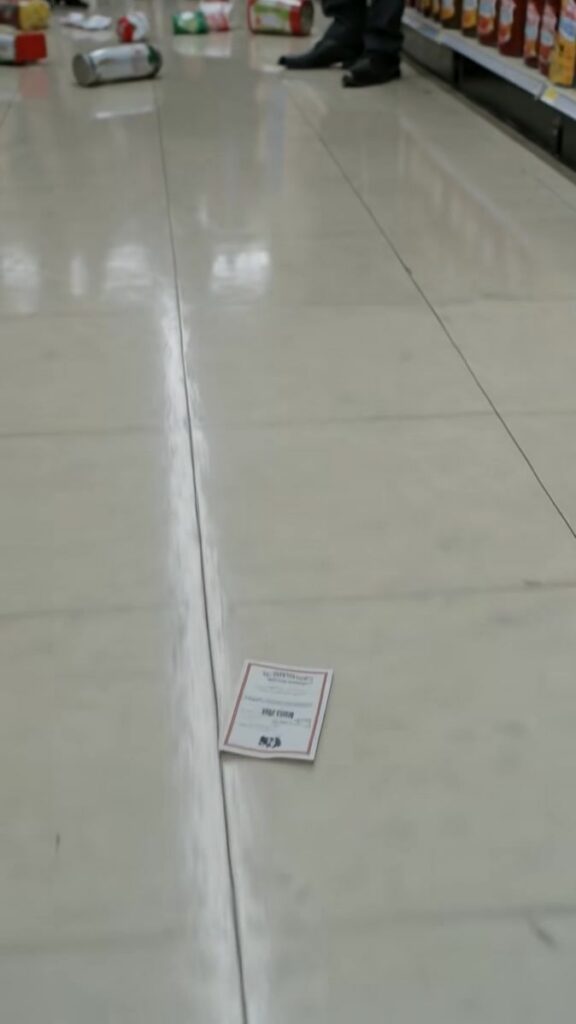
The sound was a crash and a slap and a whole aisle inhaling at once. Milk burst like a dropped water balloon. Oranges rolled, bright suns under the shelves. Pasta boxes skittered. Eggs shattered in a quiet horror. Mina fell to her knees so fast she didn’t even feel the sting until later. Lio screamed, the kind of panicked cry that makes strangers’ hearts lurch, and the cereal box thudded against the floor with a dull finality.
“You can’t pay for any of this!” the woman shouted, switching into English like she was announcing a verdict. Her voice ricocheted down the aisle. “Now everyone can see what happens when people like you pretend!”
Phones rose. Mina saw them out of the corner of her eye, little black rectangles turning her humiliation into content. She grabbed an orange with trembling hands, then another, trying to make it look like she was in control. Her throat burned. “Please,” she whispered, not even sure who she was begging. “Please stop.”
Lio sobbed, reaching for her. “Mama, mama, I scared!”
“It’s okay,” Mina lied, scooping him toward her with one arm while the other tried to corral rolling fruit. She could taste the metallic edge of panic. She didn’t want to look up. She didn’t want to see the smirk that voice promised.
Something slid out from under a fallen bag and skated across the shiny floor. A tiny plastic rectangle, spinning until it lost momentum near a young store worker’s shoes.
He bent down. Picked it up. Frowned at the barcode like it was speaking a language he didn’t expect in a grocery aisle.
The rich woman noticed. “Go on,” she said, loud and pleased. “Check it. Scan it. Let’s see what kind of little scam she’s running.”
The worker—his name tag said Jasper—walked to the nearby scanner station with the tag held carefully between his fingers. He swiped it once. The scanner beeped. He stared at the screen.
His face did something strange, like the muscles forgot their script. His eyebrows lifted. His mouth opened slightly, then closed. He scanned it again, slower, like he wanted the machine to tell him he was wrong.
The aisle had been noisy—murmurs, Lio’s crying, someone whispering “oh my God”—but it started to quiet. People sensed the shift. Even the rich woman’s voice faded into a watchful pause.
Jasper turned his head and looked past Mina, past the puddle of milk, toward the front of the store. A manager in a navy blazer was hurrying over, expression already annoyed, ready for the usual problem.
Jasper swallowed. “Uh,” he said, then lowered his voice. In the sudden silence, it still carried. “This account…” He glanced at the screen again as if it might change out of mercy. “This account is linked to the founder’s private family balance.”
A gasp spread like a ripple. Someone dropped a phone a fraction of an inch and caught it again. The manager went pale so quickly it looked like the lights had drained him.
Mina froze, still on her knees with orange juice on her hands, Lio clinging to her neck. “What?” she whispered.
The rich woman’s smirk cracked. “That’s not—” she started, but her confidence didn’t land the way it had a minute ago.
The manager stepped closer, eyes locked on the tag now like it was a live wire. “Where did you get that?” he asked Mina, but his tone had shifted from accusation to something like fear mixed with reverence.
Mina’s mind raced back to the unknown number, to the message: It’s time. She could feel the tag’s absence in her pocket like a missing tooth. “I… I was told to use it,” she said, voice small. “I didn’t steal anything.”
“Of course not,” the manager said quickly, too quickly. He turned to Jasper. “Call security—no, don’t call security. Call corporate.” He took a breath, then addressed the gathering crowd with a forced calm. “Everyone, please give her space.”
The rich woman made a sharp laugh, but it sounded thin. “This is ridiculous. Anyone could print a tag. You’re all falling for it because she looks pitiful.”
Jasper looked up, eyes steady now. “Ma’am,” he said, and the word came out like a boundary, “the system doesn’t ‘fall’ for anything. It’s encrypted. This is real.”
The manager’s gaze flicked to the overturned cart, the ruined groceries, the broken eggs. Then to Mina’s shaking hands. He softened, just a notch. “Let’s get you and your son somewhere quieter,” he said. “We’ll handle this.”
“Handle what?” Mina asked, still trying to make sense of the phrase founder’s private family balance, like it belonged to someone else’s life.
Before the manager could answer, a new voice cut in from the end of the aisle, calm and familiar in a way Mina felt in her bones before her brain caught up.
“Mina?”
She turned. A man stood there in a charcoal hoodie, cap pulled low, like he was trying not to be noticed but failing because he carried himself like someone who didn’t need permission to exist in any room. He stepped closer, eyes on Lio first, then on Mina.
Mina’s breath caught. “Eli?”
It had been years since she’d said his name out loud. Eli had been her before-everything friend, the one who’d handed her ramen in college and told her she was too stubborn to quit. He’d left town, then the news had started saying his last name with that special tone—startup darling, retail disruptor, youngest CEO, founder of the very chain they were standing in.
He crouched down beside her without caring about the milk soaking his jeans. “Hey,” he said softly. “I’m sorry I didn’t warn you better. I didn’t think… I didn’t think it would turn into this.”
The rich woman’s eyes widened, then narrowed, her brain recalculating. “Who are you?” she demanded, but her voice wobbled.
Eli looked up at her like she was a fly on a window. “Someone who just watched you tip a cart onto a mother and her kid,” he said. “In my store.”
The manager straightened like he’d been plugged into a wall socket. “Mr. Hart,” he said, suddenly formal, suddenly terrified.
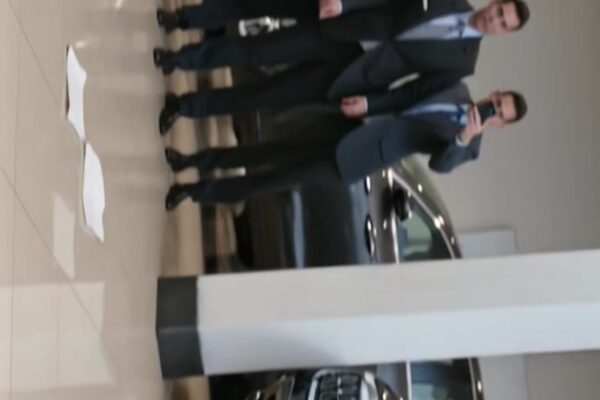
That was the moment the aisle truly stopped. The phones didn’t just record anymore; they hovered, unsure if they were allowed to witness this.
Eli didn’t raise his voice. He didn’t have to. “Mina,” he said, returning his attention to her, “that tag is yours. Not as charity. As restitution. I asked you to come because I finally found the paperwork from back then. The account that was supposed to be set up when my dad…” He swallowed, eyes flickering with old grief. “When things went wrong. You were the one who took care of us more than anyone. And you disappeared. I couldn’t find you.”
Mina’s throat tightened. “I didn’t disappear. I just… life happened.” She glanced at Lio, at his tear-wet cheeks. “I wasn’t trying to make a scene.”
“I know,” Eli said. He reached out, careful, and wiped a smear of orange off Lio’s hand like it was the most normal thing in the world. “I’m making it right. Starting with today.”
He stood and looked at the rich woman. “You,” he said, flat as a closed door, “need to apologize. And then you need to leave.”
“Excuse me?” she snapped, trying to recover. “Do you know who my husband is?”
“No,” Eli said. “But I know who I am. And I know what you just did.” He nodded at the manager. “Have security escort her out. Ban her from this location. Send the footage to legal in case she wants to argue about it.”
The rich woman’s face shifted through disbelief, anger, and finally something like panic. Her gaze flicked to Lio, to Mina, to the watching crowd. For the first time, she looked small, not because her coat got less expensive, but because power had changed hands in a single scanned beep.
“This is insane,” she muttered, backing up as the manager signaled toward the front.
As she was led away, Mina watched her go, feeling something inside her uncoil. The shame, the hot tight knot she’d been carrying since the cart hit the floor, loosened like a fist opening.
Jasper and another employee appeared with towels and a fresh cart. Someone offered Lio a small stuffed dinosaur from a display near the registers, and he clutched it like a lifeline, hiccuping his way back to calm.
Eli crouched again so he was eye level with Mina. “You don’t have to prove anything here,” he said. “Not to her. Not to anyone. You never did.”
Mina looked at the mess—the broken eggs, the spilled milk, the aisle that had turned into a stage. She looked at the tag in Eli’s hand, the tiny piece of plastic that had stopped a whole store in its tracks. “I don’t even know what to do with this,” she admitted.
“Start with groceries,” Eli said, casual, like it was simple. “Then let’s talk. If you’re willing.” He hesitated, then added, “And if it helps… I didn’t just link it to some account. I put your name on it. That’s yours. For real.”
Mina’s eyes stung. “Why now?”
Eli exhaled. “Because I saw a photo someone posted last week. A kid in a thrift store parking lot eating dry cereal out of a bag. I thought it was you. I couldn’t sleep. I realized I’ve been building all this—stores, money, headlines—while the one person who taught me how to survive might’ve been barely hanging on.”
Mina laughed once, wet and shaky. “So you sent a mysterious text.”
“Yeah,” he said, sheepish. “Bad call. I’m trying to be less dramatic, but apparently I’m failing.”
Lio sniffled and leaned into Mina. “Mama, can we get the dinosaur cereal?” he asked, voice hopeful again, like the world hadn’t just flipped.
Mina looked up at Eli. He nodded like it was the easiest yes he’d ever given.
She stood slowly, knees aching, and accepted the new cart Jasper offered. People were already dispersing, the moment moving on like the store’s air-conditioning. But Mina felt different, like something had been rewired. Not because she’d been rescued in front of strangers, but because the story the rich woman tried to write about her had been interrupted—hard—by a tiny tag that told the truth louder than any insult.
As she pushed the cart forward again, Eli walked beside her like it was natural. Mina glanced once at the wet floor behind them, then straight ahead. The lights were still bright, still a little too honest, but they didn’t feel like interrogation anymore.
They felt like a spotlight she didn’t need to fear.