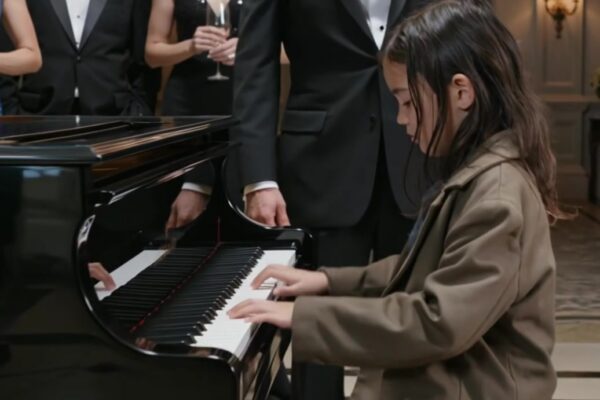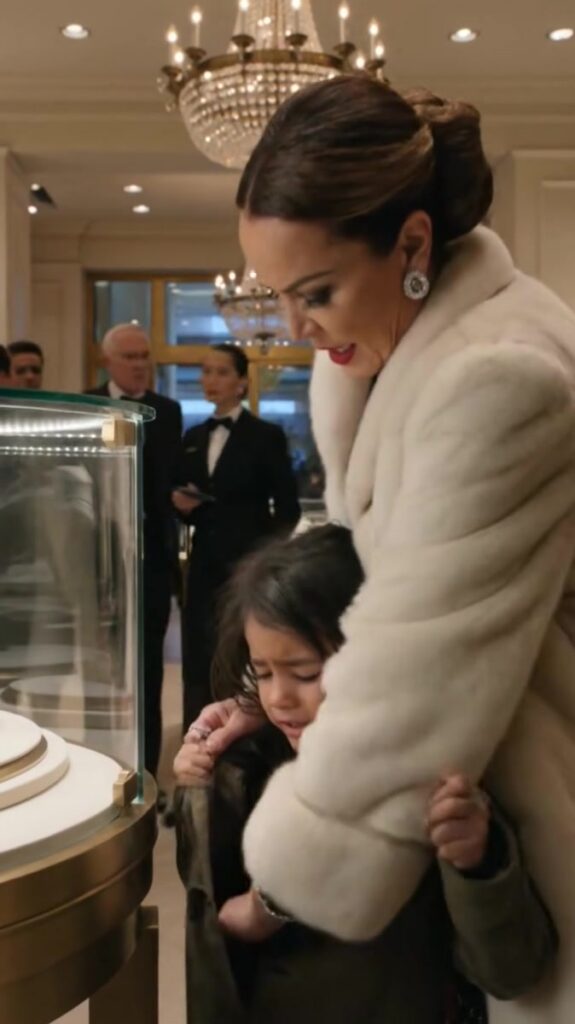
The jewelry boutique glittered like a palace of light, the kind of place where the air smelled expensive—like citrus and polished wood—and the silence was so clean it practically squeaked. Crystal chandeliers hung overhead, throwing little rainbows onto the marble floor. Behind spotless glass, diamonds lounged on velvet like they had nowhere better to be. Even the customers moved differently in here: slow, careful, like they didn’t want to wrinkle the atmosphere.
Mara Bell loved it. Not because she loved jewelry—she didn’t, not really—but because she loved what the place did to people. In this boutique, everyone tried harder. Everyone lowered their voice. Everyone remembered their manners. It was a tiny kingdom, and she walked through it like she’d been born to it, her coat perfectly tailored, her hair an effortless wave of perfection that probably took thirty minutes and two different brushes.
She was halfway through telling her friend Celeste why she refused to wear “anything smaller than a stone with opinions” when she saw the girl.
A child stood by the second display case on the left, where the statement necklaces were arranged—big, dramatic things meant to look like heirlooms the second they touched skin. The girl’s coat was too thin for the season and frayed at the sleeves. Her shoes were the kind you got at a donation bin if you were lucky, and her hair had been brushed sometime recently but not enough to make it forget where it came from.
She wasn’t touching the glass. She wasn’t even leaning close. She just stared at one necklace—a delicate chain with a central diamond that looked like a frozen tear. Her face was tipped up, her mouth slightly open, and her eyes were wet, like she’d been holding back crying for a long time and had finally gotten tired.
It was the staring that set Mara off. Not the coat, not the shoes. The staring. Like she belonged there. Like she had the right to look.
Mara’s heels clicked over marble as she crossed the room. People noticed the sound. They always did. The nearest associate—tall, nervous, perfect suit—started to move as if to intercept the child, but Mara got there first.
“Excuse me,” Mara said, her voice bright and sharp, the way you speak to someone who doesn’t understand rules. She grabbed the girl’s wrist. It felt too small, bird-boned. The child flinched like she’d been hit before.
“Check her pockets before she steals something!” Mara announced, loud enough for the chandeliers to hear.
The effect was immediate. Heads turned. A couple near the engagement rings paused mid-sigh. Someone’s phone lifted, angled just right for a dramatic story later. Two staff members hurried over, smiles tight, trying to look calm while their bodies screamed Security.
The girl’s lips trembled. She tried to pull her wrist back, but Mara’s grip tightened without thinking. “No,” the child whispered, and then louder, panicked, “No… I’m not—please—”
Her eyes flicked to the necklace again, like she needed it to keep breathing. “My mother said that necklace belonged to her,” she blurted, words tripping over each other. “Before they took her away. She said if I ever saw it… I’d know… I’d know I wasn’t making her up.”
A few people shifted. Not sympathy exactly—more like the discomfort of someone hearing a sad song in a place meant for happy music.
Mara laughed, short and cruel. “Oh, of course. And I suppose this whole boutique belongs to your family too?”
The child’s face crumpled. Tears finally spilled, hot and silent. Mara, irritated by the messiness of it, reached into the girl’s coat pocket with the confidence of someone who’d never been told no. The fabric was thin, and beneath it she felt paper.
She pulled out a small photograph, edges curled and darkened like it had been close to fire. Half of it was smoke-stained. Mara lifted it high between two fingers like it was a dirty tissue. “Look at this,” she said, tilting it for the nearby phones. “They always come with a little tragic story.”
The girl lunged for it, desperate, but one of the associates stepped forward, hand out in a soothing gesture that somehow made everything worse. “Miss, please—” he began, though he didn’t know who he was speaking to, the child or Mara.
Across the room, the elderly owner had been arranging a set of bracelets. He wasn’t a man who hovered; he let his staff handle the daily drama. But the raised voice pulled his attention like a hook. He looked up, irritated at first, then curious, then suddenly… empty.
His face drained so quickly it was like someone had turned him off. He stared at the photograph in Mara’s hand as though it were a ghost standing under the chandelier.
He stepped forward, slow and unsteady, and the boutique seemed to quiet around him. Customers stopped whispering. Even the phone recording didn’t move, like the person holding it forgot they had hands.
The owner’s name was Ruben Hale, and he knew that necklace. He knew it the way you know the sound of your own door unlocking. He had designed it himself decades ago, custom work for his daughter’s twenty-fifth birthday: a simple chain, an impossible diamond, a setting shaped like a tiny teardrop because she’d told him she wanted something “sad but brave.”
In the photograph, a young woman smiled with a tired sort of joy. The necklace lay against her collarbone, unmistakable even through smoke stains. Her hair was pulled back, and her cheeks were fuller than Ruben remembered, like she’d been eating well for the first time in years.
And in her arms—wrapped in a soft blanket—was a newborn baby.
Ruben’s breath made a thin, broken sound. “That picture…” he said, and the words scraped out of him. “That picture was taken the night they told me both of them were dead.”
Mara’s fingers loosened on the child’s wrist. Not because she’d suddenly found compassion, but because the room had shifted, and she could feel it. Rich people were excellent at sensing when a story stopped being entertaining and started being dangerous.
The girl wiped her face with her sleeve, leaving a streak of dirt and tears. Her voice came out small. “My mom,” she said, staring at Ruben now, like she didn’t dare hope. “Her name was Lina. She said her dad had a shop with lights like stars.”
Ruben blinked hard, like he was trying to force the past into focus. Lina. His Lina. She had run away at nineteen with a musician who promised the world and delivered a series of locked doors. For years Ruben had sent people to look, letters returned unopened, calls unanswered. Then a message had arrived—official and cold—about an accident and a fire and no bodies worth identifying. He’d grieved in the only way he knew: by making things that lasted longer than people.
“What’s your name?” he asked, voice trembling so badly one of the employees moved as if to steady him.
The girl swallowed. “Nessa,” she whispered. “My mom called me Nessa. She said it meant… it meant ‘miracle’ but she was joking because she said miracles were loud and I was quiet.”
Ruben’s hand rose, hovering in the air between them. He didn’t touch her yet. He looked at her face—at the shape of her eyes, the little tilt of her nose, the stubborn set of her chin that made him feel like he’d been punched and hugged at the same time.
Mara tried to recover, smoothing her expression like a wrinkle. “This is ridiculous,” she said, though her voice lacked its earlier bite. “People forge things. Anyone can tell a sob story. Surely we—”
Ruben didn’t even look at her. He held out his hand, palm open. “May I?” he asked the girl, nodding toward the photograph.
Nessa hesitated, then reached up with shaking fingers and took the picture from Mara, like retrieving something stolen twice. She passed it to Ruben carefully, as if it might fall apart under attention.
Ruben stared at it a moment longer, then turned to his staff. “Lock the doors,” he said quietly. The words weren’t dramatic, but they landed heavy. “And call my attorney. And the police, yes—but not for her.” He nodded at Nessa. “For whoever made that call years ago.”
The associate’s eyes widened. “Mr. Hale—”
“Now,” Ruben said, still quiet. And somehow, quiet was stronger.
The boutique became a sealed glass box filled with breathless people. Mara’s phone-wielding audience looked suddenly nervous about being caught in someone else’s tragedy. Celeste had gone pale, tugging at Mara’s sleeve like, Please, we should leave, we should vanish, we should become background.
Ruben crouched down so he was level with Nessa. It looked wrong to see him—this polished, expensive man—on the marble floor. But he didn’t seem to care. “Where have you been living?” he asked gently. “Who have you been with?”
Nessa’s shoulders lifted in a small shrug that didn’t belong on a child. “Anywhere,” she said. “Shelters sometimes. Under the bridge when it’s not raining. A lady at the soup place told me this was… this was a rich street and rich people leave things behind.” Her eyes flicked to the necklace. “I didn’t want to take it. I just wanted to see if it was real.”
Ruben’s mouth tightened. Something like fury passed through him, quick and controlled, like a blade being drawn. “It is real,” he said. “But it isn’t the necklace that matters.” He looked at her again, and his eyes shone in a way chandeliers couldn’t compete with. “You’re real.”
Nessa blinked, unsure what to do with that sentence.
Behind them, Mara tried one last angle, voice brittle. “If she’s been on the streets, she could be anyone. This could be a scam. People will say your boutique is unsafe. Your reputation—”
Ruben finally turned his head. His gaze landed on Mara like a door shutting. “My reputation survived burying my daughter,” he said. “I think it can survive you.”
There was a soft intake of breath from the customers—an involuntary gasp at hearing someone wealthy speak without politeness.
Ruben stood, still holding the photograph. He motioned to Nessa. “Come with me,” he said. “We’ll sit in my office. We’ll get you warm. We’ll call someone who can verify things properly. And then,” he added, voice low, “we’re going to find out who decided you were dead.”
Nessa took one step, then another, as if expecting the marble to vanish. As they passed the display case, her eyes lingered on the diamond necklace, the one that had been her mother’s anchor. For the first time, she didn’t look at it like an unreachable star. She looked at it like a signpost.
The boutique still glittered. The chandeliers still tossed light across glass and gold. But the shine didn’t feel like a wall anymore. It felt like something opening—like a door that had been locked for years finally turning, inch by careful inch, to let a stolen life walk back inside.