Every evening at 6:17, Celeste Marlowe slid into the same corner table at Lirio Café like she’d made a reservation with fate. The chair always wobbled slightly. The marble tabletop always felt cool through her sleeves. The waiter always pretended not to recognize her, which was exactly the kind of courtesy she tipped for.
She wore the same black dress because it gave her fewer chances to make a decision she might regret. She drank the same white coffee—milk-heavy, sugarless—because bitterness felt like a choice, and she didn’t like choices. Routine kept her life clean. Clean meant controlled. Controlled meant the past stayed quiet.
Most evenings, the café’s terrace filled with people who looked like they’d never been forced to make hard phone calls. Couples leaned close over pastries. Tourists took photos of their spoons, as if spoons were art. A trio of office coworkers laughed too loudly and watched their own reflections in the glass. Celeste sat alone, composed, elegant in a way that made strangers glance and then remember they had somewhere else to look.
The sun that evening fell in honeyed streaks across the street, turning the hedge along the walkway into something soft and expensive. The air smelled faintly of orange peel and car exhaust. Celeste was halfway through a page of her book—she didn’t actually read, she just liked how it looked—when a small shadow landed beside her chair.
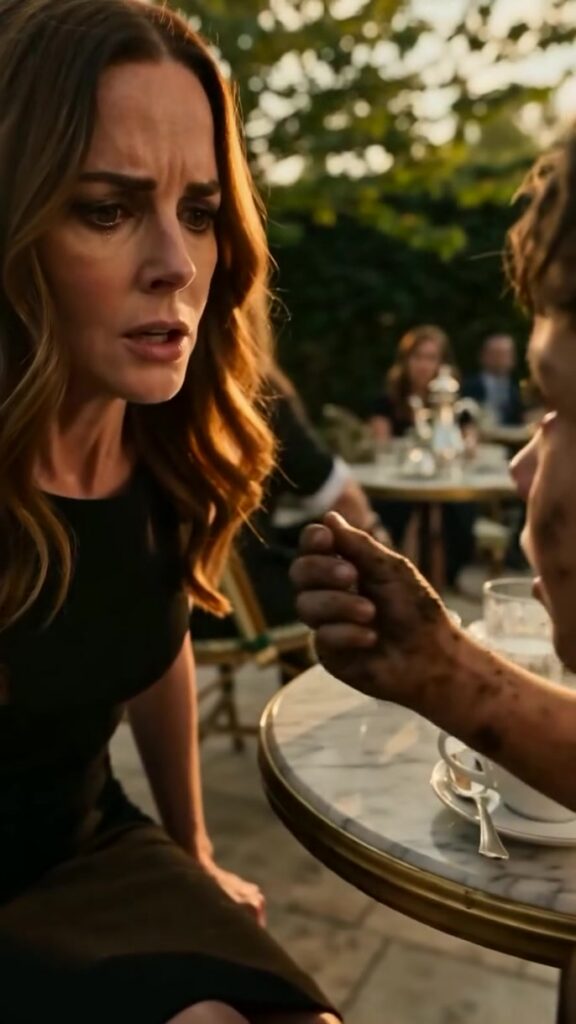
It was a boy. Filthy is what the mind supplied, because his knees were caked with city dirt and his hoodie looked like it had been slept in. His hair stood up in uneven spikes, as if a comb had never met it, and his eyes were huge in a face that seemed too narrow for them.
Celeste’s first thought was practical: Security. Her second thought was more embarrassing: How did he get this close without the staff noticing?
Before she could push her chair back, the boy reached out and touched her hair.
Not grabbing. Not yanking. His fingers barely skimmed the side of her head, careful as if her hair might shatter. Like someone touching a memory and hoping it didn’t disappear.
Celeste flinched so fast her necklace snapped against her collarbone. “Hey—don’t touch me.”
It wasn’t loud, but it cut through the terrace like a dropped glass. Conversation hiccupped. A fork paused midair. Even the espresso machine inside seemed to hold its hiss for half a beat.
The boy jerked his hand back, trembling. He looked like he expected to be hit. But he didn’t step away. He stared at her with an intensity that made Celeste’s skin go tight.
“She has the same hair,” he whispered.
Celeste’s mouth flattened. “What are you talking about?”
The boy swallowed hard. His eyes shone, stubbornly holding tears back like they were a job. “My mom said I’d find you here.”
Her heart did something stupid—like it tried to climb out of her chest and hide behind her ribs. Celeste kept her face calm. The whole point of her life was keeping her face calm.
“Your mom,” she repeated, as if the words were a foreign language she could pronounce but not translate.
The boy opened his fist. He’d been gripping something so tightly his knuckles were white. When he finally relaxed his fingers, an ornate jeweled hair clip lay in his palm.
It was old-fashioned, the kind of accessory that belonged in a velvet box, not in the hand of a child who smelled faintly of rainwater and alley dust. Tiny stones caught the café’s golden light and flashed softly. One stone was missing near the edge, a small imperfect gap like a chipped tooth.
Celeste’s stomach dropped as if the floor had disappeared.
She knew that clip. She knew its weight. She knew the way the clasp sometimes pinched. She knew the exact moment she’d told herself it was gone forever.
“That’s impossible,” she said, and heard how thin her voice sounded.
A tear slipped free from the boy’s eye and tracked down his cheek. He didn’t wipe it. He seemed too afraid that any sudden movement would break the spell. “She said you’d say that.”
Celeste stood so fast her chair scraped against the stone patio with a sound like protest. Her book slid a few inches. The waiter took one step forward and stopped, uncertain whether this was a scene he was allowed to interrupt.
“Where is she?” Celeste demanded. Her hands were already cold. She could feel every detail of the evening—music, murmurs, sunlight—as if it had sharpened into something that could cut.
The boy didn’t answer with words. He simply turned his head, slow and deliberate, and looked toward the edge of the terrace where the hedge ran along the sidewalk like a green border.
Celeste followed his gaze.
At first, she saw only the obvious: pedestrians drifting past, a couple arguing softly near a parked scooter, a woman taking a phone call with her back turned. Then her eyes found the person standing half in shadow near the hedge.
A woman in a beige suit. Not fashionable-beige. Practical-beige. The kind of beige that tried to disappear.
She stood still, hands folded in front of her as if she was waiting in a hospital corridor. Her hair was pulled back, and her face—older than Celeste remembered, sharper at the cheekbones, threaded with strain—was unmistakable.
Celeste’s lungs forgot what to do. Her vision narrowed until the terrace, the cups, the chatter all became background noise behind the one fact she couldn’t make sense of.
“No,” she whispered, but the word didn’t change anything.
The woman by the hedge looked directly at her. She didn’t wave. She didn’t smile. Her expression was careful, like she was holding something fragile inside her ribs and didn’t trust her own hands.
And then—just slightly—she nodded. A small motion, more question than greeting.
Celeste felt the years between them slam into her like a door. She remembered a cramped apartment that smelled like bleach. A shouted name in a hallway. Fingers fumbling with that jeweled clip before a night that changed everything. She remembered making a decision that she told herself was the only way to survive.
She also remembered the promise she made afterward: bury it. Never dig it up. Build something clean over the top.
The boy tugged lightly at the hem of her dress. “She didn’t want to scare you,” he said, voice small. “She said… you don’t like surprises.”
Celeste looked down at him. Up close, his face had freckles beneath the grime. His lower lip was split, healing. On his wrist was a thin red thread bracelet, frayed like it had been tied too many times. He wasn’t just lost; he’d been carried by purpose to this exact moment.
“What’s your name?” Celeste asked, and heard the wobble she usually never allowed.
“Noah,” the boy said. He lifted the hair clip a little higher, offering it like a key. “She said you’d know it. She said you’d remember.”
Celeste stared at the missing stone. Her mind tried to do math—how many years, how old would he be, what could be true, what had to be impossible. But the past didn’t care about her equations. It had arrived anyway, wearing beige and carrying a child with her eyes.
Celeste’s throat tightened. She didn’t know what she was more afraid of: that the woman was real, or that the life Celeste had built on routine could be undone by a single hair clip and a boy’s trembling hand.
Her gaze returned to the woman by the hedge.
The woman took one step forward, then stopped. Even from across the terrace, Celeste could see the tension in her jaw, the careful way she held herself as if bracing for impact.
Celeste’s feet moved before her pride could stop them. One step. Then another. Her chair sat abandoned behind her, coffee cooling in its cup, the evening’s control leaking away like spilled milk.
As she crossed between marble tables, the café’s quiet attention followed her like a spotlight. Celeste had always hated being watched. Now she barely noticed.
When she reached the hedge, she stopped a few feet away, close enough to see the faint scar near the woman’s eyebrow—still there, as if time had politely refused to erase it.
“You’re supposed to be gone,” Celeste said, because the truth in her mouth tasted like panic.
The woman exhaled. “I tried to be,” she replied softly. “For your sake.”
Celeste’s hands curled into fists. “Don’t say that like you did me a favor.”
The woman’s eyes flicked toward Noah, who hovered behind Celeste now like he didn’t know which adult he belonged to. “I didn’t come for forgiveness,” she said. “I came because I ran out of options. And because he deserves to know the truth.”
Celeste’s stomach clenched. “What truth?”
The woman’s voice stayed calm, but it shook at the edges. “That you didn’t just disappear from my life. You were taken from it. And I let you believe you had chosen it, because I thought it would hurt less.”
Celeste blinked, stunned by the bluntness. Her world had always been about managing what could be said. About turning life into something manageable. This was not manageable.
Noah stepped forward, wedging himself between them like a small bridge. “She told me you’re not bad,” he said, looking up at Celeste. “She told me you’re just… good at pretending.”
Celeste let out a short, unsteady laugh that wasn’t humor at all. Her eyes burned. She hated that. She hated that she was about to cry in public like a normal person.
The woman in beige reached into her pocket and pulled out a small envelope. It looked old, edges softened by being handled too often. She held it out but didn’t push it into Celeste’s hands.
“I wrote this years ago,” she said. “I never had the courage to send it. Then I figured courage doesn’t matter much when time’s already eaten half your life.”
Celeste stared at the envelope as if it might bite her. “Why now?”
The woman’s gaze dropped to Noah’s shoulders, too thin beneath his hoodie. “Because I’m tired,” she admitted. “Because I got sick. Because he found the hair clip in my things and kept asking why I cried when I held it. Because the past doesn’t stay buried just because you put on a black dress and drink the same coffee.”
Celeste flinched as if struck, not by insult but by accuracy.
She reached out, slowly, and took the envelope. The paper was warm from the woman’s hand. For a moment, their fingers brushed—brief contact that carried years of resentment, regret, and something that might have been love once, before it got complicated.
Behind them, the café’s noise returned in cautious trickles. Someone laughed again. A spoon clinked. Life, always eager to move on, tried to resume.
Celeste looked at Noah. “Did she really tell you I’d be here?”
Noah nodded. “She said you always sit at the corner table because you like seeing the whole place.”
Celeste swallowed. That had been true. She liked to see exits. She liked to predict danger. She liked to know she could leave.
Now, for the first time in years, leaving felt like the wrong instinct.
Celeste lifted her eyes to the woman in beige. “If we talk,” she said, voice low, “you don’t get to rewrite what happened.”
The woman nodded once. “Deal.”
Celeste glanced back toward her table—the abandoned cup, the untouched book, the tidy life she’d arranged like props. Then she looked at Noah, who still held the jeweled clip like a small shining accusation.
“Come on,” Celeste said quietly. “Sit down. Both of you.”
And as they walked back through the golden light, Celeste realized routine hadn’t kept her safe at all. It had only kept her alone. Tonight, the past had found her anyway—messy, inconvenient, and alive—and she didn’t know what would happen next.
But for the first time in a long time, she wasn’t sure she wanted control more than she wanted the truth.