The bank didn’t belong to people. Not really. People walked through the glass doors every day with their little errands—cash a check, wire some money, argue about overdraft fees like it was a moral issue—but they were visitors. The building tolerated them the way a locked room tolerates footsteps.
This place belonged to secrets. The kind that got filed, indexed, buried behind polite smiles and laminated name tags. The kind that never left the building because the building was built for them: thick walls, soft carpet, quiet corners where your voice died before it could echo.
I didn’t realize any of that until the afternoon a kid walked in like he owned the air.
I was behind the counter, three hours into a shift that felt like it had started last week. The lobby smelled faintly like floor polish and expensive coffee. A couple sat at the desk with Sandra from loans, whispering like they were planning a heist. A man in a windbreaker kept checking the door as if the street outside might suddenly turn into a courtroom.
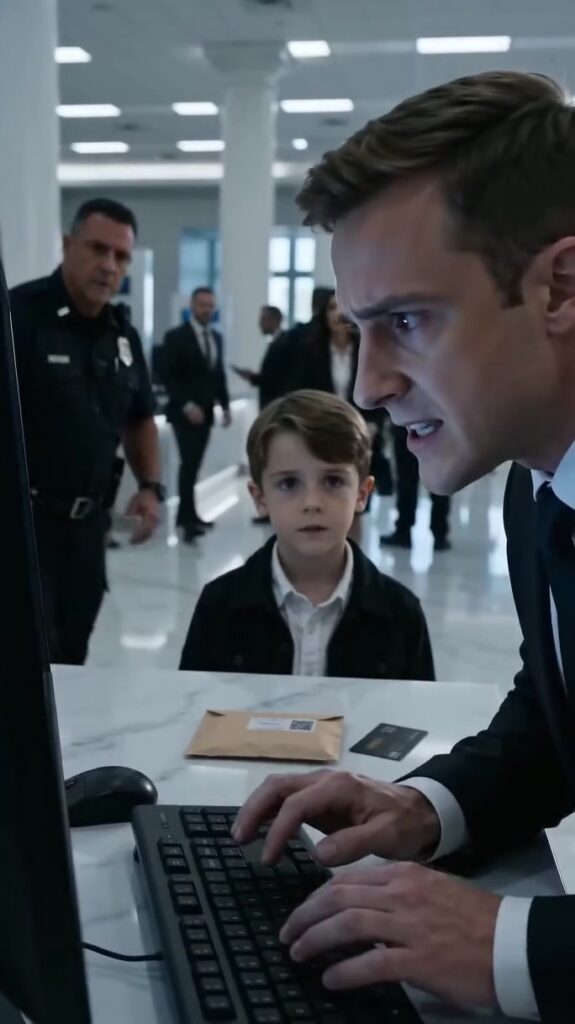
Then the front doors opened and in came this boy. Seven, maybe. Skinny legs, clean sneakers, hair like someone had tried to tame it with water and lost. No parent trailing behind, no frantic adult voice calling his name. He just walked straight to my station with the calm focus of somebody picking up dry cleaning.
I barely looked up at first. Kids wandered in sometimes with grandparents. Kids got bored, poked brochures, asked if we had candy, then got dragged away by an apologetic adult.
“Hey,” I said, because politeness is automatic when you wear a tie. “You’re in the wrong place, kiddo.”
He didn’t stop. He stepped closer. Slow. Like he was counting the tiles. Like he wanted me to see the distance shrinking and understand it was on purpose.
He placed a brown envelope on the counter. Thick. Worn at the corners. Then he set down a black card, the kind of matte black that swallows the light around it. It wasn’t shiny or new. It looked handled. Like it had lived in someone’s wallet for years and survived things.
Something about that card made my brain sit up straighter. I laughed anyway because my body didn’t know what else to do.
“Okay,” I said, keeping my voice low and friendly. “You think this is funny?”
The boy’s eyes didn’t move. His pupils looked too steady, like they didn’t have the normal jittery energy of a kid’s attention span. He nodded once toward my terminal.
“Check it,” he said.
Not a request. A command. A tiny voice wearing a grown-up’s certainty.
I should’ve called security right then. I should’ve slid the card back and told him to find his parents. But the thing about a secret bank is that it trains you to obey strange cues. You learn to respond to the unspoken rules. You learn that sometimes the person with the least obvious power has the most dangerous leverage.
I picked up the card. No name printed on it. No logo. Just a small etched symbol in one corner that made my stomach twitch with recognition I couldn’t place.
I swiped it through the reader.
The system accepted it instantly. No cheerful chirp, no “Welcome!” banner. The screen went gray for a heartbeat, then a small prompt appeared. AUTHORIZATION REQUIRED.
I typed in my employee ID. It rejected me. I tried again, faster, annoyed. It rejected me again and then—like someone had been waiting behind the screen—another prompt replaced it. ENTER BRANCH OVERRIDE.
I felt heat crawl up my neck. That prompt wasn’t supposed to exist. Not for tellers. Not for anything in the lobby. That was back-room territory.
My fingers hovered. “Where did you get this?” I asked, keeping my tone casual because there were other customers nearby and my brain was trying to keep panic in a box.
He didn’t answer. He nudged the envelope forward with one finger.
I opened it just enough to see documents inside. Not copies. Originals. Thick paper, stamped, signed with ink that had faded in a way you can’t fake. There was also a single photograph—creased down the middle—showing a family standing in front of a house. Four people. Smiling the kind of smile that makes you want to look away because it feels intimate.
The boy tapped the card again. “Check it,” he repeated. Same flat tone.
I swallowed and did what the bank had trained me to do: follow the procedure as if procedure could protect me. I entered the branch override code that only managers used, the one I’d watched our supervisor type a hundred times and never thought I’d need.
The screen blinked. A loading bar appeared, then an account dashboard popped up—except it wasn’t any dashboard I’d ever seen. The interface was older, sharper, like a system that had been built for a world with fewer laws.
At the top was a name I hadn’t seen in years. Not in the system, not in a file, not whispered in break rooms. A name I had been told—explicitly—was never to be searched.
My hands went cold. “What the—” slipped out before I could stop it.
I typed the account number manually, thinking maybe the card had spoofed something. The same page returned immediately, like it had been waiting for my touch.
My face must’ve changed because the guard near the door started paying attention. He shifted his weight, one hand drifting toward the radio on his belt.
“Problem over there?” he called, trying to sound casual but failing.
I didn’t answer. I couldn’t. The screen filled with alerts, not error messages but warnings. INTERNAL RECORD INCONSISTENCY. ACCESS EVENT LOGGED. REDACTION ORDER CONFLICT.
A red banner flickered once across the top: SYSTEM INTEGRITY AT RISK.
The lobby noise started to thin out. It wasn’t that people stopped talking on purpose. It was more like the building itself was inhaling, sucking the sound into its vents. Even Sandra glanced up from her desk, eyes narrowing.
From the corner of my vision, I saw a woman in black step out from the hallway that led to the private offices. I’d seen her before—never at a desk, never in a meeting, always passing through like a shadow with a badge that didn’t reflect light. She leaned over my shoulder and looked at the screen.
She didn’t ask me anything. She didn’t blink. She just said two words, sharp as scissors.
“Shut it down.”
I reached for the keyboard like I could simply close a window and pretend nothing happened.
Too late.
The system didn’t just display the account. It started pulling up attachments. Scanned letters. Audio transcripts. Memos with subject lines that made my throat tighten. There were words like “containment” and “quiet resolution” and “non-disclosure implementation.” There were dates. There were initials I recognized from framed photos on the wall of past executives.
My hands shook so badly my fingertips kept missing the keys. “This… this account was erased,” I whispered, not to anyone in particular. “Someone ordered it gone.”
The boy finally spoke again, and his voice was still small, still kid-sized, but there was nothing childlike in it.
“And yet,” he said, “here it is.”
I stared at him. Up close, his face had that weird calm you see in people who’ve already decided the worst thing won’t happen because it already did.
“Who sent you?” I managed.
He leaned in slightly, close enough that I could smell peanut butter on his breath, like he’d eaten lunch on the way to ruin my life. His eyes stayed locked on mine.
“No one,” he said.
A beat passed. The air felt heavy, like the bank had switched from oxygen to something denser.
“I came myself.”
The guard took a step forward. The woman in black stiffened like she’d been slapped. Sandra’s customer stopped whispering and just stared.
I looked back at the screen. The name at the top seemed to glow brighter than everything else.
“That account,” I said, my voice breaking in the middle like cheap plastic, “belongs to a dead family.”
The boy didn’t blink. Didn’t flinch. He just reached into the envelope and slid the creased photograph toward me, stopping it right at the edge of the counter.
In the photo, the family smiled under the sun. The boy in the picture—shorter, with rounder cheeks—was holding a toy rocket. Behind them, on the porch, a black mailbox displayed the same last name as the account.
His last name.
He didn’t point to himself. He didn’t explain the impossible math of it. He simply whispered, soft enough that only I could hear, like he was giving me one last chance to choose how this went.
“Say their name.”
My lips trembled. I felt my tongue shape the first syllable. The woman in black moved fast, reaching for the phone on the wall. The guard’s radio crackled to life, though no one had pressed it. Somewhere deeper in the building, a door slammed.
The bank wasn’t full of people anymore. It was full of listening.
I drew in a shaky breath and looked at the boy, trying to find any trace of a prank, any hint of adult supervision hiding behind a plant.
There was nothing.
Just a kid demanding a name that the building had been designed to swallow.
And as I opened my mouth to speak it, the screen flashed red one more time—brighter, angrier—like the system itself was warning me that once a secret leaves the bank, it never goes back in.
Then everything cut out: the lights, the monitors, the hum of the air conditioner, even the soft music that always played too quietly to notice. In the sudden dark, the boy’s voice carried clearly, calm as a bedtime story.
“Good,” he said. “Now we can talk.”