By month twelve, Ethan had stopped telling people he was tired. It was obvious in the way his eyes looked permanently bruised, in the twitch of his jaw every time a stranger said, “I’m sure he’ll turn up,” like missing kids were socks behind a dryer.
Some nights he’d doze sitting upright in the driver’s seat, forehead against the steering wheel, the smell of cold coffee and printer ink still on his hands from making fresh flyers. Other nights he’d walk until dawn, letting the city’s streetlights pulse overhead like a heartbeat that wasn’t his.
His son, Milo, had vanished on a Tuesday. A regular Tuesday with a homework folder and a half-eaten granola bar and Ethan’s quick promise—be right back, buddy, I’m just grabbing the mail. The kind of moment you don’t lock into your memory because it feels too normal to matter. Then it mattered forever.
The police had their checklist. The news had its brief attention span. Friends had their casseroles and careful voices. Ethan had one thing: a photograph of Milo at eight years old, front tooth missing, grin too big for his face, a drawing in his hands like it was a trophy.
Every morning Ethan updated the same routine: tape, poster, walk. Tape, poster, ask. He’d learned which shop owners would let him use their windows, which neighborhoods stared at him like he was contagious, which corners had so many flyers already that his would blend in like another layer of forgotten.
On the morning that changed everything, he found himself in the part of the city people pretended didn’t exist. Even the buses seemed to pass through it faster, like they didn’t want to breathe too deep. The buildings there had the exhausted look of things that had been yelled at for years—graffiti over old signs, boarded windows, doors with locks too cheap to keep anyone out.
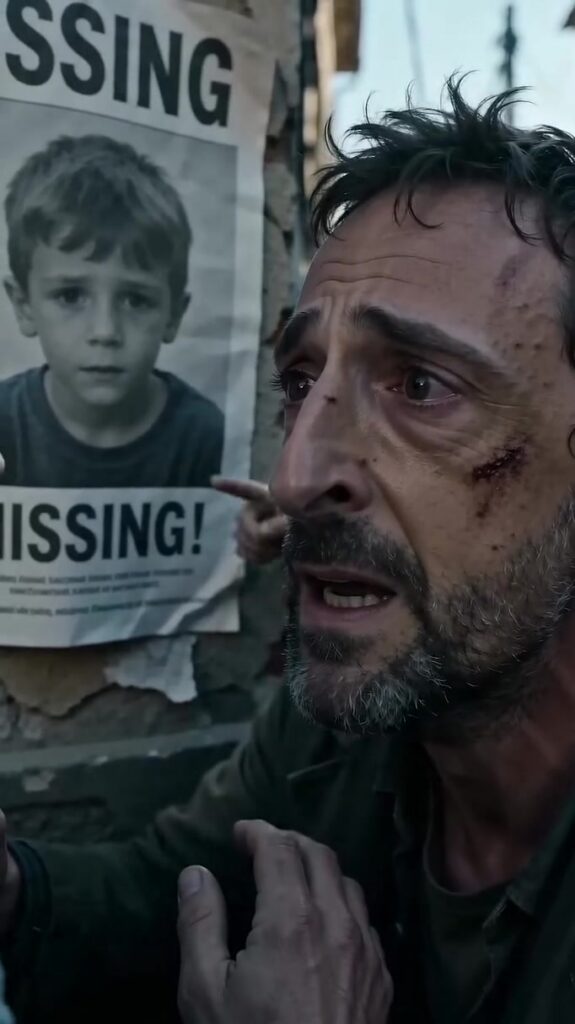
Ethan’s hands shook as he pressed a fresh poster onto a cracked wall beside a shuttered bakery. The glue was cold, the paper too thin. His stomach felt hollow in a way that wasn’t hunger. It was the kind of emptiness that came from asking the universe a question every day and getting silence back.
He smoothed the corners, then stepped back, blinking hard at Milo’s face staring out into the gray morning. He whispered his son’s name like it might turn into a signal flare.
“Mister?”
The voice was small and careful, like it didn’t trust itself to take up space. Ethan turned.
A little girl stood a few feet behind him, barefoot on the dirty sidewalk. Her hair was gathered into two messy puffs, and she wore an oversized sweatshirt that swallowed her hands. She held a grocery bag with one bruised apple peeking out.
She wasn’t looking at Ethan. She was looking at the poster.
“That boy,” she said, nodding at the photo, “he lives in my house.”
Ethan’s brain tried to reject the words the way it rejected scams and false tips, the way it protected itself from hoping too hard. Hope had become dangerous. But the girl’s face was blank with honesty, and that scared him more than any liar ever had.
“What did you say?” Ethan heard himself ask. His voice sounded like gravel dragged across concrete.
She pointed again, not dramatic, just specific, like pointing out a street sign. “He’s there. He cries at night. He says ‘Dad’ and he says it like it hurts.”
Ethan’s knees threatened to fold. For a second, the street tilted, and the noise of the city—distant sirens, a rattling shopping cart, someone laughing too loudly—went muffled, as if his ears had been filled with water.
“Sweetheart,” he said, forcing his voice to steady, “what’s your name?”
“Lina.” She shifted the grocery bag from one arm to the other. Her eyes stayed on the poster. “I wanted to tell you before but I didn’t see you until today.”
“Lina,” Ethan repeated, anchoring himself to something real. “Can you take me there?”
She hesitated, gaze darting toward a street corner as if checking for permission from someone invisible. “He’s scared,” she said finally. “The lady says I shouldn’t talk to people. But he’s… he’s small. Like my brother.”
Ethan swallowed. “I’m his dad,” he said, and the words came out raw, almost embarrassing. “I’ve been looking for him.”
Something flickered in Lina’s expression—not surprise, but recognition, like a puzzle piece clicking into place. She nodded once and started walking without waiting to see if he followed.
Ethan stayed close, careful not to crowd her, like spooking a stray cat. They moved through narrow side streets where the sun couldn’t reach. Old posters flapped from lamp posts, torn faces and lost phones and band flyers. Lina walked fast, her bare feet somehow avoiding the worst glass and grit like she’d memorized where danger lived.
As they went, she spoke in short bursts, as if too many words might summon trouble. “He came one night. The lady brought him. He was sleepy. He had a jacket that was too big.” She looked back briefly. “He asks for you. A lot.”
“Does he have… does he have an arm with—” Ethan’s throat tightened. “A little scar? From falling off his bike?”
“Yeah,” Lina said. “I saw it when I gave him water.”
Ethan’s vision blurred. He blinked hard and kept walking.
They turned onto a street that felt quieter than the others, like the buildings were holding their breath. Halfway down was a small yellow house squeezed between a laundromat and a vacant lot. The yellow paint was faded, but someone had tried—there were plastic flowers in the window and a wind chime made from old keys that clinked softly in the breeze.
Lina slowed. “That’s it,” she whispered. “Sometimes the door doesn’t close right.”
Ethan stared at the house as if it might dissolve. This was too plain, too normal to be where his son had been for months. He expected something obvious—an abandoned warehouse, a dark van, a movie villain’s lair. Not a yellow house with a crooked welcome mat.
The front door sat slightly ajar.
Ethan’s heart pounded so hard he tasted metal. He stepped forward. His hand hovered near the doorframe, not touching yet, like it might burn him. Behind him, Lina hugged her grocery bag to her chest.
“Stay here,” Ethan murmured. “Okay?”
She nodded, but her eyes were wide and steady, watching like she needed to know how this ended too.
Ethan pushed the door open.
The hinges gave a tired squeal. The inside smelled like boiled vegetables and old carpet. A TV murmured somewhere deeper in the house, the laugh track tinny and wrong for the moment.
“Hello?” Ethan called, voice shaking. “My name is Ethan Reyes.”
No answer. Only the TV and, faintly, the slow drip of a faucet.
He stepped into a small living room with mismatched furniture and stacks of magazines. A blanket was folded on the couch like someone had slept there. Ethan’s gaze snapped to the hallway—three doors, all closed except the last one, which was open a crack.
Ethan’s legs moved before his brain fully agreed. The hallway felt too long. Each step landed like thunder in his ears.
Then, from behind that cracked door, a voice.
Small. Worn-out. Familiar in a way that made Ethan’s lungs forget how to work.
“Dad?”
Ethan’s entire body froze, like someone had pressed pause on him. His hands rose without him meaning to, palms open, as if he could catch the word in the air and prove it was real. He couldn’t answer right away. If he spoke, he might break into pieces.
“Milo,” he whispered, and it came out like prayer and apology and relief all at once.
The door creaked wider from the inside. A thin face appeared—pale, eyes too big, hair cut unevenly like someone had done it in a hurry. For a second, father and son just stared, both of them unsure if this was a trick the universe was playing.
Then Milo’s lip trembled. “You came,” he said, like he’d been practicing the sentence in the dark for a year.
Ethan dropped to his knees right there in the hallway, not caring about the dirty carpet, not caring about anything but the fact that Milo was standing, alive, in front of him. “I’m here,” Ethan said, voice breaking. “I’m here. I’m not leaving.”
Behind him, at the open front door, Lina’s key wind chime tinkled softly in the breeze, like a tiny signal that something buried had finally been found.
And somewhere deeper in the house, the TV laughed on, oblivious—until a floorboard creaked, and Ethan realized this was only the first moment of getting his son back.
Because finding Milo was one thing.
Getting them both out of that yellow house was going to be another.