The register light blinked like it had a pulse of its own—green, then red, then green again—while the cashier scanned items with the kind of robotic calm that made everything feel even stranger. A pack of diapers. A tiny bottle of infant formula. A loaf of bread that had been discounted twice. And a single chocolate bar the young mom had probably grabbed without thinking, like a promise to herself that she’d still get to be a person at some point.
The line behind her stretched into the aisle, people shifting their weight, pretending not to stare. The young mother—Maya, according to the name on her worn-out rewards keychain—kept bouncing the baby gently against her shoulder. He was bundled in a gray knit blanket with a little bear face on the corner. His cries weren’t loud, but they were steady, like he’d decided the world was too bright and too cold and he wanted a manager.
“You’re okay,” Maya murmured, her voice cracking. She tried to wipe her cheek with the back of her hand and missed, smearing a little mascara across her skin. She didn’t look like someone who’d slept in days. She looked like someone who’d forgotten what sleep was.
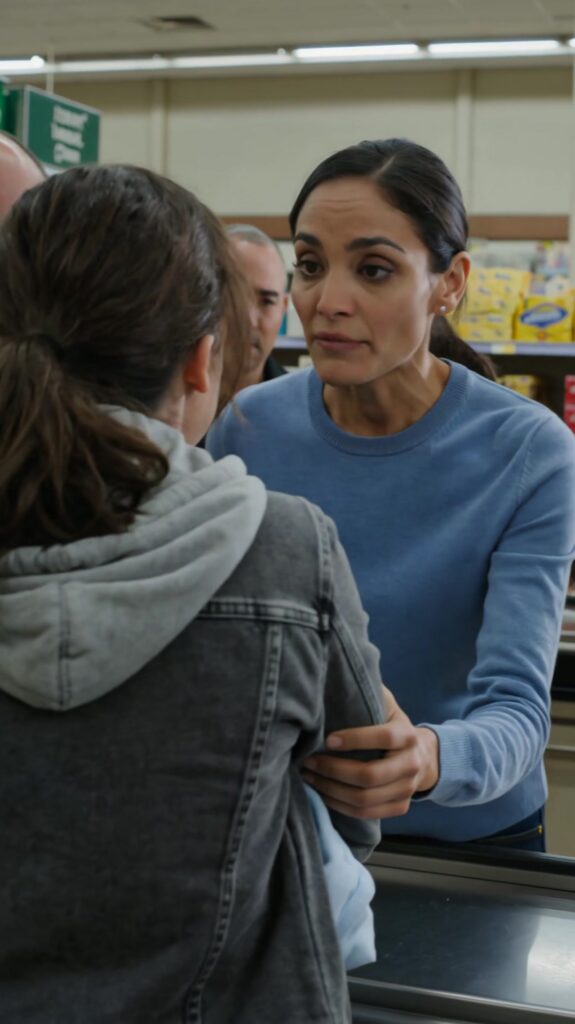
Behind her stood a woman in a soft blue sweater, the kind that looked expensive but also like it had been washed a thousand times. She had a coat draped over one arm, a basket with two apples, a box of tea, and a bottle of dish soap. Normal stuff. Ordinary errands. The kind of purchase that said: I’m living a normal life. I’m fine.
But the way she watched Maya wasn’t ordinary. It wasn’t even curiosity. It was the careful, tight focus of someone holding themselves together with a thread.
When the baby’s cry sharpened, Maya’s eyes flooded again. “I’m sorry,” she whispered to the cashier, to the line, to the fluorescent lights, to the baby. “He’s just—he’s just hungry, and I’m trying, okay? I’m trying.”
The cashier’s expression softened, but her hands kept moving. “It’s fine. You’re fine. Let’s just get you checked out.”
Maya reached for her wallet and fumbled it. A few coins clinked onto the conveyor belt. Her card slid out of her fingers and landed face-down like it was too embarrassed to be there.
The woman in the blue sweater stepped forward without thinking. Not heroically, not dramatically—more like her body moved before her brain caught up. She bent down, picked up the card, and held it out. “Here,” she said quietly.
Maya took it with shaky fingers. “Thank you.”
The baby wriggled, his tiny fist punching the air from inside the blanket. As he did, the knit shifted, and a small silver bracelet flashed under the lights.
It wasn’t new. It wasn’t one of those cute modern baby tags with little cartoon animals. This one looked older, slightly scratched, like it had been worn and saved and worn again. It sat loosely around the baby’s wrist, a strange choice for a newborn. But it was there, catching the light with every little movement.
The woman in blue froze mid-breath.
Her hand—still hovering near Maya’s arm, as if she’d been about to steady her—stopped in the air. Her fingers curled slowly, like they’d forgotten what they were supposed to do.
The store noise didn’t stop, not literally. Someone in the back laughed too loudly at nothing. A cart squeaked. A freezer hummed. But at the checkout lane, everything seemed to thin out until the sound didn’t matter.
The woman stared at the bracelet as if it were a sentence she couldn’t finish reading.
She leaned closer, just enough to see the engraving. Then, without meaning to, she said a name out loud—soft, like a confession slipped through teeth that hadn’t planned to open.
“Ethan…”
Maya blinked. “What?”
The woman in blue swallowed hard. Her face had changed, not in a dramatic TV-way, but in the small, terrifying way someone’s life can tilt on a single word. Her eyes went glassy. Her lips parted, then pressed together, as if she was trying to physically hold something in.
“His bracelet,” the woman whispered, still staring. “It says Ethan.”
Maya’s grip tightened on the baby. “Yeah,” she said, cautious now. “That’s… that’s his name.”
The baby hiccupped, then cried again, the sound thin and tired. Maya bounced him, but her eyes never left the woman’s face. The line behind them had started to notice that something was going on. A man with a six-pack of soda leaned forward slightly. A teenager held her phone higher, pretending she wasn’t aiming it.
The woman in blue blinked rapidly, like she was trying to force the present back into place. She lifted a hand to her coat pocket, hesitated, then shoved her fingers inside as if she had to prove something was real.
When she pulled her hand out, she was holding an old photograph.
It looked like it had been carried around too long—edges rounded, surface slightly warped. The colors had faded into that nostalgic almost-yellow that made everything seem like it happened in another lifetime. A little boy smiled at the camera, missing one of his front teeth. He wore a bright striped shirt and held a toy dinosaur like it was a trophy.
Maya’s eyes widened. “Why—”
The woman turned the photo over with a trembling thumb. There was writing on the back, ink darkened from being touched too often. She didn’t have to read it out loud. Her throat did that thing where it tried to close. Still, the words were there, plain as a label on a jar.
Ethan — 2019.
Maya stepped back instinctively, shifting the baby higher against her chest. “Why do you have that name?” she asked, her voice suddenly sharper, fear bleeding into every syllable. “Why do you have a picture with that name?”
The cashier stopped scanning. The register’s little beep died halfway through a breath. For the first time since Maya got to the front of the line, the lane truly went quiet.
The woman in blue stared at the picture like she hated it and needed it at the same time. Her knuckles were white around the edges of the photo. She looked like someone who’d practiced not crying for years and was about to fail.
“I…” she started, and her voice cracked so badly the word barely made it out. She took another breath, but it didn’t help.
The baby’s cry softened into a tiny, questioning whimper, as if even he could feel the air had changed.
Finally, the woman lifted her eyes to Maya. There was no accusation in them, no anger. Just shock, grief, and something else—something that looked like hope’s dangerous cousin.
“Because,” she said, and the sentence wobbled, “that’s my son’s name.”
Maya didn’t respond right away. Her mouth opened slightly, then closed. Her eyes flicked from the woman’s face to the bracelet and back again. She held the baby like she was afraid the woman might reach out and take him, or like she might drop him if her hands started shaking too hard.
“That’s… that’s not possible,” Maya whispered, but it didn’t sound like certainty. It sounded like prayer.
The woman in blue took a tiny step forward, then stopped herself, as if she didn’t trust her own body. “I’m not saying—” she tried. “I’m not accusing you of anything. I just—” She swallowed. “I haven’t heard that name said out loud in years without it feeling like someone punched me in the chest.”
Maya’s face pinched, confusion and exhaustion tangled together. “I named him Ethan because… because it felt right.” She frowned as if the memory was foggy. “My grandma had this bracelet. She gave it to me before she—” Maya’s voice caught. “She said it was special. She said it belonged to a boy once. I thought it was just… family history.”
The woman’s eyes snapped to the bracelet again, hungry for details. “Your grandma,” she repeated. “What’s her name?”
Maya hesitated. “Lillian. Lillian Hart.”
At that, the woman in blue went pale. Like the color drained from her in one smooth, awful wave.
She whispered, almost to herself, “Lillian Hart.” Then, as if she’d stepped on a hidden trap door in her own mind, she looked up, voice shaking. “How did you know her?”
Maya stared. “She’s… she was my grandma,” she said slowly. “Why?”
The woman’s laugh came out wrong—thin, strangled, not humor at all. She pressed her free hand to her mouth like she was trying to hold something in. “Because,” she said, and now the words started tumbling like they’d been stacked too high, “I used to clean houses when I was nineteen. I worked for a woman named Lillian Hart for three months. She was kind. She was strict. She paid me in cash and told me I had ‘good hands.’”
Maya’s brow furrowed deeper. “Okay…?”
The woman’s eyes shone. “And then my son—” She stopped, forcing herself to say it. “Ethan. He disappeared. And the last place I remember seeing that bracelet—” Her gaze fell to the baby’s wrist again. “—was on my kitchen table.”
Maya’s breath hitched. The baby let out a small cry, then went quiet again, as if waiting.
The woman in blue lowered the photograph carefully, like it was fragile enough to break from air. “My name is Nora,” she said. “And I think we need to talk somewhere that isn’t under a security camera with a line of strangers listening.”
Maya didn’t answer. She just clutched her newborn closer, eyes wide and wet, while the name on the bracelet seemed to glow in the harsh store lighting—small, scratched, and suddenly huge.
In that narrow strip of space between the conveyor belt and the card reader, the world shrank down to one question neither of them was ready to ask out loud: how could a name travel this far and still land like a blade?