The first thing you noticed about Lumen wasn’t the food. It was the shine. Everything reflected something else—light off glass, glass off silver, silver off teeth. Even the laughter felt polished, like it had been buffed before it left anyone’s throat.
Sun cut through the tall windows and turned the white tablecloths the color of melted butter. The servers moved like they’d been trained by a choreographer who hated accidents. A guy in a blazer played piano by the bar, soft enough that you could pretend you didn’t hear him, and expensive enough that you could brag later that you did.
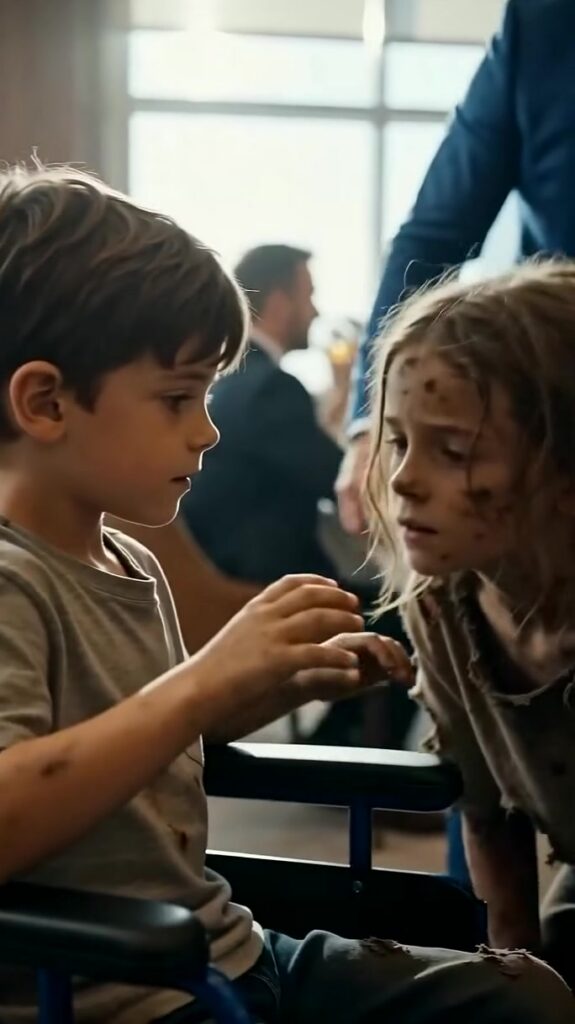
At table twelve, close to the windows, Mr. Harrow sat with the posture of someone who believed posture was a moral choice. His suit was deep blue, the kind of blue that looked like it came with a lawyer. Beside him, his son Eli sat in a wheelchair with a tray table clipped in front like an apology. Eli’s hair was neatly combed, his hands set on the armrests as if they’d been placed there earlier and forgot to leave.
The menu sat open in front of Mr. Harrow, but he wasn’t reading. He was negotiating with reality in a low voice, the way people do when they think money should be able to change physics. The private doctor had come and gone. The specialists had shaken their heads. The philanthropy gala had raised “awareness” like awareness could rewire nerves.
Across the room, I was pretending to be invisible, which is easier when you’re a server. The restaurant had a rule about keeping your face neutral, like you’re not allowed to have opinions. But you can’t work places like this long without collecting tiny opinions the way a broom collects dust.
Then the front door opened and didn’t close quietly.
A little gust of street air rolled in, carrying exhaust and summer heat and something harsher—hunger that hadn’t been toned down for polite company. A girl slipped inside like she was sneaking into a movie. She was small, maybe twelve, maybe fifteen—hard to tell when someone’s body is basically a running tally of missed meals. Her clothes were torn in a practical way, not a fashion way. Knees scabbed. Cheeks smudged. Hair the color of burnt toast pulled into a messy knot.
She didn’t hover by the hostess stand. She didn’t glance at the prices. She walked straight through the room as if she’d been there before, as if the chairs and table legs weren’t obstacles but suggestions.
And then she slapped her hand down on table twelve.
It wasn’t a dramatic movie slam. It was a dirty, real slap, palm meeting linen with a soft thud that somehow sounded louder than the piano. The plates trembled. A wine glass made a nervous little chime. Conversations tripped over themselves.
Mr. Harrow’s head lifted slowly, like he couldn’t believe the air had the audacity to change.
The girl pointed at Eli. Not at Mr. Harrow. Not at the food. At the boy. “Feed me,” she said, voice steady like she’d practiced it, “and I’ll heal him.”
For a second Mr. Harrow just blinked, the way people do when their brains are buffering. Then he laughed. It wasn’t even the kind of laugh that tries to hide cruelty with charm. It was a laugh built out of insult, like his lungs were offended.
“You’ll heal my son?” he said, making it louder so nearby tables could enjoy the performance. “Go away.”
Most kids—most adults—would’ve flinched. This one didn’t. She didn’t even look at him. That was what made the room go weird, like someone had turned the music down a little too far.
Instead she stepped around the table and crouched until she was level with Eli’s face. Up close, you could see her eyes were an unnervingly bright hazel, the kind that didn’t match the rest of the grit. Like the dirt on her was temporary, but the gaze was permanent.
“Do you want to stand?” she asked him, casual as if she was offering gum.
Eli’s expression had been set all evening—polite, careful, the calm mask people put on when they’re tired of being everyone’s tragedy. But at that question, something cracked open. It wasn’t belief, exactly. It was worse than belief. It was hope. Raw, risky hope that didn’t care if it embarrassed him.
Mr. Harrow leaned forward, arm reaching as if he could pluck the moment out of the air and throw it away. “Enough,” he hissed.
And then Eli’s hand moved.
It wasn’t dramatic either. Just a small lift of fingers from the armrest, like a marionette string had been gently tugged. But I’d watched Eli all night. Everyone had. That hand hadn’t moved once. Not even when the server had bumped his chair slightly while delivering the sparkling water.
The whole room inhaled. Someone at table ten stopped chewing and never resumed.
Mr. Harrow froze mid-reach, eyes flicking from Eli’s hand to the girl like he’d just witnessed his own authority get interrupted by a glitch.
“What did you do?” he demanded.
The girl, still crouched, held out her own hand toward Eli—not touching yet. Her fingers were thin and scraped, nails short and uneven, the hand of someone who had climbed fences and rummaged through dumpsters and survived without permission.
“Nothing yet,” she said.
That line did something to the silence. It made it heavier. Because she said it like the impossible wasn’t the miracle—like it was just the warm-up.
Mr. Harrow took a step closer, and I saw the muscles in his jaw tense as he prepared to become the kind of man who throws children out of restaurants. Behind him, the servers hovered with the uncertain posture of people who don’t know if this is a safety issue or a social issue.
“You’re trespassing,” Mr. Harrow snapped. “Security—”
“Wait,” Eli said, and it came out rough, like his voice hadn’t been used in a while for anything that mattered. The word wasn’t loud, but it landed harder than the father’s threats.
Eli looked at the girl like she was the first person in a long time who’d asked him a question that wasn’t really about his condition. “How?” he whispered.
The girl shrugged. “I don’t know how to explain it without sounding like a scam. But I know the feeling of your legs, okay? Like they’re there and they’re not. Like they belong to somebody else.” She said it with the weird intimacy of truth, the kind you can’t fake because you wouldn’t know which parts to mention.
Mr. Harrow’s voice sharpened. “You don’t know anything about my son.”
The girl finally lifted her head and looked up at him. Not afraid. Not defiant, either. More like bored that he was slowing things down. “He knows me,” she said.
Mr. Harrow laughed again, but it was thinner now. “My son has never met you.”
Eli swallowed. His eyes stayed on the girl’s face, and I watched something terrifyingly soft happen there—recognition, not of her name or her history, but of the exact shape of her presence. Like she reminded him of something he’d forgotten was possible.
“I saw you,” Eli said slowly. “At the park. Last winter.”
Mr. Harrow’s confidence hesitated. “Eli—”
“You were under the bridge,” Eli continued, voice trembling with effort. “You had… a blanket with stars. You were feeding a dog.” His eyebrows knitted like he was pulling the memory out through static. “I… I told Dad to stop. The driver didn’t. But I saw you.”
The girl’s mouth tightened. Not into anger. Into something like, Finally.
“Yeah,” she said. “And you were watching like you wanted to get out of the car and help, but you couldn’t. And you hated that more than anything.”
Mr. Harrow opened his mouth and shut it again. The polished restaurant suddenly felt too clean to hold the mess of that moment. The shine didn’t fit. Lumen was built for appetites with manners, not hunger that spoke first and asked permission never.
I found myself stepping closer with a basket of bread I hadn’t been told to bring, because my body made the decision before my job could stop it. I set it on the edge of table twelve. The smell of warm butter hit the air like a memory of being safe.
The girl’s eyes flicked to the bread, fast. She didn’t grab it. Not yet.
“You feed me,” she said again, quieter now, “and I’ll try. I’m not promising a magic trick. I’m promising I’ll do the thing I can do. And if it doesn’t work, you can call me a liar and throw me out and I’ll still be hungry, so it’ll be the same as usual.”
Eli stared at his father. “Dad,” he said, and the word sounded older than him. “Please.”
Mr. Harrow looked around, as if searching for the right kind of crowd to support him. But the room had changed sides without meaning to. People who’d been sipping wine like time was infinite were now watching like time was a knife.
Finally, Mr. Harrow’s shoulders sank a fraction, just enough to show he was human. “Fine,” he said, voice tight. “Feed her. And then she leaves.”
I tore the breadbasket open and slid it closer. The girl took a piece, then another, chewing fast but not wildly, as if she’d learned that panic wastes calories. Eli watched her eat like it was part of the ritual.
When she’d swallowed, she wiped her mouth with the back of her wrist and held her hand out again. This time she didn’t hesitate. She placed her fingers over Eli’s, light as a napkin.
“Okay,” she murmured, like she was talking to something inside him that wasn’t broken, just quiet. “Don’t fight it. Don’t try to impress anyone. Just… remember what standing feels like.”
Eli’s eyes fluttered shut. Mr. Harrow’s hands hovered uselessly, torn between controlling and believing.
In that gleaming room, with its golden tablecloths and careful voices, the most indecent thing happened: everyone waited. Not for dessert. Not for a check. For a boy’s body to decide whether it was done listening to its own failure.
And for the first time all evening, the restaurant wasn’t polished at all.
It was hungry.